
AEE Energy Practice Test & Exam Prep
$69.00
- Buy to unlock unlimited access to all Quiz questions.
- After purchase you can print a PDF of the whole quiz at any point. The PDF will contain the questions and the correct answers.
About this Exam
Achieving certification from the Association of Energy Engineers (AEE) is the gold standard for professionals committed to advancing energy efficiency and sustainability. Whether you are aiming for the Certified Energy Manager (CEM®), Certified Energy Auditor (CEA™), or another specialized AEE designation, these credentials validate your expertise in a rapidly growing field. The official AEE Energy Practice Test and Exam Prep are designed to bridge the gap between your on-the-job experience and the rigorous certification requirements. This comprehensive preparation is tailored for energy engineers, facility managers, energy auditors, and consultants who are serious about passing the AEE exam on their first attempt and establishing themselves as leaders in the global energy industry.
Ready to test your knowledge?
Buy Now to Access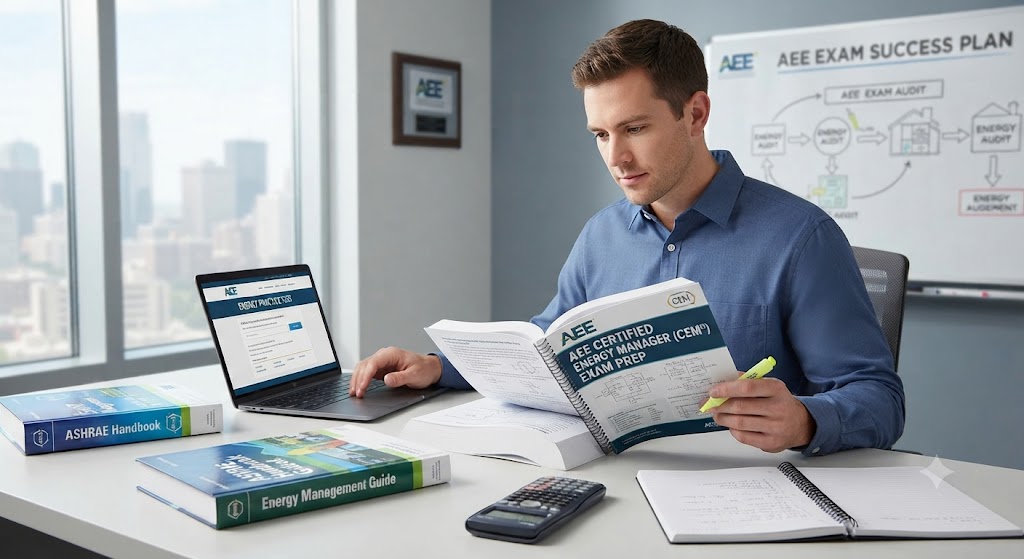
Additional Information
What the Course Entails and Exam Details
AEE certification courses are intensive training programs
that provide a deep dive into the essential principles of energy management and
engineering. While the specific syllabus varies depending on the certification
you are pursuing (e.g., CEM vs. CEA), the preparatory materials and exams
generally cover a wide array of critical topics. Core subjects typically
include energy procurement, energy accounting and economics, auditing
processes, lighting systems, HVAC systems, motors and drives, building
automation and control systems, and industrial processes. The coursework also
heavily emphasizes relevant codes, standards, and regulations, such as ASHRAE
standards and the International Energy Conservation Code (IECC). The exam
itself is structured to test not just your theoretical knowledge, but your
ability to apply these concepts to real-world scenarios, solve complex
engineering problems, and make sound decisions regarding energy projects.
What to Expect in the Final Exam
The AEE final exam is a rigorous assessment designed to test
your mastery of the course material. For most certifications, such as the CEM,
the exam is a timed, open-book test, typically lasting four hours. The format
is predominantly multiple-choice, although it may include some quantitative
problems that require calculations based on the provided reference materials.
Candidates must achieve a passing score, which is generally set at 70% or
higher. It is important to note that while the exam is open-book, the time
constraint means you must be intimately familiar with the reference materials
and cannot rely on looking up every answer. Success requires thorough
preparation, a strong understanding of the key concepts, and the ability to
quickly locate and apply information during the test.
How to Study and Exam Centers
Effective preparation for the AEE exam requires a
multi-faceted approach. First, thoroughly review all course materials,
textbooks, and lecture notes provided during your training. Utilize the
official AEE Energy Practice Test as a diagnostic tool early in your study
process to identify your strengths and weaknesses, and again later to simulate
the exam environment. Form study groups with colleagues, create flashcards for
key formulas and definitions, and dedicate consistent time each week to
reviewing the material. When you are ready to schedule your exam, AEE offers
flexibility. Most exams are administered electronically at proctored testing
centers worldwide (often through a partner like Pearson VUE), or via live
remote proctoring, allowing you to take the exam from the convenience of your
home or office. Ensure you check the AEE website for the most current
information on registration deadlines, testing locations, and required
identification.
Job Opportunities
from the Course
Earning an AEE certification is a powerful career catalyst
that opens doors to a wide range of high-impact roles within the energy sector.
This credential signals to employers that you possess the specialized skills
and knowledge necessary to lead energy-saving initiatives, reduce operational
costs, and enhance sustainability. Certified professionals are in high demand
across various industries, including commercial real estate, government,
healthcare, education, and manufacturing. Specific job titles and career paths
that this certification unlocks include: Certified Energy Manager (CEM), Energy
Auditor, Energy Engineer, Sustainability Manager, Facility Manager, Energy
Analyst, Director of Facilities and Energy, Utility Program Manager, and
Performance Contracting Manager. By achieving AEE certification, you position
yourself for significant career advancement and increased earning potential in
the critical field of energy efficiency.
Frequently Asked Questions
Reviews
5.0
Based on 0 reviews
Leave a Review
No reviews yet. Be the first to review!