
Adult Health 1 Test 4 Practice
$69.00
- Buy to unlock unlimited access to all Quiz questions.
- After purchase you can print a PDF of the whole quiz at any point. The PDF will contain the questions and the correct answers.
About this Exam
The Adult Health 1 Test 4 Practice exam is a vital tool for nursing students seeking to solidify their knowledge and improve their performance on a major milestone in their Medical-Surgical Nursing education. This specific practice assessment is tailored to a critical segment of a foundational adult health course, often focusing on some of the most complex physiological systems in adult care. The test is designed for students who are advancing toward their Registered Nursing (RN) or Licensed Practical/Vocational Nursing (LPN/LVN) licensure. By simulating the actual exam environment, this practice resource allows learners to identify knowledge gaps, practice time management, and build confidence in managing complex patient care scenarios.
Ready to test your knowledge?
Buy Now to Access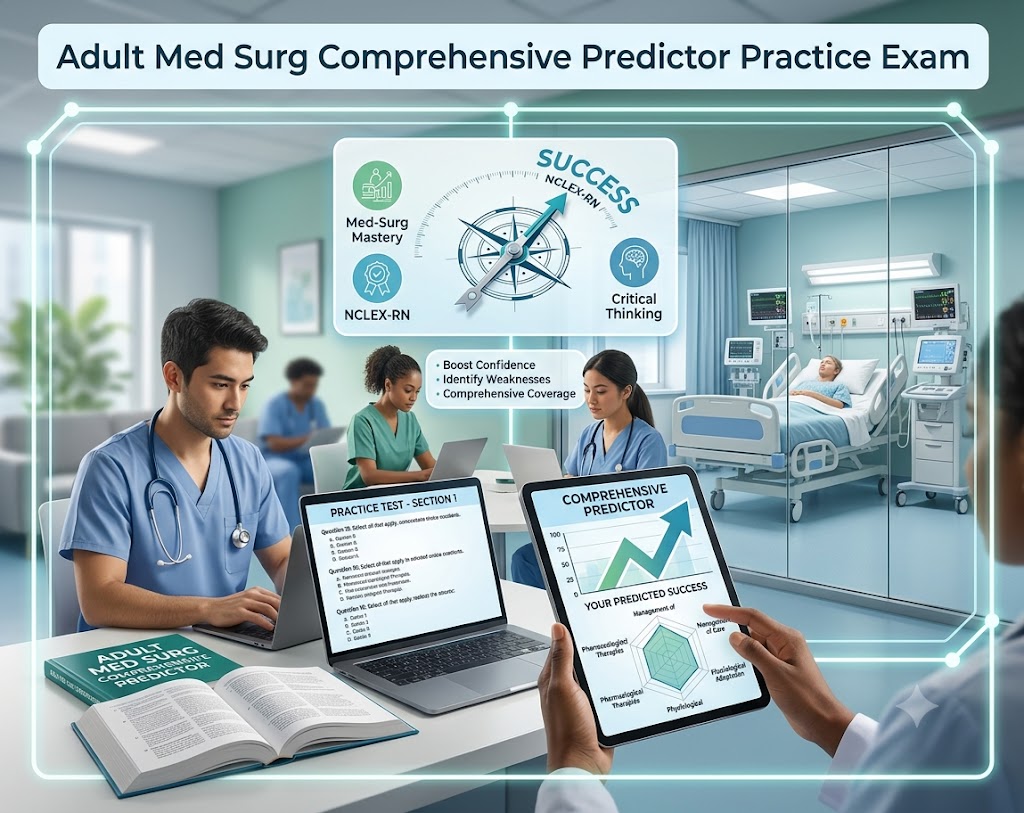
Additional Information
What the Course Entails and Exam Details
This examination focuses on the application of the nursing
process to adult patients experiencing specific, often advanced, health
challenges. While the exact curriculum may vary by institution, "Test
4" typically delves into the comprehensive care required for disorders in
areas such as the advanced respiratory, cardiovascular, and endocrine systems,
and sometimes includes renal or neurological care. The key themes include
demonstrating competency in sophisticated physical assessment, understanding
complex pathophysiology, interpreting advanced diagnostic results,
administering related pharmacological agents, and implementing prioritized
nursing interventions. Students must exhibit critical thinking skills by
prioritizing patient needs (e.g., using ABCs, Maslow’s hierarchy) and
synthesizing a complete care plan for unstable or critically ill patients.
What to Expect in
the Final Exam
This practice exam directly mirrors the format, rigor, and
topic distribution of the comprehensive course final assessment. The final is a
high-stakes proctored exam, often computerized or using standardized scantron
forms. It relies heavily on NCLEX-style questions to gauge practical readiness.
Expect a mix of multiple-choice, select all that apply (SATA),
prioritizing/ordering (e.g., "Which action is priority?" or
"Which patient should be seen first?"), clinical reasoning scenarios
based on unfolding case studies, and drug calculation questions. The test
typically has a specific time limit, such as 90 minutes to two hours, forcing
students to make safe and rapid decisions. A common minimum passing score
required for the actual final exam is between 75% and 80%, depending on the
program's standards.
How to Study and
Exam Centers
Preparation for this exam requires a multifaceted approach
to master both the content and the test-taking strategy. Start by utilizing
specific NCLEX-style question banks with an emphasis on Medical-Surgical
Nursing, always ensuring you read and understand the "rationale" for
both correct and incorrect answers to train your thinking, not just your
memory. Create visual aids such as concept maps or Venn diagrams that link
complex body systems, pathophysiology, required diagnostic tests, and
associated nursing assessments. Forms study groups to practice teaching
concepts to each other and solving prioritized case studies. On test day,
remember to prioritize based on safety and life-sustaining measures (e.g.,
checking airway before breathing or circulation).
This practice test is usually hosted online through an
institution’s learning management system (like Canvas or Blackboard) or a
professional platform such as Kaplan or ATI, allowing for multiple attempts in
a low-stakes environment. For the actual comprehensive final exam, it will be
administered under strict proctored conditions. This usually occurs at a
designated testing lab on the university campus or, for online programs,
through authorized third-party proctoring services (e.g., ProctorU), requiring
a secure environment and photo identification to maintain test integrity. It is
not typically taken at commercial centers like Pearson VUE, which are reserved
for final licensure exams (the NCLEX).
Job Opportunities
from the Course
Successfully mastering Adult Health 1, which includes
achieving a passing score on the corresponding Test 4 and the final exam, is a
critical milestone that brings nursing students significantly closer to their
professional licensure. Once licensed as an RN or LPN/LVN, the comprehensive
skills and acute-care knowledge gained through this course are the foundation
for numerous career paths. Graduates are equipped to pursue a wide array of
specialized nursing roles, such as:
- Acute
Care Staff Nurse (Medical-Surgical Units)
- Telemetry/Step-Down
Unit Nurse
- Progressive
Care Unit (PCU) Nurse
- Post-Anesthesia
Care Unit (PACU) Nurse
- Home
Health Nurse (with relevant experience)
- Nursing
Case Manager
- Correctional
Health Nurse
- Travel
Nurse (Medical-Surgical and Acute Care specialties)
Frequently Asked Questions
Reviews
5.0
Based on 0 reviews
Leave a Review
No reviews yet. Be the first to review!