
Adult Assessment-OT Process, Framework and Activity Analysis Practice Test
$69.00
- Buy to unlock unlimited access to all Quiz questions.
- After purchase you can print a PDF of the whole quiz at any point. The PDF will contain the questions and the correct answers.
About this Exam
Welcome to your study guide for the [Adult OT Process & Analysis] Practice Exam.
This practice resource is meticulously designed for occupational therapy (OT) and occupational therapy assistant (OTA) students, as well as practicing clinicians seeking a comprehensive review.
The exam focuses specifically on the critical aspects of working with adult clients. It tests your understanding of the Occupational Therapy Process, application of the Occupational Therapy Practice Framework (OTPF), and competency in performing effective Activity Analysis. This is not just a test; it is a step towards clinical excellence in adult rehabilitation and care.
Successfully navigating this practice exam demonstrates your readiness to synthesize complex OT principles and apply them effectively to the adult population. It is an invaluable preparation tool for state licensure and national certification exams.
Ready to test your knowledge?
Buy Now to Access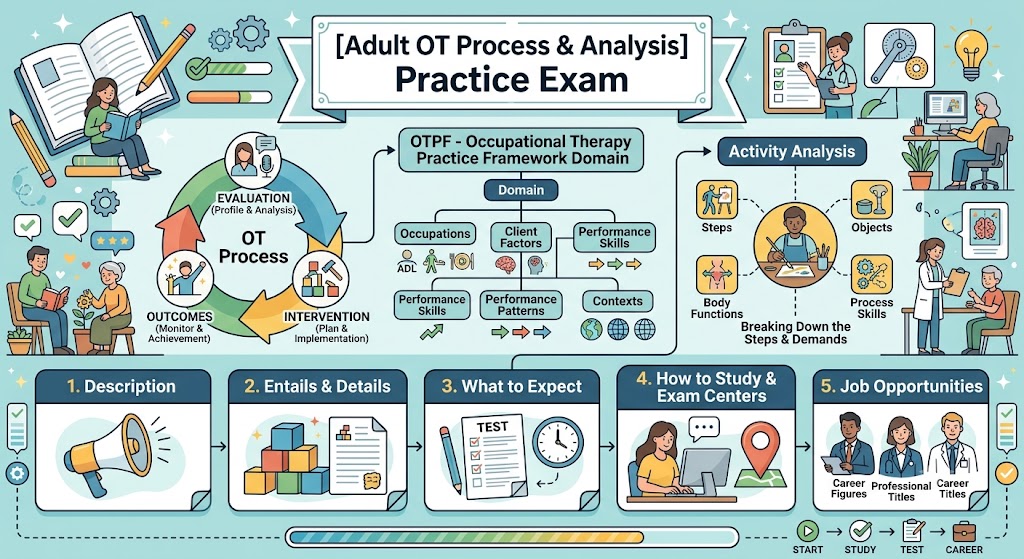
Additional Information
What the Course
Entails and Exam Details
This practice test draws upon key knowledge areas integral
to adult OT practice. While not a standalone course, its structure simulates a
rigorous educational assessment, covering:
- The
Occupational Therapy Practice Framework (OTPF) Domain & Process:
Deep understanding of key concepts, definitions, occupations, client
factors, performance skills, patterns, and contexts, alongside the
evaluation, intervention, and outcomes stages of the OT process.
- Adult
Assessment Methodologies: Techniques for evaluating physical,
cognitive, psychosocial, and environmental factors specifically relevant
to the adult lifespan.
- Activity
and Occupational Analysis: Breaking down activities to understand
their demands, and analyzing occupations within context, to design
effective, client-centered interventions.
- Clinical
Reasoning in Adult Populations: Applying OT principles to make sound
decisions during evaluation, planning, and implementation.
- Goal
Setting and Intervention Planning for Adults: Developing measurable
and meaningful goals based on assessment findings and applying
appropriate, occupation-based interventions.
The exam details, being a practice test, will vary
depending on the provider but typically:
- Format:
Primarily multiple-choice questions, which may include multi-select
questions and clinical scenario simulations to reflect professional
certification formats.
- Complexity:
Ranges from foundational knowledge questions to advanced scenario-based
questions requiring synthesis and clinical reasoning.
What to Expect in the Final Exam
While the final exam could refer to a course final, a
comprehensive practice test program's concluding assessment, or the
national certification exam (NBCOT), this study guide prepares you for all. For
the professional certification exams you are likely aiming for, you should
expect:
- Format:
Typically computer-based, incorporating single-response multiple-choice
questions, potentially multi-select items, and potentially complex
clinical simulation tests (CSTs) that involve sequential decision-making.
- Timed
Session: Professional exams are generally very strictly timed,
demanding efficient answer strategies. Expect a multi-hour session with
limited break time (clock usually stops only during official breaks if
provided).
- Focus
Areas: Expect a heavy emphasis on client evaluation, intervention
planning, intervention implementation, and professional/legal/ethical
aspects of practice, all within the adult context. Clinical reasoning is
paramount.
- Passing
Requirements: Criterion-referenced scoring with a specific scaled
score required for a passing grade, often including a breakdown of
performance by domain.
Your performance on this [Adult OT Process &
Analysis] Practice Exam is a strong indicator of your readiness for these
final hurdles.
How to Study and
Exam Centers
Effective study for both this practice test and professional
licensure is essential. Consider these strategies:
- Active
Recall & Spaced Repetition: Test yourself frequently on key
concepts and definitions from the OTPF and standard assessment tools. Use
flashcards and review material at increasing intervals.
- Review
of the OTPF (Current Edition): The OTPF is your bible. Master its
structure, terminology, and application. Refer to it constantly.
- Practice
with Multiple Question Formats: Work through various practice
questions. Practice single-answer MCQs, multi-select items, and, if
possible, clinical simulations. Understand the why behind both
correct and incorrect answers.
- Case
Study Application: Apply OT concepts to adult case studies. Practice
conducting virtual activity analysis and intervention planning.
- Focus
on Adult Assessment Tools: Familiarize yourself with common
standardized and non-standardized assessment tools used with adults (e.g.,
specific cognitive, functional, and physical measures). Understand their
purpose, application, and scoring.
- Time
Management Practice: Simulate exam conditions by taking full-length
practice tests under time pressure.
- Study
Groups: Discussing concepts and challenging each other with
scenario-based questions can deepen understanding.
Exam Centers & Formats:
This practice test is likely administered online
through a specific platform, academic portal, or prep course provider. You can
typically take it from any computer with an internet connection.
For the subsequent actual professional certification exam
(e.g., NBCOT in the US):
- These
are usually administered via Pearson VUE testing centers, which are
secure physical locations across the country and sometimes
internationally.
- You
must apply, receive an Authorization to Test (ATT), and then schedule your
specific date and time with a testing center.
- Stringent
security protocols are enforced at physical testing centers. Online
proctoring might be available under specific circumstances and will have
its own set of strict rules and requirements.
Job Opportunities from the Course
A strong understanding and demonstrated competency in the
adult assessment OT process, framework, and activity analysis are crucial for
success in numerous clinical and non-clinical roles. Developing this expertise
through your educational journey, licensure, and continued practice opens doors
to diverse career paths.
Specific job roles and career directions include:
- Occupational
Therapist (OTR or L)
- Certified
Occupational Therapy Assistant (COTA)
- Adult
Rehabilitation Therapist
- Acute
Care OT
- Skilled
Nursing Facility (SNF) Therapist
- Home
Health OT
- Outpatient
Clinic Therapist
- Geriatric
Specialist
- Case
Manager
- Clinical
Educator or Instructor
- Practice
Manager or Director
- Research
& Development roles in OT products/interventions
Mastering these key concepts is your ticket to a rewarding
and varied career dedicated to empowering adults to live meaningful and
independent lives through occupational participation. Good luck on your
practice exam!
Frequently Asked Questions
Reviews
5.0
Based on 0 reviews
Leave a Review
No reviews yet. Be the first to review!