
ADDA Mechanical Drafter Certification Practice Exam
$69.00
- Buy to unlock unlimited access to all Quiz questions.
- After purchase you can print a PDF of the whole quiz at any point. The PDF will contain the questions and the correct answers.
About this Exam
The ADDA Mechanical Drafter Certification is a prestigious credential designed to recognize and validate the core skills and knowledge required for mechanical drafters. The American Design Drafting Association (ADDA) created this program to establish professional standards and offer an industry-recognized validation for the competency of mechanical drafters. This certification is suitable for both experienced drafters looking to formalize their expertise and for students seeking a competitive edge as they enter the workforce. It demonstrates to potential employers that you have mastered essential concepts, software, and standards necessary to excel in mechanical drafting. By earning this credential, you establish your dedication to the profession and showcase a verified level of achievement. The accompanying ADDA Mechanical Drafter Certification Practice Exam is a crucial diagnostic tool, mimicking the format and content of the actual test to help you gauge your readiness, identify knowledge gaps, and practice under simulated conditions.
Ready to test your knowledge?
Buy Now to Access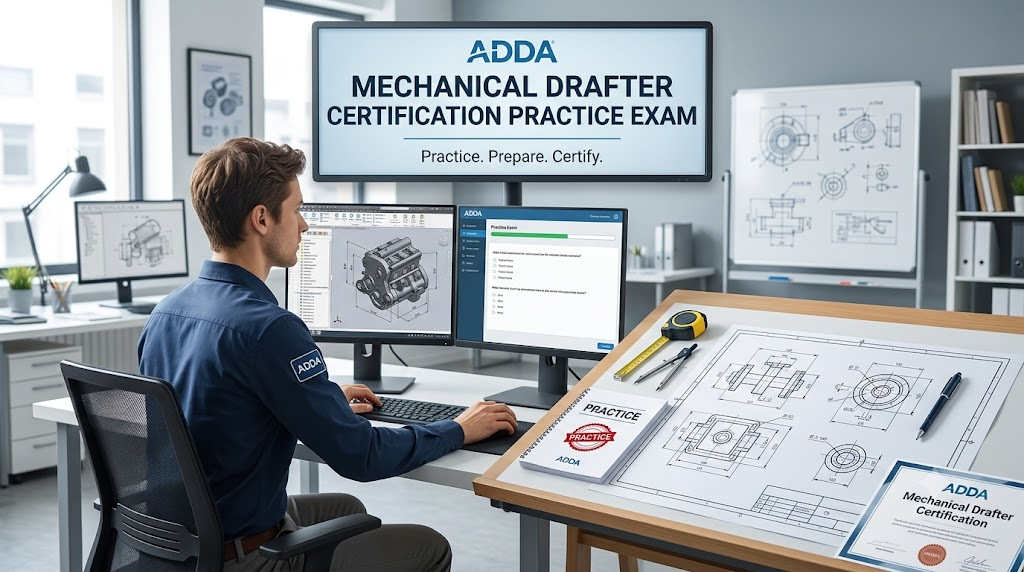
Additional Information
What the Course Entails and Exam Details
This certification doesn't just measure simple CAD proficiency; it evaluates your overall understanding of mechanical drafting principles, technical drawing fundamentals, and relevant industry standards. Preparation involves a combination of theoretical study and practical experience. Students are expected to have fundamental technical knowledge across a range of key areas, which are all covered in the actual exam and representative questions on the practice test. The certification assessment ensures you understand how to translate engineering concepts into precise technical drawings and models.
The final examination is a proctored, online test delivered via an ADDA-approved platform. It typically consists of two main parts: a theoretical component that may include multiple-choice and true/false questions, and potentially practical exercises involving technical problem-solving or basic CAD tasks, although the specific structure can vary slightly by version.
Key areas of study and examination focus include:
Orthographic Projection and View Creation: Mastering the ability to create multi-view drawings that clearly depict a 3D object from different perspectives.
Dimensioning and Tolerancing Standards: Understanding and correctly applying standard dimensioning techniques (ASME Y14.5, ISO, etc.) and tolerancing principles (geometric dimensioning and tolerancing - GD&T, as well as general tolerances) to define part functionality.
Section and Auxiliary Views: Properly utilizing sectioning and auxiliary views to reveal internal details and represent non-orthographic features.
Technical Drawing Fundamentals: A deep understanding of line types, lettering, scales, view selection, and common drawing conventions.
Material and Component Identification: Knowledge of common materials, fasteners, gears, bearings, and other standard mechanical components and how to correctly denote them in drawings.
CAD Software Proficiency: While specific software is not usually mandated by ADDA, being highly proficient in a professional CAD application (like SolidWorks, AutoCAD, etc.) is essential for both the preparation phase and the practical demands of the exam and career.
What to Expect in the Final Exam
You must achieve a minimum score of 75 to successfully complete the final certification exam. The examination is presented online, usually in two parts (Part A and Part B). The combined time limit for both parts is typically 2.5 hours, providing a structured yet challenging window to showcase your skills. A break is typically allowed by the proctor between the two sections.
Candidates should prepare for a professional, proctored environment. This means the exam must be taken in a monitored setting to ensure integrity. The questions themselves are a mix of theoretical, standard-based questions (often multiple-choice or true/false) and potentially practical problems. These practical scenarios are designed to evaluate your ability to apply your knowledge to real-world drafting challenges, such as interpreting specifications, solving for unknown dimensions, or accurately defining features. The ADDA Mechanical Drafter Certification Practice Exam is an invaluable resource precisely because it mirrors this variety and difficulty, allowing you to practice under similar conditions and time constraints.
How to Study and Exam Centers
Effective preparation is key to succeeding on the ADDA Mechanical Drafter Certification Exam. Here is a breakdown of proven study strategies and essential information regarding exam centers:
Study Strategies:
Comprehensive Review: Systematically study the core concepts outlined in Section 2. Utilize textbooks, online resources, and official ADDA study guides if available. Focus heavily on current industry standards (ASME, ISO).
Extensive Practice Tests: Treat the ADDA Mechanical Drafter Certification Practice Exam as your best assessment tool. Take it multiple times to build speed, identify weak areas, and become comfortable with the question types. Analyze any missed questions in depth. Use third-party and supplemental practice materials as well.
Hands-on CAD Practice: Dedicate considerable time to using professional CAD software. Recreate technical drawings from specifications, practice complex view generation, and define tolerances for various components. Your practical skills must be fluent.
Time Management: When taking the practice exam, time yourself rigorously. Understand how much time you can spend on theoretical questions versus any potential practical components, ensuring you can complete both parts within the 2.5-hour limit.
Join Study Groups/Forums: Connect with other drafting students and professionals. Online forums and study groups can provide valuable insights, resources, and mutual support.
Exam Centers and How to Register: The ADDA Mechanical Drafter Certification Exam is primarily administered online through proctored sessions. This provides flexibility, allowing you to take the exam from a convenient location, but you must arrange for an authorized proctor.
Find an Approved Testing Site: Many educational institutions (high schools, technical colleges, universities) are authorized ADDA testing centers and can administer the exam on-site. Check with local drafting and engineering programs.
Identify an ADDA Approved Proctor: If taking the exam outside of a designated center, you can arrange to have it proctored by an approved individual, such as an instructor, administrator, or HR professional, who meets ADDA's proctor qualifications. Site and proctor approval from ADDA are required beforehand.
Register through ADDA: Visit the official ADDA website for the most up-to-date information, registration forms, applicable fees, and detailed procedures for scheduling your proctored online exam. The ADDA website is your primary source for understanding exact requirements, locating authorized sites, and getting approved proctors for your area.
Job Opportunities from the Course
Earning the ADDA Mechanical Drafter Certification can significantly enhance your employability and open doors to diverse career paths. Here is a clear list of job opportunities and roles unlocked by this achievement:
Mechanical Drafter
CAD Technician
Design Drafter
Engineering Drafter
Mechanical Designer (Entry Level)
Technical Illustrator
Engineering Assistant
Drafter/Designer (Mechanical specialization)
These positions exist across a vast range of industries, including:
Manufacturing and Production
Engineering Consulting Firms
Automotive Design and Engineering
Aerospace and Defense Contracting
Consumer Product Design
Robotics and Automation
In conclusion, the ADDA Mechanical Drafter Certification is a powerful step towards building a successful career in mechanical drafting. Leverage this comprehensive study guide, master the core concepts, and extensively utilize the ADDA Mechanical Drafter Certification Practice Exam to prepare for your final assessment. Earning this prestigious credential will not only validate your expertise but also significantly enhance your opportunities in the professional world, paving the way for rewarding roles and career advancement.
Frequently Asked Questions
Reviews
5.0
Based on 0 reviews
Leave a Review
No reviews yet. Be the first to review!