
ACVREP Domain 7 – Mobility Practice Test
$69.00
- Buy to unlock unlimited access to all Quiz questions.
- After purchase you can print a PDF of the whole quiz at any point. The PDF will contain the questions and the correct answers.
About this Exam
The ACVREP (Academy for Certification of Vision Rehabilitation & Education Professionals) Domain 7 – Mobility Practice Test is an invaluable tool for candidates preparing for the Certified Orientation and Mobility Specialist (COMS) credential. Orientation and Mobility is a specialized field focused on enabling individuals with visual impairments to travel safely, confidently, and independently within their environments.
This specific practice test hones in on the core skills, techniques, and practical applications that form the backbone of Domain 7, ensuring you have a strong, applied understanding of mobility concepts before sitting for the comprehensive COMS examination. It is designed for students in accredited O&M programs, professionals seeking recertification, and any individual looking to assess their readiness for the practical and applied knowledge tested in this domain.
Ready to test your knowledge?
Buy Now to Access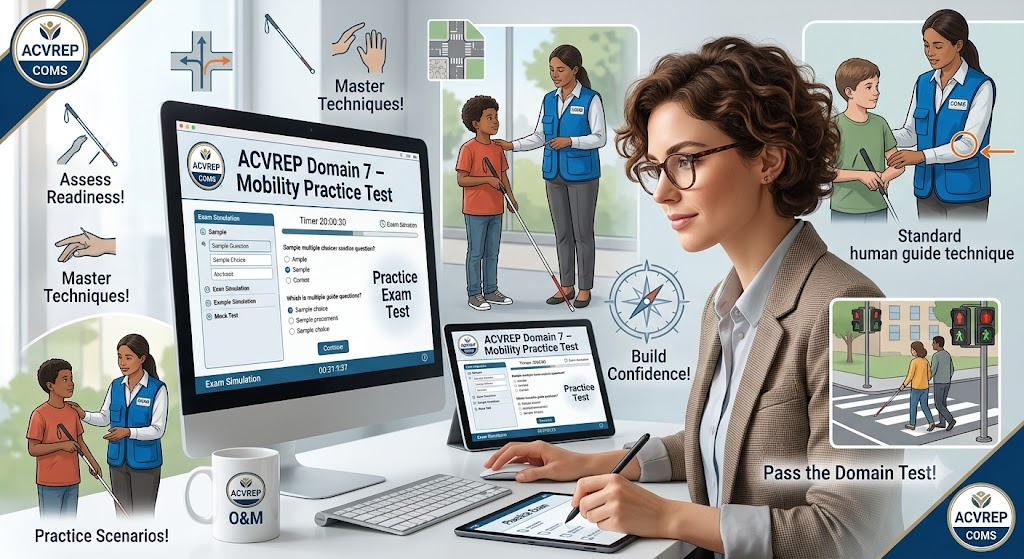
Additional Information
What the Course Entails and Exam Details
This practice test does not represent a standalone course but is a vital study resource that simulates the practical, applied knowledge areas related to Mobility Practice, likely drawn from core COMS exam domains. While specific domain numbering might vary between different preparation resources, a "Mobility Practice" domain generally covers a range of essential topics, including:
Assessment & Strategy: Understanding how to assess a client’s current mobility skills, needs, and environments, and developing individualized instruction plans.
Techniques & Tools: Mastery of various mobility techniques, including:
Human Guide (Sighted Guide) technique.
Upper and Lower Protective techniques.
Trailing.
Various long cane techniques (touch, two-point touch, three-point touch, constant contact).
Environmental analysis.
Street crossings (stop-controlled, signalized, all-pedestrian, roundabouts, complex intersections).
Utilization of sensory cues (auditory, tactile, kinesthetic).
Introduction to and integration of Electronic Travel Aids (ETAs) and GPS technologies.
Safety & Ethics: Demonstrating a deep commitment to client safety, understanding legal requirements, ADA standards, and adherence to the field’s ethical guidelines.
Diverse Populations: Applying mobility instruction effectively for individuals of all ages, including children, adults, seniors, and individuals with additional disabilities.
This practice test aims to reinforce these skills and knowledge areas through a simulated test environment, preparing you for the type of questions and practical scenarios you may encounter in the real exam.
What to Expect in the Final Exam
While this resource is a practice test, understanding the actual COMS final exam format is essential for your preparation. The comprehensive ACVREP COMS examination typically follows a rigorous structure:
Format: The actual final exam is typically a comprehensive, computer-based test composed of multiple-choice questions (MCQs), often totaling 140 scored questions. It is a criterion-referenced scaled score exam.
Passing Score: The passing score is determined through a psychometric process and is a criterion-referenced scaled score, which ACVREP specifies. You should aim for a deep understanding of all material, as there is no single percentage to aim for. The number of questions you need to answer correctly can vary based on question difficulty.
Time Limits: Candidates are typically given 4 hours to complete the comprehensive computer-based COMS exam. A practice test for a single domain might be shorter, often proportional to the weight of that domain within the full exam.
Rules & Security: Actual exams are administered under strict proctoring conditions, and specific rules apply regarding materials, breaks, and exam security. The practice test environment will naturally have fewer of these restrictions but should still be treated seriously to best simulate the real exam. A practice test labeled "Domain 7" focuses specifically on questions within that content area to build deep competence.
How to Study and Exam Centers
Effective study for a practical field like Orientation and Mobility goes beyond simple textbook reading. Here are actionable strategies:
Practice, Practice, Practice: The core of O&M is application. Engage in hands-on practice for all techniques. Role-playing is highly beneficial—practice human guide, cane skills, and environmental analysis with a partner, taking turns being the specialist and the traveler (perhaps while blindfolded/wearing vision simulators).
Utilize This Practice Test: Treat this practice test seriously. Set aside dedicated, timed sessions, mimicking real exam conditions. Review incorrect answers thoroughly, focusing not just on the correct choice but also on the rationale. Identify your weak areas to target further study.
Review Standard Technique Manuals: Refer to recognized O&M technique manuals and textbooks. Ensure your understanding of cane angles, hand positions, and instructional cues aligns with accepted best practices.
Mock Assessments & Scenarios: Practice creating mini-O&M assessments and lesson plans for simulated clients. Analyze various street crossing scenarios, considering environmental and traffic flow factors.
Study the ACVREP Handbook & ECC: Familiarize yourself with the full COMS examination handbook, including the Expanded Core Curriculum (ECC) and all tested domains.
Exam Centers: The actual, official ACVREP COMS examination is administered at authorized computer-based testing centers. The most common provider for such professional certifications is Pearson VUE.
Candidates must register for the exam directly through the ACVREP website once eligible.
Upon registration and payment, you will receive instructions on how to schedule your exam at a convenient Pearson VUE testing center or via an online proctored option if available and approved.
Job Opportunities from the Course
A successful score on the ACVREP Domain 7 – Mobility Practice Test is a strong indicator of your readiness for the practical application questions in the final COMS exam. Attaining the Certified Orientation and Mobility Specialist (COMS) credential unlocks a rewarding and in-demand career path. Potential job opportunities and career avenues include:
Certified Orientation and Mobility Specialist (COMS) (primary role)
O&M Instructor in K-12 school districts
Itinerant O&M Specialist for multi-district services
Vision Rehabilitation Therapist (VRT) with O&M specialization
Special Education Teacher specializing in O&M
Vocational Rehabilitation Counselor for people with visual impairments
V.A. Blind Rehabilitation Specialist
Researcher or academic in the field of vision impairment and rehabilitation
Independent O&M Contractor or consultant
Mobility Specialist in non-profit blindness organizations
Good luck with your preparation for the ACVREP Domain 7 – Mobility Practice Test and your eventual COMS certification journey! This guide and your dedicated practice will bring you closer to making a profound difference in the lives of individuals with visual impairments.
Frequently Asked Questions
Reviews
5.0
Based on 0 reviews
Leave a Review
No reviews yet. Be the first to review!