
ACVREP Domain 2 – Relevant Medical Information Practice Test
$69.00
- Buy to unlock unlimited access to all Quiz questions.
- After purchase you can print a PDF of the whole quiz at any point. The PDF will contain the questions and the correct answers.
About this Exam
Welcome to your essential first step toward mastering ACVREP Domain 2: Relevant Medical Information. This comprehensive practice test is a powerful tool designed to support aspiring and current vision rehabilitation professionals preparing for their ACVREP certification exams.
Whether you are pursuing the Certified Orientation and Mobility Specialist (COMS), Certified Vision Rehabilitation Therapist (CVRT), or Certified Low Vision Therapist (CLVT) credentials, understanding the underlying medical principles of visual impairment is non-negotiable. This practice exam allows you to assess your knowledge of the physiological and pathological factors that impact vision, ensuring you can provide safe, effective, and individualized care.
Designed for students in vision rehabilitation programs, university graduates, and international applicants, this resource builds the confidence needed to excel in your final certification journey. It’s not just about memorizing facts; it's about synthesizing medical data to make sound clinical decisions.
Ready to test your knowledge?
Buy Now to Access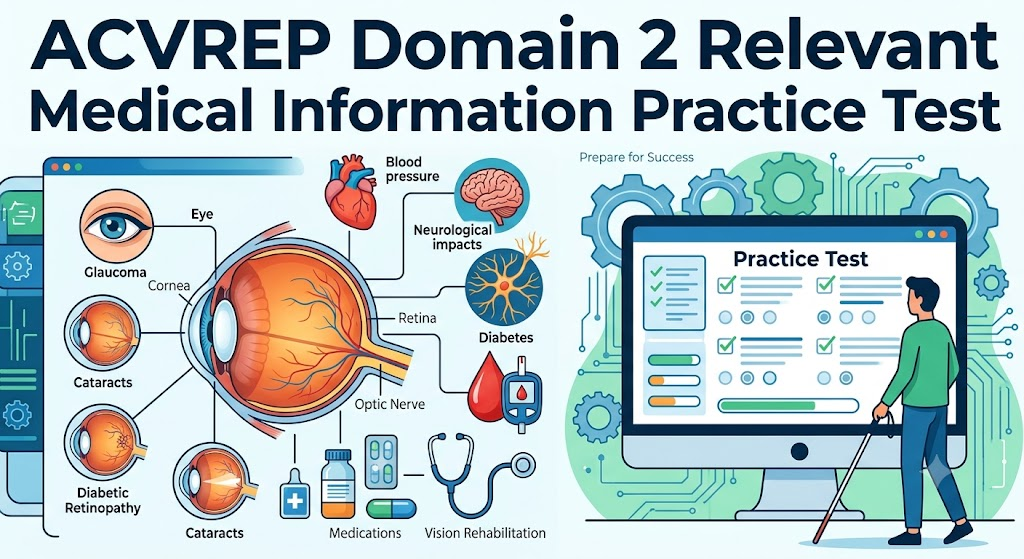
Additional Information
What the Course Entails and Exam Details
This practice test focuses exclusively on ACVREP Domain 2, a critical pillar of knowledge. The content areas within this domain include, but are not limited to, the following core competencies:
Anatomy and Physiology of the Human Eye and Visual System: Master the structures, functions, and pathways of the eye and their interconnected roles in sight.
Common Eye Diseases and Disorders: Deepen your understanding of etiologies, progressions, and symptoms for conditions such as Age-Related Macular Degeneration (AMD), glaucoma, diabetic retinopathy, cataracts, and retinitis pigmentosa.
Functional Implications of Visual Conditions: Analyze how specific pathologies manifest in daily life, affecting navigation, daily tasks, and environmental perception.
Interpretation of Eye Reports and Medical Documentation: Develop the essential skill of accurately reading and applying information from medical professionals to create customized rehabilitation plans.
Systemic Health Conditions Affecting Vision: Understand the relationships between non-ocular medical issues (e.g., diabetes, hypertension) and visual performance.
Medical Remediation and Contraindications: Learn about medical, surgical, and optical treatments for eye conditions and the physical limitations these may impose.
The practice test consists of multiple-choice questions that mirror the style and difficulty of the content you will face in the official final certification exam.
What to Expect in the Final Exam
While this tool focuses on Domain 2, the actual ACVREP final exam for your chosen certification is a single, rigorous examination covering all relevant domains. You must understand the landscape of that final hurdle. Here is a general breakdown of what to expect:
Format: The final ACVREP certification exams (COMS, CVRT, CLVT) are comprehensive, multiple-choice tests. They are administered entirely in an online, computer-based format.
Time Limit: You will typically be given a standard duration of approximately three to four hours to complete the full exam, depending on the specific certification.
Content: The exam integrates questions from all domains required for that specific credential. Domain 2—Relevant Medical Information—is a substantial component, but you must also excel in assessment, instructional strategies, and professional issues.
Passing Score: ACVREP uses a scaled score model to ensure fairness across exam forms. The passing score is determined by content experts based on the minimal competence required for safe practice, not a fixed percentage. It is designed to be challenging.
Language and Special Accommodations: The final exam is offered in classic English and classic French. Accommodations are available for candidates with documented disabilities.
This Domain 2 practice test is an essential component of preparing for that comprehensive final exam.
How to Study and Exam Centers
Preparation is the key to confidence and success. Your strategy for mastering Domain 2 should include a multi-faceted approach. Here are actionable study strategies and essential information on taking the final exam:
How to Study Effectively:
Utilize Official ACVREP Handbooks: These are your primary resources. Study the Body of Knowledge (BOK) sections relevant to your certification to know the exact boundaries of what you will be tested on.
Go Beyond the Practice Test: Use this test as a diagnostic tool. Analyze which types of medical conditions or anatomical systems you find challenging, then dedicate focused study time to those areas. Use standard vision rehabilitation textbooks to deepen your understanding.
Master Medical Documentation: Practice reading real-world de-identified eye reports. Create scenarios based on those reports: "Based on this report, what are the primary functional limitations?"
Create Visual Aids: Draw and label diagrams of the eye. Make flowcharts connecting eye diseases to functional outcomes. Visual learners excel with these techniques.
Form Study Groups: Collaborating with peers is highly beneficial. Explain complex medical concepts (like the mechanism of glaucoma) to each other; this is one of the best ways to test your own mastery.
Exam Centers and Final Testing:
Online and Proctoring: The final ACVREP certification exams are administered through an official online proctoring platform, primarily Webassessor, in partnership with third-party vendors.
Convenience: Candidates can schedule and take their exams from any location that meets the stringent security and technology requirements required for a proctored, online test environment, including home or professional spaces.
Authorized Locations: While many exams are taken via live, online proctoring, some organizations or schools authorized by ACVREP may occasionally provide physical space or computers for candidates taking the exam.
Scheduling: To take the final exam, you must first apply for and receive a letter of eligibility from ACVREP. Once eligible, you will log into your ACVREP portal to create an account with the testing partner and schedule your date.
Job Opportunities from the Course
Mastering Domain 2 is a crucial step toward obtaining the certifications that unlock a wide range of rewarding career paths in vision rehabilitation. The skills you validate directly relate to high-demand roles. Here are the job opportunities and career paths this journey unlocks:
Certified Orientation and Mobility Specialist (COMS): Training individuals to travel safely, efficiently, and independently in all environments, from familiar homes to complex communities, by applying their knowledge of how medical visual conditions affect movement.
Certified Vision Rehabilitation Therapist (CVRT): Teaching individuals who are blind or have low vision techniques for independent living, including personal management, communication skills, adaptive computer use, and vocational tasks, leveraging a deep understanding of medical implications.
Certified Low Vision Therapist (CLVT): Conducting detailed functional vision evaluations and instruction to help clients maximize their remaining vision through the use of optical and non-optical devices, directly referencing medical reports.
Teacher of Students with Visual Impairments (TVI): A common career path for those who obtain an ACVREP credential alongside a teaching license, specializing in educating children with vision loss in academic settings.
Deafblind Intervenor: Professionals trained to provide a direct and consistent presence for individuals who are Deafblind, enabling access to information, communication, and environmental interaction.
Vision Rehabilitation Program Director: Experienced, certified professionals who progress into administrative and leadership roles, overseeing rehabilitation services in state agencies, non-profits, or medical centers.
Assistive Technology Specialist for Visual Impairments: Focusing on evaluating and training clients in specialized technology, software, and devices.
Frequently Asked Questions
Reviews
5.0
Based on 0 reviews
Leave a Review
No reviews yet. Be the first to review!