
Acute Care Nurse Practitioner Certification Practice Exam
$69.00
- Buy to unlock unlimited access to all Quiz questions.
- After purchase you can print a PDF of the whole quiz at any point. The PDF will contain the questions and the correct answers.
About this Exam
The Acute Care Nurse Practitioner Certification is a hallmark credential for advanced practice nurses dedicated to providing high-quality, complex care in acute care environments. This certification, typically specializing in Adult-Gerontology (ACNP-AG) or sometimes Neonatal/Pediatric areas, signifies that a registered nurse with advanced graduate education has met rigorous national standards of knowledge and clinical competency. It is designed for nurses working, or aiming to work, in settings such as Intensive Care Units (ICUs), emergency rooms, hospitalist teams, and specialized acute care clinics. Achieving this certification not only demonstrates a commitment to professional excellence but also validates readiness to make critical decisions, manage high-acuity patients, and perform essential procedures in fast-paced medical environments.
Ready to test your knowledge?
Buy Now to Access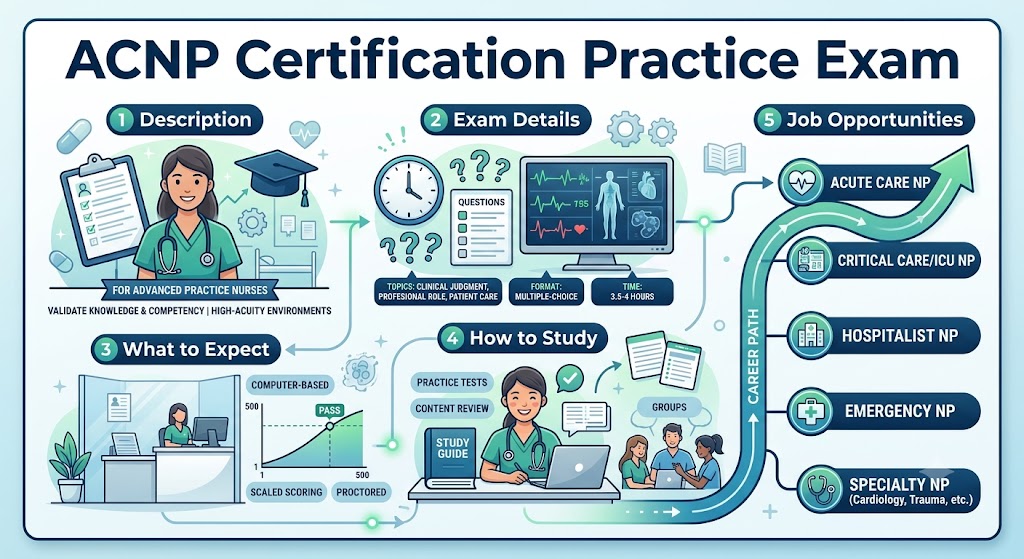
Additional Information
What the Course Entails and Exam Details
To be eligible for the certification, candidates must first
complete a nationally accredited graduate-level nurse practitioner program
(Master’s, Post-Graduate Certificate, or DNP) with a specific focus on acute
care. This educational journey includes intensive didactic coursework in areas
such as advanced physiology and pathophysiology, advanced pharmacology,
advanced health assessment, and specialized acute care management of various
patient populations and conditions.
Crucially, the program includes a significant number of
faculty-supervised clinical hours (often at least 500) where students gain
hands-on experience in acute care settings. The core topics covered in both the
educational programs and subsequently detailed on the certification exam
include:
- Clinical
Judgment and Management: The largest portion of the exam, this area
assesses the ability to assess, diagnose, and manage acute and complex
chronic illnesses across various body systems (e.g., cardiovascular,
respiratory, neurological, renal).
- Professional
Role and Core Competencies: This section evaluates understanding of
the ACNP role, including ethical issues, legal principles, healthcare
policy, quality improvement processes, evidence-based practice,
interprofessional collaboration, and patient and family education.
- Foundational
Sciences: Implicit and explicitly tested knowledge in advanced
pharmacology, pathophysiology, and assessment is crucial for all clinical
reasoning.
The specific domains and percentages may vary slightly
depending on the certifying body, such as the American Nurses Credentialing
Center (ANCC) or the American Association of Critical-Care Nurses (AACN), so
reviewing the official test blueprint is essential for any study plan
What to Expect in the Final Exam
he actual certification exam is a computer-based, timed test
administered at secure testing centers. Here’s what you can generally
anticipate:
- Format:
The exam typically consists of multiple-choice questions. It includes a
total number of questions, with a specific portion being unscored
"pretest" items used for future test development. Expect a total
count in the range of 175 to 200 questions, with around 150 of those being
scored.
- Time
Limit: Candidates are usually given between 3.5 and 4 hours to
complete the exam. Effective time management is key to ensuring you can
address all questions within the allotted window.
- Scoring:
ACNP certification exams typically use a criterion-based scaled scoring
system. A passing score is determined by subject matter experts to reflect
the minimum level of competency required, with the specific number varying
by testing body and set on a specific scaled range.
- Proctoring
and Rules: The exam is strictly proctored. Personal items are not
allowed in the testing room, and candidates must check in with proper
identification. Specific rules regarding breaks and tutorial availability
are outlined by the testing centers.
How to Study and
Exam Centers
Preparation is paramount for success on the ACNP
certification exam. Here are actionable study strategies and information on
testing:
- Detailed
Content Review: Utilize comprehensive study guides, current textbooks,
and review courses specifically designed for the ACNP exam (e.g., ANCC
AGACNP-BC, AACN ACNPC-AG). Focus on the core clinical areas and
professional role domains.
- Practice
with Practice Exams: Taking realistic, timed practice exams is one of
the most effective ways to prepare. This helps you become familiar with
the question style, practice time management, reduce test anxiety, and
identify specific areas of weakness. Look for resources provided by major
certifying bodies and reputable educational companies.
- Utilize
a Study Plan: Develop a structured 6-12 week study schedule,
dedicating specific time to each major content domain and prioritizing
areas where you have gaps in knowledge.
- Form
Study Groups: Collaborating with peers can provide support, different
perspectives, and accountability. Consider dividing topics and presenting
them to each other.
- Flashcards
and Quick Reviews: Use flashcards for key pharmacology,
pathophysiology concepts, and clinical guidelines.
- Testing
Centers: The certification exams are administered at authorized
computer-based testing centers. These centers are located in numerous
cities across the country and often internationally, offering professional
and secure environments. Some certifying bodies might also offer online
proctored options for certain candidates under specific conditions. You
will be able to select your testing center and schedule your exam date
through the relevant testing agency's online portal after your application
is approved and you receive an Authorization to Test.
Job Opportunities from the Course
Obtaining the ACNP certification unlocks a diverse range of
rewarding and high-impact career paths within the acute care landscape.
Certified individuals are highly sought after to fill critical advanced
practice roles. Some specific job opportunities and career paths include:
- Acute
Care Nurse Practitioner (ACNP) – Generically, in a wide variety of
acute settings
- Critical
Care Nurse Practitioner / ICU NP – Managing critically ill patients
- Hospitalist
Nurse Practitioner – Coordinating and managing care for admitted
patients
- Emergency
Medicine Nurse Practitioner / ER NP – Providing urgent and emergent
care
- Specialty
ACNP roles in areas such as:
- Cardiology
ACNP
- Pulmonology
ACNP
- Neurology
/ Neurosurgery ACNP
- Trauma
/ Acute Care Surgery ACNP
- Oncology
ACNP (in acute settings)
- Nurse
Practitioner, Acute Care Team / Consultation Services
- Nurse
Educator (with experience and sometimes further education) in academic
or clinical settings.
Each certified ACNP, with their extensive knowledge and
specialized skills, plays a vital role in patient outcomes, quality of care,
and the overall efficiency of acute care services. Your dedication to this
rigorous process will open doors to fulfilling and impactful professional
opportunities. Good luck with your study and your exam!
Frequently Asked Questions
Reviews
5.0
Based on 0 reviews
Leave a Review
No reviews yet. Be the first to review!