
ACT Science Practice Exam
$69.00
- Buy to unlock unlimited access to all Quiz questions.
- After purchase you can print a PDF of the whole quiz at any point. The PDF will contain the questions and the correct answers.
About this Exam
The Advanced Router Tech Certification is a premier credential designed for network professionals seeking to validate their expertise in complex routing environments. This certification is specifically engineered for network engineers, administrators, and systems architects who work with enterprise-scale infrastructure. It demonstrates a candidate’s ability to design, implement, troubleshoot, and manage sophisticated routing protocols and technologies required for modern, resilient networks.
Ready to test your knowledge?
Buy Now to Access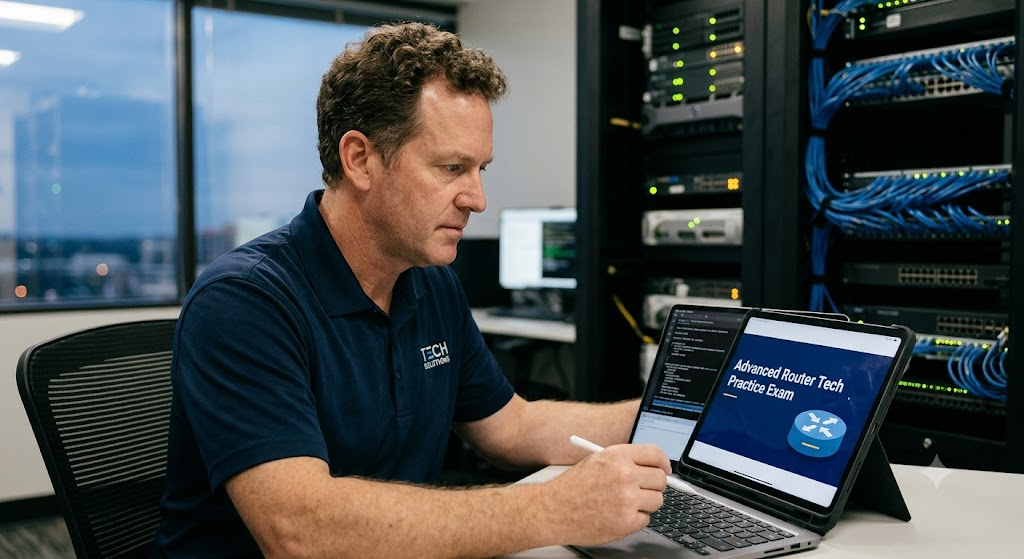
Additional Information
What the Course Entails and Exam Details
This comprehensive practice exam focuses on the core competencies required for mastering advanced routing. The curriculum delves deeply into practical scenarios and theoretical knowledge across several key domains.
Core Topics Covered:
Interior Gateway Protocols (IGP): Advanced configuration and troubleshooting of OSPF and EIGRP, including multi-area setups, summarization, and authentication.
Border Gateway Protocol (BGP): Implementing BGP for enterprise multihoming, path attribute manipulation, and route reflectors.
Route Redistribution and Control: Managing route maps, prefix lists, and administrative distance in multi-protocol environments.
VPN and Tunneling: Configuring and securing GRE, DMVPN, and IPsec implementations.
Advanced IPv6 Routing: Implementing IPv6 RIPng, OSPFv3, and MP-BGP.
Infrastructure Services and Security: High availability (HSRP, VRRP), DHCP services, and router hardening techniques.
What to Expect in the Final Exam
The final certification exam is a rigorous assessment consisting of various question formats. Candidates should expect a standard time limit of 120 minutes to complete approximately 60-70 questions.
The exam format is typically composed of multiple-choice questions (single and multiple answer), drag-and-drop scenarios, and complex performance-based simulations that require candidates to configure or troubleshoot routers in a virtual environment. A passing score generally ranges from 750 to 850 on a scale of 1000. Strict adherence to time management is required, and certain questions cannot be reviewed once the candidate moves forward.
How to Study and Exam Centers
Effective preparation is key to success. A structured study plan combining theory and practice is highly recommended.
Study Strategies:
Hands-on Labs: Utilize network simulators (like GNS3 or Cisco Modeling Labs) or physical hardware to build and tear down complex topologies. Practice redistributing routes between three or more protocols.
Official Certification Guides: Read vendor-specific study guides cover-to-cover, focusing on the configuration examples and "Key Topics" sections.
Practice Tests: Utilize comprehensive practice exams to build test-taking endurance and identify weak areas in your knowledge base.
Join Study Groups: Participate in online forums and communities to discuss challenging routing scenarios.
Exam Centers:
The final certification exam is administered through authorized testing providers such as Pearson VUE. Candidates must register on the provider’s website to schedule their exam. Tests can be taken at authorized physical testing centers worldwide, or via proctored online testing, subject to availability and vendor policy. Physical testing centers provide a controlled, quiet environment, while online testing offers flexibility for remote candidates.
Job Opportunities from the Course
Achieving certification in advanced routing techniques opens doors to specialized and high-level career paths. This qualification is highly sought after by organizations managing large-scale networks.
Career Paths and Job Titles:
Senior Network Engineer: Leading the design and maintenance of critical network infrastructure.
Network Architect: Creating high-level network designs and strategy.
Infrastructure Administrator: Managing corporate data centers and complex routing environments.
Network Security Specialist: Implementing routing-level security features and VPNs.
Network Operations Center (NOC) Tier 3 Support: Resolving escalated, complex routing issues.
Technical Consultant: Providing expert networking advice to external clients.
Frequently Asked Questions
Reviews
5.0
Based on 0 reviews
Leave a Review
No reviews yet. Be the first to review!