
ACT Math Practice Test 2 (60 Question Full Test with PDF and Solution)
$69.00
- Buy to unlock unlimited access to all Quiz questions.
- After purchase you can print a PDF of the whole quiz at any point. The PDF will contain the questions and the correct answers.
About this Exam
The ACT Math section is a critical component of the American College Testing (ACT), an essential standardized exam for high school students seeking admission to colleges and universities in the United States and some other international locations. This practice test is part of a series designed specifically for students preparing to maximize their scores on the Mathematics portion of the exam. This particular "Practice Test 2" is a comprehensive, full-length simulation of the actual exam. It is an invaluable tool for students looking to assess their readiness, practice under timed conditions, identify area-specific weaknesses, and review detailed solutions. Whether you are aiming for a competitive score for a selective university or simply looking to meet admission requirements, this full test offers the realistic practice you need to feel confident on test day.
Ready to test your knowledge?
Buy Now to Access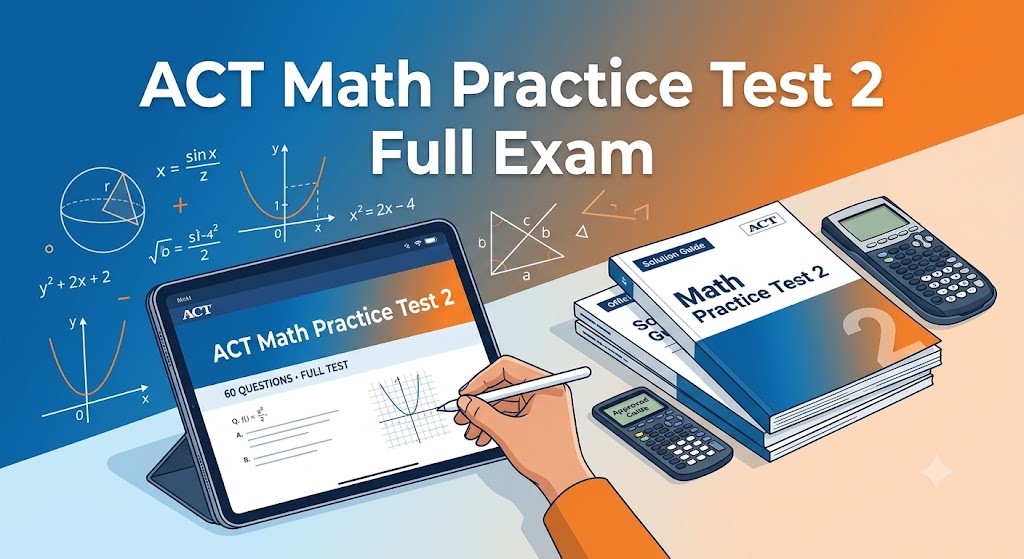
Additional Information
What the Course Entails and Exam Details
This practice material simulates the ACT Mathematics
section, which focuses on quantitative reasoning and the application of
mathematical skills relevant to typical college introductory math courses. The
full test consists of 60 questions, covering a wide range of topics
traditionally taught in algebra I, geometry, and algebra II, with a smaller
number of pre-algebra and trigonometry questions. Key content areas you must
master include:
- Pre-Algebra
(basic operations, probability, and statistics)
- Elementary
Algebra (linear equations, inequalities, and data analysis)
- Intermediate
Algebra (quadratic equations, systems of equations, and complex numbers)
- Coordinate
Geometry (slopes, lines, and distances)
- Plane
Geometry (triangles, circles, properties of geometric figures)
- Trigonometry
(basic functions and relationships in right-triangle trigonometry)
The complete package includes the full 60-question test
provided as a downloadable PDF, along with comprehensive solutions and
explanations for each question, which are crucial for active learning.
What to Expect in the Final Exam
When you sit for the actual ACT Mathematics exam, you will
have exactly 60 minutes to complete 60 multiple-choice questions. This means
you must manage your time efficiently, averaging one minute per question. The
questions are categorized into two major domains: "Preparing for Higher
Mathematics" (accounting for about 57-60% of the test) and "Essential
Skills" (accounting for about 40-43%). While there isn't a single
"passing score," your math scaled score (ranging from 1 to 36)
contributes significantly to your composite ACT score, which colleges use for
admission decisions. You are allowed to use specific approved models of
calculators on this section, so it is vital to be familiar with yours and its
limitations. Note that formulas are not generally provided on the exam, so
memorization of core formulas is essential.
How to Study and Exam Centers
The key to success in the ACT Math section is consistent, targeted
practice and analysis. Follow these actionable study strategies using this
resource:
Simulate Real Conditions:
Set aside a quiet 60-minute block and complete the entire 60-question practice
test without interruption, mimicking the official testing experience to build
your pacing and endurance.
Review the Solutions: This
is the most crucial step. After completing the test, do not just check your
answers. Carefully review the provided solutions and explanations for every
single question, especially the ones you missed or found challenging.
Understand why the correct answer is correct and why the other options are
wrong.
Focus on Weaknesses:
Identify the specific content areas (e.g., Coordinate Geometry or Trigonometry)
where you made errors. Use your main textbooks or online resources to study
those specific concepts before taking another practice test.
Practice Frequently: One
practice test is not enough. Plan to take multiple full-length practice tests,
along with smaller practice sets, leading up to your test date.
To take the official ACT, you must register in advance
through the official ACT website. You cannot take the exam on an open online
portal; it is administered on specific national test dates at designated
testing centers, which include registered high schools, colleges, and some
professional testing centers. When you register, you will select your preferred
test center from a list of authorized locations based on your location and
availability.
Job Opportunities from the Course
While the ACT itself is not a course or a standalone
certification that qualifies you for a specific job title, achieving a high
score on the Mathematics section unlocks significant career-building and
professional opportunities in the following ways:
- University
Admission: A strong ACT score is often a primary entry requirement for
competitive four-year universities and colleges.
- Scholarship
Opportunities: Many merit-based and competitive scholarships use ACT
scores as a key criterion for awarding funds.
- Placement
into Advanced Courses: Your ACT Math score can help you bypass
remedial math classes in college and enroll directly into advanced
coursework, saving you tuition and time.
- Competitive
College Programs: Many engineering, STEM, and business-focused college
programs look closely at your ACT math subscore for admission into their
specific degree paths.
A high ACT score ultimately serves as a gateway to higher
education, which is the foundational step toward virtually all professional
career paths.
<!--[if mso & !supportInlineShapes & supportFields]> SHAPE \* MERGEFORMAT <![endif]--><!--[if gte vml 1]>
Frequently Asked Questions
Reviews
5.0
Based on 0 reviews
Leave a Review
No reviews yet. Be the first to review!