
ACT English Strategies Practice Test
$69.00
- Buy to unlock unlimited access to all Quiz questions.
- After purchase you can print a PDF of the whole quiz at any point. The PDF will contain the questions and the correct answers.
About this Exam
The ACT English section is a foundational component of the ACT college readiness assessment. It is designed to measure your ability to revise and edit a variety of written texts, ensuring clarity, coherence, and grammatical correctness. This 45-minute, 75-question test is critical for high school students seeking admission to competitive undergraduate programs in the United States and Canada. Achieving a top score in ACT English demonstrates to universities that you possess the advanced writing and communication skills essential for academic success.
Ready to test your knowledge?
Buy Now to Access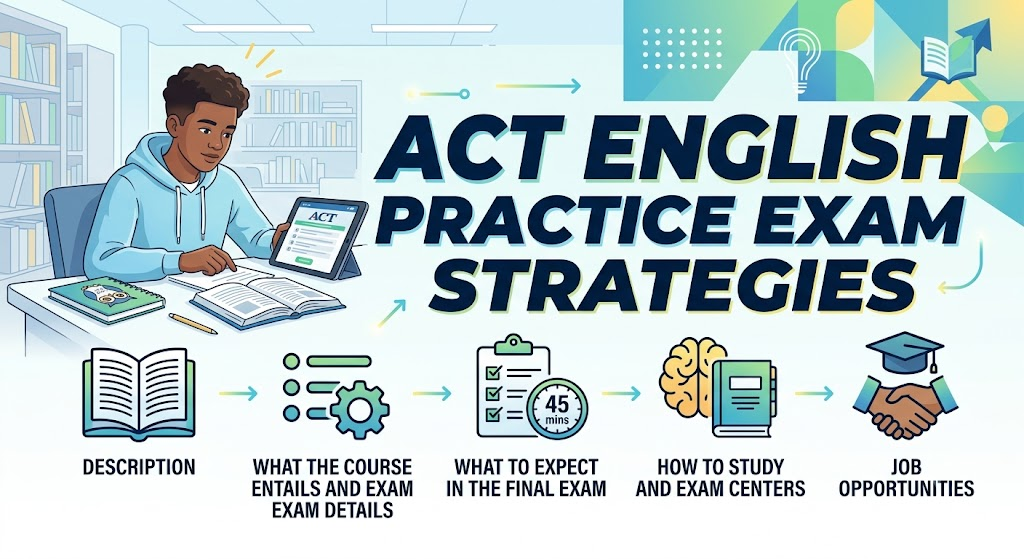
Additional Information
What the Course Entails and Exam Details
This section of the exam does not measure your creative writing skills; rather, it assesses your critical reading and editing abilities. The "course" you must master is a strong understanding of standard written English conventions and rhetorical strategy. The primary content categories you must prepare for include:
Production of Writing: Analyzing topic development, organization, unity, and cohesion in passages.
Knowledge of Language: Applying effective word choice and tone for precise meaning.
Conventions of Standard English: Ensuring accurate usage of punctuation, sentence structure, and grammar rules (e.g., subject-verb agreement, pronoun use, modifier placement).
What to Expect in the Final Exam
When you sit for the full ACT, the English section is typically the first section you will encounter. You will have 45 minutes to answer 75 multiple-choice questions. This challenging time constraint requires efficiency and focus.
The exam presents five unique prose passages. Portions of each passage will be underlined and accompanied by corresponding multiple-choice options. You must determine the best revision for the underlined section. Your options may include choosing a grammatically correct version, selecting the option that best fits the surrounding context or intended rhetorical goal, or choosing the phrase that is most concise and clear. Some questions will even ask about the overall passage structure or purpose. Your goal is to maximize your raw score, which is then scaled to a final score from 1 to 36.
How to Study and Exam Centers
Effective preparation is the key to maximizing your score. We recommend a multi-faceted approach:
Practice with Real Materials: The most accurate practice comes from official ACT English materials and full-length retired tests.
Time Yourself: Since speed is critical, time yourself during practice sessions. Aim to spend about 36 seconds per question (or about 9 minutes per 15-question passage).
Analyze Mistakes: When you miss a question, don't just find the right answer. Analyze why you got it wrong. Was it a specific grammar rule, a timing issue, or a misreading of the rhetorical context?
Develop Core English Skills: Review rules of punctuation (commas, semicolons), agreement, and sentence structure. Use a comprehensive guide to refresh your knowledge.
Learn Section Strategies: Focus on strategies unique to the English section, such as reading for context (rather than just isolating the underlined portion) and selecting the most concise (shortest) answer when multiple options are grammatically correct (a common ACT strategy).
Exam Centers: You cannot take the "ACT English Strategies Practice Test" as a standalone certification. This test is taken as part of the comprehensive ACT exam. To register for the exam, students must create an account on the official ACT website. You will select a test date and choose an official testing center. These authorized locations are typically local high schools, community colleges, or university facilities. The full ACT is offered multiple times per year, both in the United States and internationally.
Job Opportunities from the Course
While the ACT is an academic, not a vocational, assessment, success on the ACT English section is a significant gatekeeper for future career and professional development. Achieving a high score directly impacts your academic path:
Undergraduate Admission: Your ACT English score is a major factor in admission decisions at selective colleges and universities, setting the foundation for high-earning degree programs.
Academic Scholarships: Many merit-based institutional scholarships are awarded to students who achieve specific score thresholds on the ACT, reducing the cost of higher education.
Career Advancement (Long-Term): Strong written communication is the single most important skill across nearly all professional industries. A high ACT English score validates your fundamental proficiency in the language skills necessary for executive, leadership, and analytical roles.
Frequently Asked Questions
Reviews
5.0
Based on 0 reviews
Leave a Review
No reviews yet. Be the first to review!