
ACSO Reserve Basic Course (RBC) 2 Practice Test
$69.00
- Buy to unlock unlimited access to all Quiz questions.
- After purchase you can print a PDF of the whole quiz at any point. The PDF will contain the questions and the correct answers.
About this Exam
The ACSO Reserve Basic Course (RBC) 2 Practice Test is an essential study tool designed for candidates preparing for the California Commission on Peace Officer Standards and Training (POST) Regular Basic Course – Modular Format Module II. Specifically tailored for individuals in the Alameda County Sheriff's Office (ACSO) training pipeline, this practice test simulates the rigorous examination process that Level II Reserve Peace Officer candidates must undergo. Successful completion of the RBC Module II is a critical milestone, enabling individuals to perform a wide range of law enforcement duties under the immediate supervision of a Level I Reserve Officer or a full-time peace officer. This test is designed to assess and reinforce a student's understanding of the core concepts, legal principles, and practical skills required at this intermediate level of training.
Ready to test your knowledge?
Buy Now to Access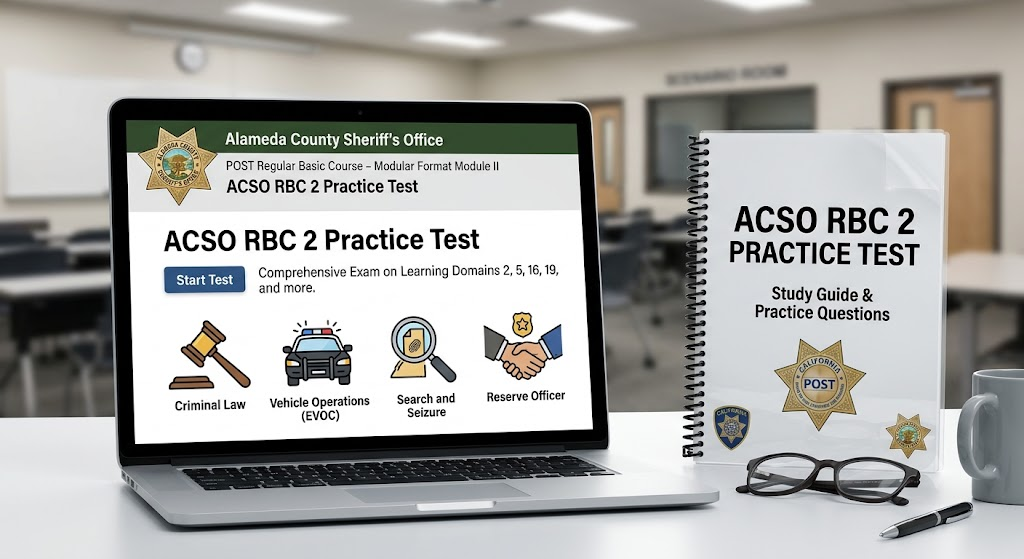
Additional Information
What the Course Entails and Exam Details
The RBC Module II course, on which this practice test is based, involves a comprehensive and intensive curriculum. It builds upon the foundation of Module III and prepares students for the final module to achieve full basic course completion. The comprehensive exam covers a vast array of Learning Domains (LDs), which include, but are not limited to:
Criminal Law (LD 2)
Rules of Evidence (LD 5)
Search and Seizure (LD 16)
Vehicle Operations (LD 19), including Emergency Vehicle Operations Course (EVOC) principles
Arrest and Control (LD 33)
Crime Scenes, Evidence, and Forensic Technology (LD 30)
Crimes Against the Justice System (LD 9)
Juvenile Law and Procedure (LD 11)
Patrol Techniques (LD 21)
The course entails both extensive classroom instruction and practical, hands-on training to ensure students can not only recall legal definitions but also apply them in high-pressure scenarios.
What to Expect in the Final Exam
The final POST Modular Format Module II exam is a standardized test, and candidates must pass both the end-of-course comprehensive test and any required scenario-based evaluations to progress. The physical exam is typically:
Format: A comprehensive, multiple-choice examination. This test is designed to measure the knowledge and understanding of the specific POST Learning Domains covered in the course. It often uses a significant number of scenario-based questions, forcing students to apply the correct legal principles to a hypothetical set of facts.
Passing Score: While the exact minimum score can vary by presentation, POST requires students to demonstrate proficiency. Typically, a passing score is a minimum of 70-80%.
Time Limit: Students are given a generous but fixed time limit to complete the multiple-choice portion of the exam.
Practical Component: In addition to the written test, students must successfully complete all practical skills tests, such as those in vehicle operations, arrest and control, and scenario evaluations, to achieve certification.
Rules: Standard testing rules apply, and strict academic integrity is maintained.
How to Study and Exam Centers
Preparation is the key to success. Here are actionable strategies for studying for the RBC Module II exam:
Master the Student Workbooks: The California POST Student Workbooks are the official and primary source of information. Read every chapter, complete all the self-assessment questions, and review all the learning activities.
Use the ACSO RBC 2 Practice Test: This practice test is an invaluable resource. Treat it like a real exam. Note which areas you find challenging and focus your subsequent study on those specific Learning Domains.
Create Flashcards: Use the specific terminology, case law, and code sections provided in the workbooks and Learning Domains to create digital or physical flashcards.
Practice Scenario Application: Don't just memorize definitions; practice applying them. Create your own scenarios or use the examples in your workbooks to determine the correct penal code or search-and-seizure authority.
Form Study Groups: Collaborating with other recruits can provide different perspectives and help explain complex legal concepts.
Review EVOC Principles: Pay special attention to the vehicle dynamics and emergency driving policies covered in Learning Domain 19.
Exam Centers: The modular exams are typically administered at the specific law enforcement academy where you are enrolled. For ACSO candidates, this will be at the Alameda County Sheriff's Office Regional Training Center. POST does not utilize third-party vendors like Pearson VUE for these specialized modular training exams. The academy coordinators will provide specific information regarding date, time, and exact location for both the written and practical examinations.
Job Opportunities from the Course
Successfully completing the ACSO Reserve Basic Course (RBC) Module II unlocks distinct and rewarding career paths within law enforcement. The certification is recognized throughout California as evidence of specialized training and competence. Here is a clear list of job titles and career opportunities that this course unlocks:
Level II Reserve Peace Officer (ACSO and other California agencies)
Level II Reserve Deputy Sheriff
Level II Reserve Police Officer
Progression to Level I Reserve Peace Officer training (RBC Module I)
Bridge toward full-time career peace officer academies
Specialized Reserve Units (e.g., search and rescue, marine patrol, air support, and ceremonial units, depending on agency)
Competitive advantage for full-time law enforcement positions
Frequently Asked Questions
Reviews
5.0
Based on 0 reviews
Leave a Review
No reviews yet. Be the first to review!