
ACSM/NCHPAD Certified Inclusive Fitness Trainer (CIFT) Practice Test
$69.00
- Buy to unlock unlimited access to all Quiz questions.
- After purchase you can print a PDF of the whole quiz at any point. The PDF will contain the questions and the correct answers.
About this Exam
The ACSM/NCHPAD Certified Inclusive Fitness Trainer (CIFT) credential is a unique certification that bridges the gap between general fitness and adaptive exercise programming. This certification is jointly developed by the American College of Sports Medicine (ACSM) and the National Center on Health, Physical Activity and Disability (NCHPAD). It is designed specifically for fitness professionals who wish to demonstrate their knowledge of designing and implementing safe and effective exercise programs for individuals with physical, sensory, and cognitive disabilities.
If you are a personal trainer, exercise physiologist, or wellness professional looking to expand your practice to serve a wider, often underserved demographic, earning the CIFT credential is a critical step. It validates your competency in understanding the specific needs of diverse populations and your ability to adapt fitness environments and programs to be truly inclusive.
Ready to test your knowledge?
Buy Now to Access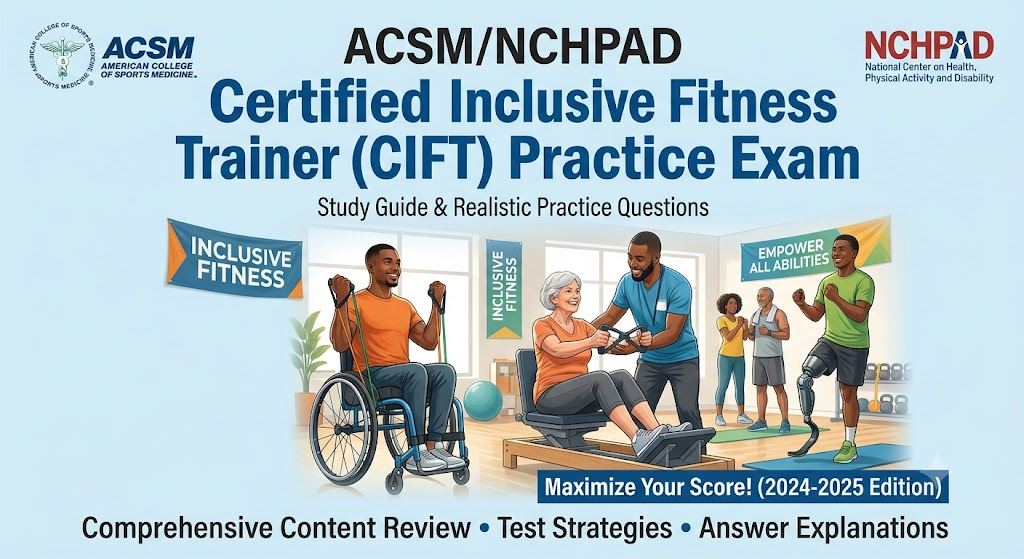
Additional Information
What the Course Entails and Exam Details
The CIFT certification course focuses heavily on practical application, theoretical knowledge of disabilities, and the creation of adapted exercise environments. Preparing for this certification entails understanding both the physiological and psychological aspects of exercise for individuals with various conditions.
The core syllabus and skills covered generally include:
Understanding Disabilities: Defining and understanding diverse populations, including physical (e.g., spinal cord injury, cerebral palsy), sensory (e.g., visual or hearing impairment), and cognitive/intellectual disabilities.
Health Screening and Risk Stratification: Modifying traditional health screening processes for clients with disabilities and recognizing specific risk factors.
Adapted Exercise Programming: Learning techniques to adapt aerobic, resistance, and flexibility exercises. This includes understanding equipment modifications and alternative training modalities.
Inclusive Facility Design: Assessing and implementing changes to fitness environments to ensure they are welcoming and physically accessible to everyone, in compliance with standard guidelines like the Americans with Disabilities Act (ADA).
Communication and Inclusive Behavior: Developing effective communication skills for interacting with clients of differing abilities and fostering positive motivational climates.
Motivation and Adherence: Applying psychological strategies to promote long-term exercise adherence and behavior change in inclusive settings.
What to Expect in the Final Exam
The CIFT certification is awarded upon successful completion of the official ACSM exam. It is vital to understand that while a practice test helps you prepare, the final proctored exam is the requirement for certification.
Here are the typical details regarding the official final exam:
Exam Format: The test is a computer-based, proctored examination consisting of multiple-choice questions. It tests both theoretical knowledge and situational application of inclusive fitness principles.
Passing Score Requirements: Candidates must achieve a passing score set by ACSM. Scores are typically scaled, and the passing benchmark is determined based on the statistical difficulty of the exam form.
Time Limits: You will be given a specific time limit to complete all the questions. Standard testing time is generally around 2 hours, though it is crucial to verify the exact time limit at the time of your scheduling.
Practical Component: Crucial Note: Historically, some ACSM specialized certifications involved a practical component. You must check the most current eligibility requirements and exam structure directly from the official ACSM website. Current testing pathways might focus primarily on the cognitive assessment (the written exam).
How to Study and Exam Centers
Effective preparation for the CIFT exam requires a strategic study plan combining theoretical study with practical application.
Actionable Study Strategies:
Study the Official Textbooks: Your foundational knowledge must come from the official ACSM preparation materials and recommended textbooks focused on inclusive fitness.
Focus on the Content Outline: Review the detailed Job Task Analysis (Content Outline) provided by ACSM. It breaks down the exam by domain and weighted percentage, showing you exactly where to focus your study time.
Use Practice Tests: Engage thoroughly with a Certified Inclusive Fitness Trainer (CIFT) Practice Test. Use it to identify weak areas and familiarize yourself with the question style and pacing.
Real-World Application: Volunteer or find opportunities to work with individuals with disabilities in a fitness capacity. Practical experience is invaluable for understanding adaptive strategies.
Exam Centers and Registration:
The proctored final exam is usually administered by a third-party testing partner, such as Pearson VUE.
You will schedule your exam through the authorized testing partner's network, which includes thousands of computer-based testing centers worldwide.
In recent years, ACSM has also offered live remote proctoring options, allowing you to take the exam from a private, secure location with a stable internet connection.
You must register and pay for the exam directly through the ACSM website before scheduling your specific test center location or time.
Job Opportunities from the Course
Earning your CIFT credential distinguishes you as a highly qualified specialist in a growing field. This certification unlocks several specific career paths and employment opportunities:
Inclusive Fitness Specialist at a Commercial Gym or Studio
Medical Fitness Coordinator in clinical settings or physical therapy clinics
Adaptive Sports Coach or Program Manager
Community Center Adaptive Fitness Program Director
Corporate Wellness Inclusive Health Coordinator
Personal Trainer specializing in diverse populations (Self-Employed)
Assisted Living and Geriatric Wellness Fitness Instructor
This credential is more than a title; it is a commitment to ensuring that fitness is truly accessible to every individual.
Frequently Asked Questions
Reviews
5.0
Based on 0 reviews
Leave a Review
No reviews yet. Be the first to review!