
ACSM Certified Exercise Physiologist (EP-C) Practice Exam
$69.00
- Buy to unlock unlimited access to all Quiz questions.
- After purchase you can print a PDF of the whole quiz at any point. The PDF will contain the questions and the correct answers.
About this Exam
The American College of Sports Medicine’s Certified Exercise Physiologist (ACSM EP-C) designation is more than a certification; it’s a standard of excellence for fitness professionals looking to work at the intersection of health, wellness, and clinical science. Designed for candidates with a bachelor's degree in exercise science or a related field, this credential validates your ability to perform pre-participation health screenings, conduct physical fitness assessments, and create individualized exercise prescriptions for individuals who are apparently healthy or have medically controlled diseases. It bridges the gap between theoretical knowledge and practical application, positioning you as an expert in using exercise as a tool for health optimization.
Ready to test your knowledge?
Buy Now to Access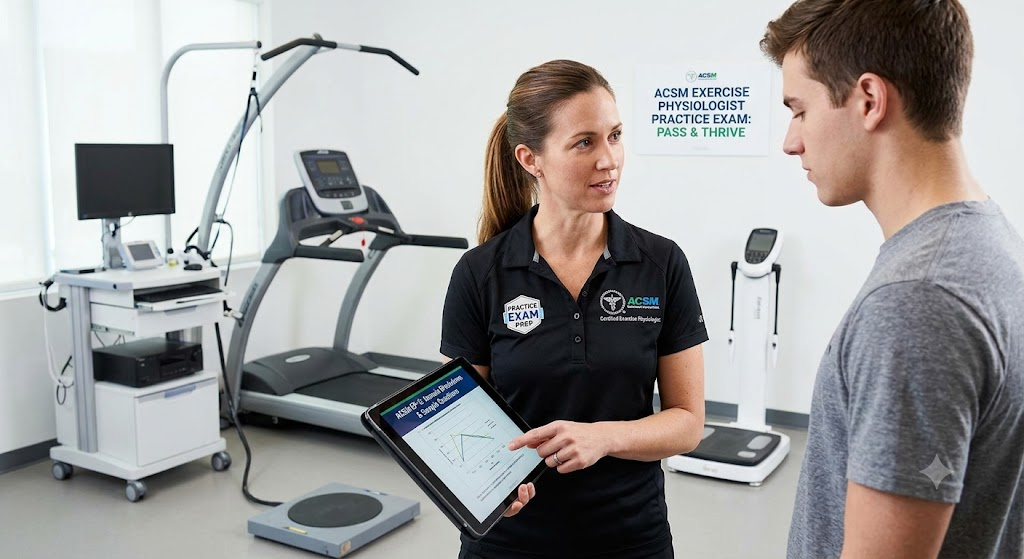
Additional Information
What the Course Entails and Exam Details
Preparing for the ACSM EP-C involves mastering a vast body of knowledge centered on exercise physiology and health-fitness management. The final exam content is organized into four core domains, each crucial to the role of an exercise physiologist. These are:
Domain I: Health & Fitness Assessment (33%) covering risk stratification, physiological testing, and metabolic calculations.
Domain II: Exercise Prescription & Implementation (40%) focusing on designing safe and effective programs using the FITT-VP principle for various populations.
Domain III: Exercise Counseling & Behavioral Strategies (20%) emphasizing motivational interviewing, behavior change models, and adherence strategies.
Domain IV: Risk Management & Professional Responsibilities (7%) detailing emergency procedures, legal issues, and ethical standards. To sit for the exam, you must have a bachelor's degree from an accredited institution in exercise science, exercise physiology, or kinesiology, alongside a current Adult CPR/AED certification that included a live, in-person practical skills component.
What to Expect in the Final Exam
The actual ACSM EP-C exam is a rigorous computer-based test comprised entirely of multiple-choice questions. Candidates are given 3.5 hours to complete the examination. The test consists of 140 questions, of which 125 are scored and 15 are non-scored pre-test questions used for future exam development. The scaled passing score is 550 on a scale ranging from 200 to 800. This scaled scoring means the number of correct answers needed to pass can vary slightly depending on the difficulty of the specific exam form you receive.
How to Study and Exam Centers
A successful study strategy for the ACSM EP-C combines deep content review with active retrieval practice. The primary resource should be the official textbooks: ACSM's Guidelines for Exercise Testing and Prescription and ACSM's Resources for the Exercise Physiologist. Start by downloading the official exam content outline (blueprint) and create a structured study schedule that allocates time proportioned to the domain weights. Utilize practice exams extensively, treating them as diagnostic tools to identify weak areas. Actively study difficult concepts, like metabolic equations for walking, running, and cycling, by applying the Feynman Technique—explaining them out loud to a peer or even an imaginary audience. The final exam is administered by Pearson VUE. Candidates have the flexibility to schedule their test at one of Pearson VUE’s hundreds of secure, authorized testing centers globally or to opt for an OnVUE online proctored exam from their home or office, provided they meet the specific technical and room environment requirements.
Job Opportunities from the Course
Earning the ACSM EP-C designation opens doors to diverse and rewarding career paths in healthcare, corporate wellness, and sports performance settings. The certification is highly respected and often a prerequisite for specialized roles. Key job titles and areas of employment include:
Clinical Exercise Specialist in cardiac or pulmonary rehabilitation.
Corporate Wellness Program Coordinator or Director.
Health and Fitness Director in commercial and community fitness centers.
Sports Performance Coach or Strength and Conditioning Specialist.
Exercise Physiologist within physical therapy clinics or medical groups.
Public Health Educator focusing on physical activity and chronic disease prevention.
Lifestyle and Weight Management Consultant.
Frequently Asked Questions
Reviews
5.0
Based on 0 reviews
Leave a Review
No reviews yet. Be the first to review!