
ACS Biochemistry Practice Exam
$69.00
- Buy to unlock unlimited access to all Quiz questions.
- After purchase you can print a PDF of the whole quiz at any point. The PDF will contain the questions and the correct answers.
About this Exam
The ACS Biochemistry Exam, officially known as the Biochemistry American Chemical Society (ACS) Examination, is a standardized assessment used across the United States. It is typically administered as the final exam for undergraduate biochemistry courses, particularly those within an ACS-certified degree program. This comprehensive exam is designed for undergraduate students majoring in chemistry, biochemistry, or a related life science field. Its purpose is to evaluate a student's conceptual understanding and mastery of the fundamental principles of biochemistry, covering everything from molecular structure and function to metabolic pathways and molecular biology techniques. Successfully completing this exam often serves as a key milestone for students seeking academic recognition or those preparing for advanced studies and careers in the scientific and medical fields.
Ready to test your knowledge?
Buy Now to Access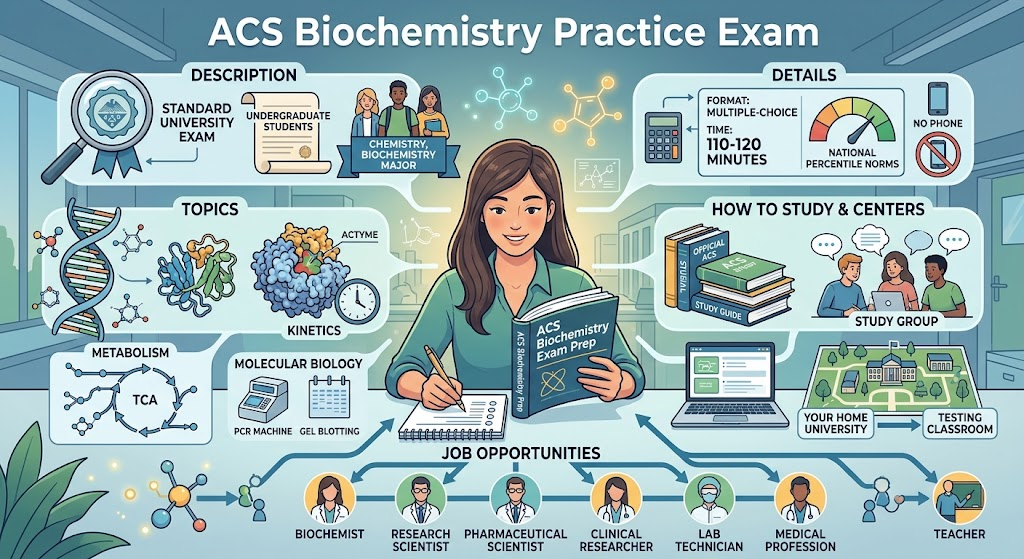
Additional Information
What the Course Entails and Exam Details
The content of the ACS Biochemistry Exam reflects the comprehensive nature of a year-long undergraduate biochemistry sequence. To prepare effectively, students must have a deep understanding of the following core topics:
Structure and Function of Biomolecules: A thorough grasp of the chemistry and biological roles of the four major classes of macromolecules: proteins (including amino acids, peptide bonds, and protein folding), nucleic acids (DNA and RNA structure, replication, and transcription), lipids (membranes, signal transduction), and carbohydrates (structure and metabolism).
Enzyme Kinetics and Mechanism: An essential area covering the principles of catalysis, Michaelis-Menten kinetics, enzyme inhibition, and allosteric regulation, along with key cofactors and coenzymes.
Bioenergetics and Metabolism: Mastery of central metabolic pathways, including glycolysis, the citric acid cycle (Krebs cycle), oxidative phosphorylation, electron transport, and the synthesis and degradation of gluconeogenesis, glycogen, and fatty acids. It also involves an understanding of thermodynamic principles applied to biological systems.
Molecular Biology Techniques: Knowledge of modern laboratory methods used to study biochemistry, such as gel electrophoresis (for DNA, RNA, and protein analysis), polymerase chain reaction (PCR), DNA sequencing, restriction digestion, and protein purification techniques like chromatography and blotting.
Gene Expression and Regulation: Understanding the flow of genetic information from DNA to RNA to protein, including transcription factors, post-transcriptional modifications, and the complex mechanisms that regulate gene expression in pro- and eukaryotic systems.
What to Expect in the Final Exam
The standard ACS Biochemistry Exam is a single-part, written test.
Format: It consists of approximately 60 multiple-choice questions. These questions are designed to test not only a student's recall of facts but also their ability to apply concepts, solve numerical problems (e.g., related to kinetics or thermodynamics), interpret experimental data, and reason through biochemical problems.
Time Limit: The allowed time is typically around 110 to 120 minutes (two hours), making it a time-pressured exam. Efficient problem-solving and time management are crucial.
Scoring: Passing scores are determined by individual academic institutions. There is no universally fixed raw score for passing. However, the ACS provides national norm data (percentiles) based on the performance of a large pool of students, which allows instructors and institutions to compare their students' achievement with a national standard.
Specific Rules: In most university settings, the use of calculators and basic trigonometric/logarithmic tables is permitted, provided they adhere to the institution's specific policy. No other study materials or electronic devices are typically allowed.
How to Study and Exam Centers
A proactive and structured study approach is vital for success on this challenging exam.
Effective Study Strategies:
Utilize the Official Study Guide: The single most valuable resource is the official ACS Study Guide, specifically tailored for the Biochemistry examination. This guide provides detailed explanations of key concepts, worked examples of typical exam questions, and several full-length practice exams with answer keys. Work through this guide systematically.
Review Your Course Materials: Revisit your lecture notes, textbook, and assignments. Pay close attention to the specific emphasis of your instructor, while also ensuring you have broad coverage across all the exam topics.
Practice with Old Exams: In addition to the practice exams in the official study guide, try to obtain and solve as many other past ACS exams (from your institution or other online sources, if available legally) as possible. This is the best way to get a feel for the exam’s style, timing, and recurring question types.
Form Study Groups: Collaborating with peers allows you to explain complex concepts to others, which is one of the most effective ways to solidify your own understanding. Group members can quiz each other, share different problem-solving methods, and fill in gaps in knowledge.
Focus on Conceptual Understanding: The ACS exam prioritizes deep understanding over rote memorization. Ensure you understand why biochemical reactions occur, the principles behind each technique, and the implications of metabolic pathways, rather than just memorizing intermediate steps.
Exam Center Locations:
Unlike standardized professional certification exams taken at dedicated testing centers, the ACS Biochemistry Exam is typically administered on-site at the student’s home college or university.
It serves as the final exam for a biochemistry course.
Students should confirm the exact date, time, and specific classroom location directly with their course instructor or the academic department office.
There is usually no need to register through an external organization for this specific academic exam.
Job Opportunities from the Course
Successfully completing a biochemistry program, validated by a strong performance on the ACS exam, opens doors to diverse and rewarding career paths in a rapidly growing field. A background in biochemistry provides essential knowledge for numerous roles, including:
Biochemist
Research Scientist (in academia or industry)
Laboratory Technician
Pharmaceutical Scientist
Clinical Research Coordinator
Biotechnology Associate
Medical Scientist
Forensic Scientist
Chemical Analyst
Quality Control Analyst
Science Writer or Editor
Postsecondary Teacher
(With advanced degrees: Physician, Dentist, Pharmacist, Genetic Counselor, Professor)
By mastering the concepts tested in the ACS Biochemistry Practice Exam, students lay a solid foundation for their professional future, ensuring they are competitive candidates for advanced degree programs and fulfilling roles within the scientific and healthcare landscape.
Frequently Asked Questions
Reviews
5.0
Based on 0 reviews
Leave a Review
No reviews yet. Be the first to review!