
ACLS Precourse Self Assessment Answers (Pharmacology, Rhythm)
$69.00
- Buy to unlock unlimited access to all Quiz questions.
- After purchase you can print a PDF of the whole quiz at any point. The PDF will contain the questions and the correct answers.
About this Exam
The Advanced Cardiovascular Life Support (ACLS) Precourse Self Assessment is a critical prerequisite for healthcare professionals preparing to undertake the full AHA ACLS Provider Course. It is specifically designed for individuals involved in the management of cardiovascular emergencies, including physicians, nurses, paramedics, and respiratory therapists. This assessment evaluates your fundamental knowledge across three critical domains: ECG rhythm recognition, ACLS pharmacology, and practical application. By identifying strengths and weaknesses beforehand, it ensures that candidates enter the ACLS classroom course with a solid foundation, ready to focus on team dynamics and megacode simulations.
Ready to test your knowledge?
Buy Now to Access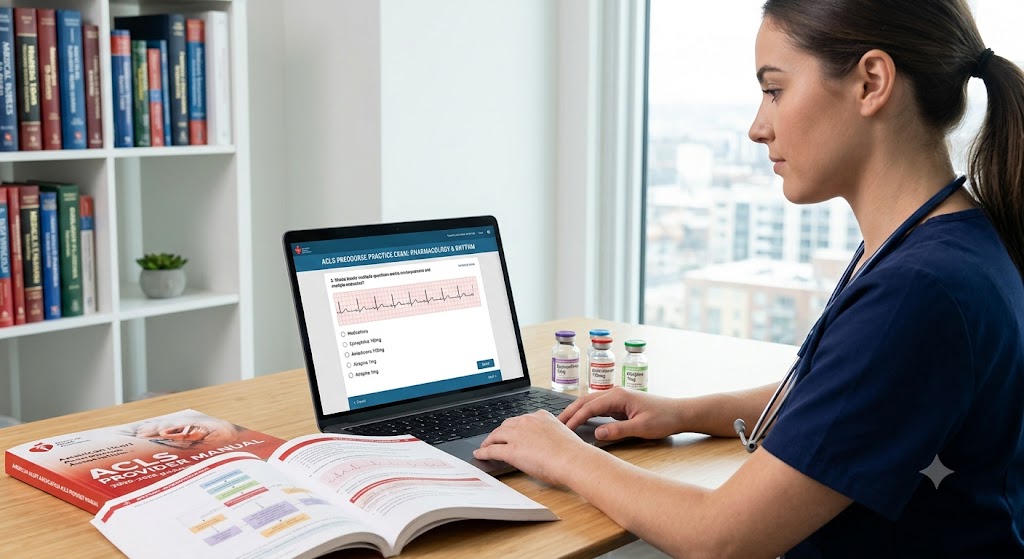
Additional Information
What the Course Entails and Exam Details
While not a taught course itself, the Precourse Self
Assessment evaluates foundational knowledge required for ACLS certification.
The assessment focuses on a clear set of topics:
- ECG
Rhythm Recognition: Demonstrating proficiency in identifying standard
ACLS rhythms, including Ventricular Fibrillation/pulseless Ventricular
Tachycardia (VF/pVT), Pulseless Electrical Activity (PEA), Asystole,
Supraventricular Tachycardia (SVT), Atrial Fibrillation/Flutter with Rapid
Ventricular Response, Stable and Unstable Tachycardias, and various
degrees of Bradycardia (including AV blocks).
- ACLS
Pharmacology: Understanding the indications, dosages,
contraindications, and mechanisms of action for essential emergency drugs
used within ACLS algorithms, such as Epinephrine, Amiodarone, Lidocaine,
Atropine, Adenosine, Magnesium Sulfate, Dopamine, and specialized
vasopressors.
Successful completion of this precourse assessment is
mandatory to attend the classroom portion of the ACLS course. Candidates must
print their score report and present it at the start of their ACLS training.
What to Expect in the Final Exam
It is essential to understand that the "final
exam" here refers to the Precourse Self Assessment itself, which you
complete before the classroom course. It is an online, unproctored
assessment that you can take from a location of your choice.
The format typically consists of approximately 60
multiple-choice questions focusing on rhythm identification and ACLS
pharmacology applications. It is an open-resource assessment, meaning you are
encouraged to use your ACLS Provider Manual as a reference.
The goal of this assessment is proficiency, rather than
speed. While there isn't usually a strict time limit, you should allocate
sufficient time to carefully review each question.
A passing score (often 80% or higher, though requirements
may slightly vary by training center) is required to receive a certificate of
completion for the precourse requirement. You can typically retake the
assessment multiple times until you achieve the passing score, emphasizing the
assessment's role as a learning tool.
How to Study and Exam Centers
Preparation for the ACLS Precourse Self Assessment relies
heavily on active studying and resource utilization.
Study Strategies:
- Utilize
Official Resources: Your primary resource should be the official
American Heart Association (AHA) ACLS Provider Manual. Study the
algorithms, dosage charts, and rhythm guides thoroughly.
- Target
Practice Questions: Focus your study time on practice question banks
and review sheets, particularly those designed around the ACLS
Pharmacology and Rhythm content. These are highly effective for improving
recall and application.
- Master
Rhythm Identification: Spend time using ECG interpretation simulators
and flashcards to quickly recognize key rhythms. Practice identifying
unstable rhythms and determining the appropriate initial intervention.
- Reinforce
Pharmacology: Create flashcards for critical ACLS drugs, detailing
their uses, adult doses (for cardiac arrest vs. symptomatic
bradycardia/tachycardia), and main side effects.
Exam Centers:
You do not need to visit a physical exam center to take the
Precourse Self Assessment. It is taken online via the American Heart
Association's eLearning portal (such as eLearning.heart.org) or other
authorized online platforms provided by your specific ACLS training center.
Once complete, you are responsible for printing your completion certificate or
score report to bring to your physical, in-person ACLS classroom session.
Job Opportunities from the Course
A strong performance on the Precourse Self Assessment is the
first step toward obtaining your full ACLS certification. Possessing an active
ACLS certification is a mandatory requirement for countless healthcare roles
and can significantly advance your career. The primary job opportunities that
this certification unlocks include:
- Registered
Nurses (especially in Emergency Departments, ICUs, CCUs, and
Post-Anesthesia Care Units)
- Paramedics
and Advanced EMTs
- Emergency
Medicine Physicians
- Critical
Care Physicians
- Anesthesiologists
and CRNAs
- Cardiologists
and Cardiology Technicians
- Respiratory
Therapists
- Flight
Nurses and Paramedics
- Rapid
Response Team Members
- Advanced
Practice Providers (PAs and NPs in acute care settings)
- Hospitalists
- Code
Blue Team Responders
Frequently Asked Questions
Reviews
5.0
Based on 0 reviews
Leave a Review
No reviews yet. Be the first to review!