
ACLS Algorithms 2026
$69.00
- Buy to unlock unlimited access to all Quiz questions.
- After purchase you can print a PDF of the whole quiz at any point. The PDF will contain the questions and the correct answers.
About this Exam
The Advanced Cardiovascular Life Support (ACLS) certification is an essential qualification for healthcare professionals involved in the management of cardiovascular emergencies, including cardiac arrest, acute coronary syndromes, and stroke.
The course is designed to equip medical personnel—such as doctors, nurses, paramedics, and respiratory therapists—with the advanced skills necessary to lead and manage complex resuscitation efforts.
The core focus is on the rapid recognition and effective treatment of acute life-threatening conditions.
Ready to test your knowledge?
Buy Now to Access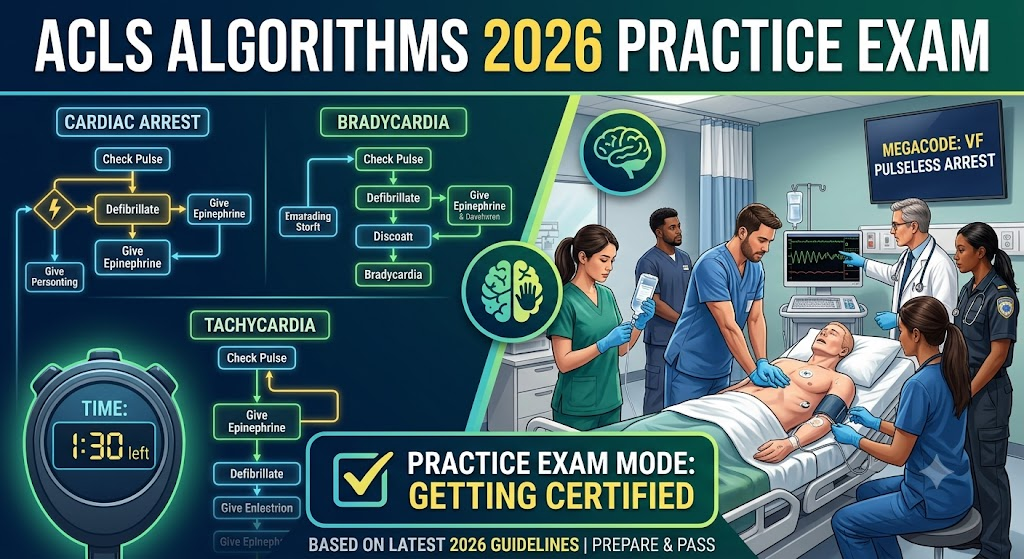
Additional Information
What the Course Entails and Exam Details
The ACLS course and subsequent exam delve into advanced life-saving techniques and clinical algorithms. Key topics covered include:
ACLS Algorithms: Mastery of specific algorithms for various scenarios, including Pulseless Electrical Activity (PEA), Ventricular Fibrillation (VF)/Pulseless Ventricular Tachycardia (pVT), Asystole, Bradycardia, Tachycardia, and Stroke.
Effective Resuscitation Dynamics: Principles of effective high-performance team dynamics during resuscitation attempts.
Post-Cardiac Arrest Care: Understanding and implementing treatment strategies for patients who have experienced a return of spontaneous circulation (ROSC).
Management of Acute Coronary Syndromes and Stroke: Rapid assessment and treatment protocols for these time-sensitive conditions.
Medication Administration: Indications, dosages, and contraindications of drugs commonly used in ACLS, such as epinephrine, amiodarone, lidocaine, adenosine, and atropine.
What to Expect in the Final Exam
The ACLS final exam typically consists of a combination of:
Cognitive Evaluation: A written, multiple-choice exam testing knowledge of ACLS algorithms, pharmacology, and clinical decision-making. The exam usually has around 50 questions.
Psychomotor Skills Evaluation: Practical, scenario-based assessments where you must demonstrate appropriate leadership and clinical skills during simulated cardiac arrest and other emergencies. You'll need to demonstrate the correct application of algorithms and effective team communication.
Passing Score: To pass, you generally need to achieve a score of at least 84% on the written exam and successfully pass all practical skill stations.
Time Limit: The written exam typically has a time limit of about 60-90 minutes.
How to Study and Exam Centers
Preparation is crucial for success on the ACLS exam. Effective strategies include:
Master the Algorithms: Memorize and practice applying all ACLS algorithms repeatedly. Understand the decision trees and the underlying clinical rationale.
Review Pharmacology: Become thoroughly familiar with the indications, dosages, and mechanisms of action of all ACLS medications.
Participate in Practical Scenarios: Practice leading a resuscitation team in simulation scenarios. This is vital for refining your psychomotor skills and practical application of the algorithms.
Use Study Materials: Utilize official ACLS provider manuals, online resources, and practice exams to test your knowledge and identify areas needing improvement.
ACLS Classes: Enroll in an authorized ACLS course, often offered by institutions like the American Heart Association (AHA), which provides hands-on training and preparation for the exam.
Exam Centers: ACLS certification courses and the final exam are often conducted through authorized training centers affiliated with major health organizations. You can locate accredited ACLS providers in your area or search online for official ACLS testing centers, often hosted in hospitals, community colleges, or medical training facilities.
Job Opportunities from the Course
Earning your ACLS certification opens up numerous opportunities within the healthcare sector, particularly in high-acuity environments. Common career paths include:
Emergency Room Physician
Critical Care/ICU Nurse
Paramedic
Flight Paramedic/Nurse
Respiratory Therapist
Cardiology Nurse Practitioner
Anesthesiologist
Trauma Surgeon
Hospitalist
These roles often require mandatory ACLS certification as part of the job requirements, demonstrating your ability to handle complex medical emergencies effectively.
Successful completion of the ACLS course and exam significantly enhances your career prospects and equips you with critical skills to save lives.
Frequently Asked Questions
Reviews
5.0
Based on 0 reviews
Leave a Review
No reviews yet. Be the first to review!