
ACI Concrete Finisher Practice Test
$69.00
- Buy to unlock unlimited access to all Quiz questions.
- After purchase you can print a PDF of the whole quiz at any point. The PDF will contain the questions and the correct answers.
About this Exam
The ACI Concrete Flatwork Finisher certification, offered by the American Concrete Institute, is the industry-standard credential for professionals who place, consolidate, finish, edge, joint, and cure concrete flatwork. This certification is designed specifically for concrete craftspeople seeking to validate their expertise, improve their knowledge of the trade, and advance their careers. It is an excellent step for both experienced finishers looking for formal recognition and those newer to the industry aiming to demonstrate their commitment to quality and standard practices. Earning this certification signals to employers and clients that you have mastered the fundamental skills necessary for producing high-quality, durable concrete flatwork surfaces.
Ready to test your knowledge?
Buy Now to Access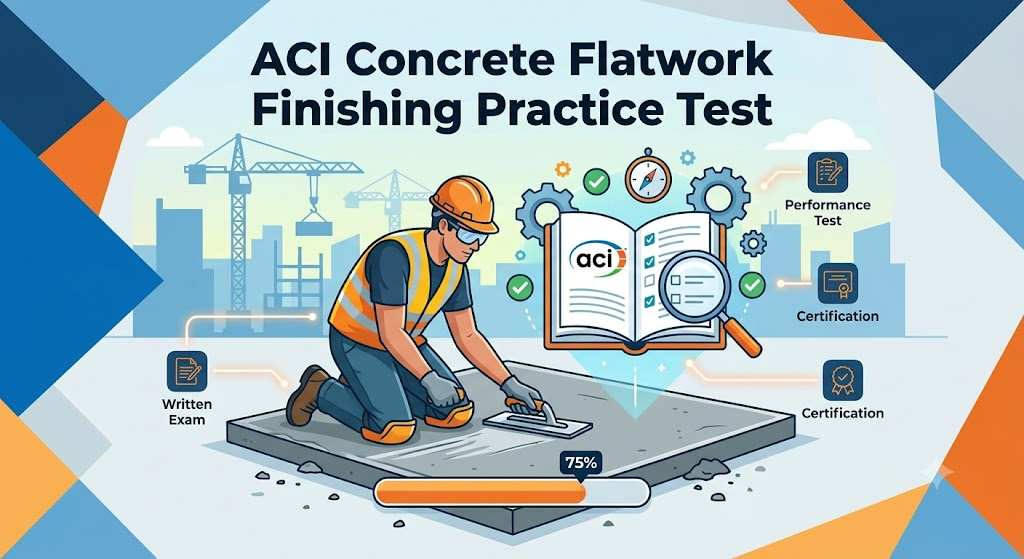
Additional Information
What the Course Entails and Exam Details
Preparing for the ACI Concrete Finisher exam requires mastering several key areas outlined in the ACI CP-10 workbook, which serves as the primary study resource. The knowledge and skills covered include:
Pre-placement Planning: Understanding job site safety requirements, preparing subgrades, setting forms properly, and planning the sequence of concrete placement.
Concrete Properties: Knowledge of fundamental concrete technology, including water-cement ratios, slump, admixtures, and how these factors affect setting times, strength, and finishability.
Placing and Consolidating: Proper techniques for discharging concrete, spreading it, and consolidating it around reinforcement and forms using vibrators to prevent segregation and voids.
Initial Finishing: Techniques for initial leveling, screeding, and bull floating (or darbying) the surface immediately after placement while the concrete is still plastic.
Waiting Periods: Understanding the importance of timing finishing operations correctly based on the concrete's setting rate and bleeding.
Final Finishing: Applying various finishes, including hand floating, troweling (power and hand), edging, and jointing using appropriate tools and techniques to meet specified textures and tolerances.
Curing and Protection: Understanding the critical importance of proper curing methods (moisture retention, curing compounds) and protecting freshly placed concrete from extreme weather conditions (hot, cold, or windy).
What to Expect in the Final Exam
The ACI Concrete Flatwork Finisher certification process typically involves two distinct components that must be passed:
1. The Written Examination:
Format: The written exam is a closed-book test, consisting primarily of multiple-choice questions designed to assess your knowledge of the materials, techniques, and procedures covered in the ACI study manual.
Number of Questions: There are typically around 50 questions on the written exam.
Passing Score: A minimum passing grade of 70% is required.
Time Limit: Candidates are usually given approximately one hour to complete the written exam.
2. The Performance (Practical) Examination:
Format: The performance exam is a hands-on assessment where you must demonstrate your ability to execute core finishing tasks effectively under the observation of an ACI Examiner.
Skills Tested: You will need to properly place, consolidate, screed, bull float, edge, and joint a sample section of concrete flatwork. The examiner evaluates your technique, tool usage, and the quality of the finished surface.
Important Note on Certification Levels:
It is essential to understand that passing only the written exam earns you the status of ACI Concrete Flatwork Technician. To achieve the full ACI Concrete Flatwork Finisher certification, you must successfully pass both the written exam and the practical performance exam.
How to Study and Exam Centers
Preparation is crucial for success on the ACI Concrete Finisher exams. Here are effective strategies:
Study the Official Workbook (ACI CP-10): This is the single most important resource. Dedicate significant time to thoroughly reading and understanding every chapter. Pay close attention to definitions, proper sequencing, safety practices, and tool usage.
Take ACI Concrete Finisher Practice Tests: Utilizing practice exams is an excellent way to familiarize yourself with the format, style, and difficulty of the questions you will encounter. This helps build testing stamina, identifies specific knowledge gaps, and provides opportunities to review incorrect answers using the study manual.
Attend a Review Session: Many ACI chapters and authorized training providers offer review sessions before the exam date. These sessions are highly beneficial for reinforcing key concepts and asking questions of experienced instructors.
Get Hands-On Experience: For the performance exam, there is no substitute for actual experience. If you are not working in the trade full-time, seek opportunities to practice placing and finishing techniques. Focus on timing and using tools properly, as these are critical elements the examiners will observe.
Finding Exam Centers and Scheduling:
ACI exams are generally administered through local ACI Chapters or other authorized Sponsoring Groups (such as state concrete associations or technical colleges). You can find upcoming exam dates and locations in your area by visiting the ACI official website (concrete.org) and searching their certification schedule database. Exams are not typically offered at general testing centers like Pearson VUE.
Job Opportunities from the Course
Earning the ACI Concrete Flatwork Finisher certification opens doors to several rewarding career paths in the construction industry. This credential is often required or highly preferred for work on state Department of Transportation (DOT) projects and commercial jobs. Potential job opportunities include:
Concrete Finisher: Performing hands-on placement and finishing work for sidewalks, driveways, floors, and other flat surfaces.
Concrete Crew Foreperson: Leading finishing crews and supervising placement operations on job sites.
Concrete Quality Control Inspector: Reviewing finished concrete work to ensure it meets project specifications, tolerances, and quality standards.
Concrete Estimator: Utilizing field knowledge to accurately estimate concrete volume, labor requirements, and finishing costs for project bids.
Field Technician: Assisting with on-site testing and quality assurance procedures during concrete placement.
Construction Superintendent (Concrete Focus): Overlooking all concrete operations for large construction projects.
Frequently Asked Questions
Reviews
5.0
Based on 0 reviews
Leave a Review
No reviews yet. Be the first to review!