
ACI Certification Practice Exam
$69.00
- Buy to unlock unlimited access to all Quiz questions.
- After purchase you can print a PDF of the whole quiz at any point. The PDF will contain the questions and the correct answers.
About this Exam
ACI Certification programs are designed to establish minimum qualifications for personnel employed within the concrete construction industry, ensuring they have the knowledge and, increasingly, the practical ability required for their specific roles. The certifications cover a broad spectrum of activities, from field testing and inspection to specialized technical work. They are primarily designed for individuals whose work directly impacts the quality, performance, and safety of concrete construction, including technicians, inspectors, engineers, and supervisors. Employers, specifiers, and project owners rely on ACI certifications as verification that their personnel meet rigorous, standardized benchmarks, which is why earning this credential is such a valuable step. The specific program detailed here is often the entry-point or key qualification for many roles.
Ready to test your knowledge?
Buy Now to Access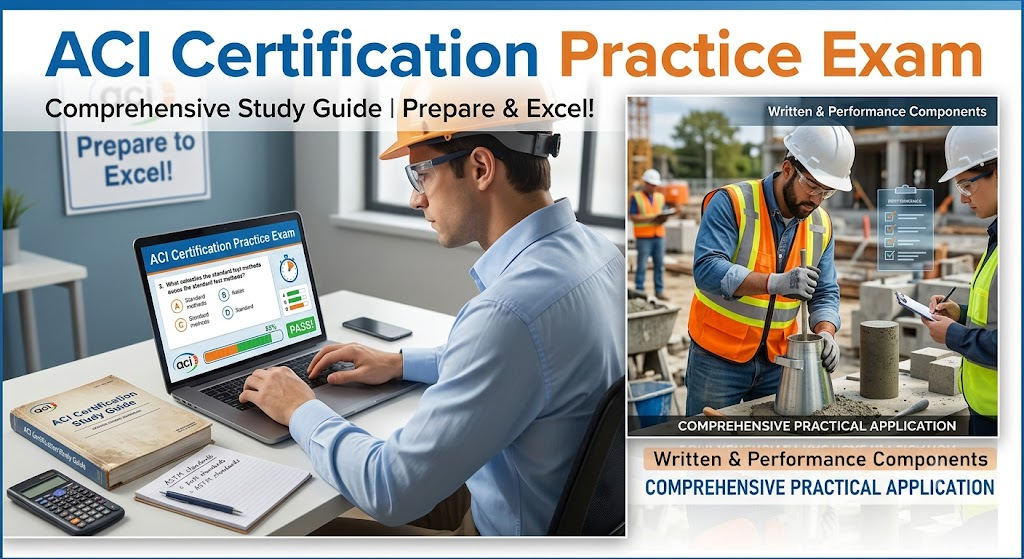
Additional Information
What the Course Entails and Exam Details
While ACI programs are technically certifications rather than a single comprehensive academic course, preparation for the associated exam(s) covers crucial procedural knowledge, standard specifications, and technical principles related to a specific certification area (e.g., Concrete Field Testing Technician, Grade I).
For many certifications, the required elements include:
Detailed Understanding of Standards: In-depth knowledge of current ASTM (American Society for Testing and Materials) standard test methods and practices specific to the certification. These form the technical backbone of the entire program.
Procedural Execution: The precise, step-by-step performance of various field or laboratory tests on freshly mixed concrete.
Accuracy and Documentation: The ability to accurately record, calculate, and report test results according to specified standards.
Safety Precautions: Standard safety protocols when working with concrete and related equipment.
Quality Control Principles: A fundamental grasp of the significance of tests, quality concrete practices, and their impact on construction projects.
Examination Format: The exam itself usually has a written section (often closed-book, multiple-choice questions on technical knowledge and procedures) and a performance section (a practical evaluation where you must correctly demonstrate various procedural tests). Note: The specific topics, number of questions, time limits, and exact tests will vary by certification program. For an illustrative example like the Concrete Field Testing Technician Grade I, the written exam might consist of approximately 55-60 multiple-choice questions with a time limit of around one hour. The performance part would involve actually carrying out specific, key tests.
What to Expect in the Final Exam
The final ACI certification exam is a two-part assessment, requiring demonstrated competence in both theoretical knowledge and practical performance. The precise structure, content, and scores will depend on the specific certification program you are aiming for (e.g., Concrete Field Testing Technician vs. Concrete Inspector). Using the popular ACI Concrete Field Testing Technician Grade I as an illustrative example, here is what you can generally expect:
Part 1: Written Examination (Illustrative Data):
Format: Multiple-choice questions, usually closed-book.
Number of Questions: Around 55-60 questions, covering all standard test methods and practices included in the program. Each specific test method will likely have a dedicated set of questions (e.g., 5-10 questions per test).
Time Limit: Often approximately one hour.
Passing Score: Typically requires a minimum score of at least 60% on each individual test method subset and an overall passing score (often 70% or higher). It is crucial to understand that failing even one section can result in a failing score for the entire written exam.
Part 2: Performance Examination (Illustrative Data):
Format: Hands-on demonstration. You will be asked to perform several key concrete tests from the program (e.g., slump test, temperature measurement, specimen fabrication, air content, etc.) under the observation of an examiner.
Passing Criteria: You must successfully perform each required procedure without error, following all specific step-by-step instructions and safety guidelines outlined in the relevant standards.
Verbals/Documentation: For some tests, you may be required to verbally describe certain procedures (like composite sampling), and for others, to correctly document and report hypothetical or your own performance data.
Key General Rules:
Preparation is Essential: You cannot pass on theory alone; both parts must be successfully completed.
Accuracy is Paramount: Procedural errors in the performance section or incorrect answers in the written section are costly.
Recertification: Certifications are valid for a specified period (typically 5 years) and require successful completion of both parts again to maintain your status.
How to Study and Exam Centers
Successfully earning your ACI certification is a serious endeavor, demanding dedicated study and significant practical practice.
Study Strategies and Practice Methods:
Utilize Official Resources: Your local ACI chapter or training location will typically provide official workbooks and study materials specifically designed for the program. These are the most direct source for what you need to know. Make sure you have the current standards.
Take ACI Training Courses: While not always mandatory, attending preparation or training courses offered by ACI, its local chapters, or approved institutions is highly recommended. These provide expert instruction, practical demonstrations, and opportunity for guided practice.
Practice, Practice, Practice - Both Parts:
Written: Use practice exams, sample questions, and quizzes to test your theoretical knowledge. Review the official workbook thoroughly. ACI University and some local chapters may offer online resources and practice questions.
Performance: Dedicate ample time to physically performing every test in the practical exam. This must be done correctly, consistently, and with the required equipment. Seek out a lab or site where you can practice under the guidance of a certified professional and have them critique your work.
Review Standard Operating Procedures (SOPs) and ASTMs: The original standards themselves are the definitive reference. Review them critically.
How & Where to Take the Exam:
Local ACI Chapters/Sponsoring Groups: ACI certification exams are typically conducted through an international network of Sponsoring Groups, including local ACI chapters, state-level concrete associations, universities, and technical colleges.
Find a Center: Visit the official ACI (American Concrete Institute) website and use their search or "Verify a Certification" tools (which also show current certifications and might link to upcoming sessions/locations) or look specifically for the certification area to find a listing of Sponsoring Groups and upcoming exam dates/locations in your region. Contact your local chapter directly for schedules and to register.
Online and Testing Providers: For the written component of some certifications, ACI may offer computer-based testing, which could potentially be available at various authorized testing centers (like Pearson VUE in certain regions) or online proctoring portals. Always check the specific and current options for your chosen program on the official ACI website or with your Sponsoring Group. The performance part always requires a physical demonstration at a designated location.
Job Opportunities from the Course
Earning an ACI Certification, especially key ones like Concrete Field Testing Technician Grade I or inspector certifications, is a significant career accelerator. It is often a hard requirement or substantial advantage for a wide array of roles. Here is a list of job titles and career paths this certification unlocks:
Concrete Field Testing Technician (all grades) - A direct application of the skills learned.
Concrete Laboratory Technician
Concrete Inspector (various grades/specialties, for construction, pavement, etc.) - Certification is critical for verifying work adherence to standards.
Quality Control Technician (QC Tech) / Quality Assurance Specialist (QA Specialist) in concrete manufacturing, testing labs, or general construction.
Project Engineer Project Manager - Certification builds crucial concrete technical knowledge and credibility.
Contractor / Construction Superintendent / Foreman Concrete Special Inspector (as defined by building codes) - Inspector certifications are typically a mandatory prerequisite.
Material Supplier Representative Public Works Inspector / Engineering Technician (government agencies) Resident Project Representative (on construction sites) Training & Education Roles in the concrete industry - With further experience and knowledge.
Your path to achieving ACI Certification is clear: dedicate yourself to understanding the standards, mastering the practical procedures, utilizing practice tools, and preparing thoroughly for both parts of this challenging yet rewarding exam. Good luck on your journey to becoming a qualified, certified professional!
Frequently Asked Questions
Reviews
5.0
Based on 0 reviews
Leave a Review
No reviews yet. Be the first to review!