
ACFE Certified Fraud Examiner (CFE) 1 Practice Exam
$69.00
- Buy to unlock unlimited access to all Quiz questions.
- After purchase you can print a PDF of the whole quiz at any point. The PDF will contain the questions and the correct answers.
About this Exam
The Certified Fraud Examiner (CFE) credential, awarded by the Association of Certified Fraud Examiners (ACFE), is the globally recognized standard of excellence for anti-fraud professionals. This certification validates expertise in fraud prevention, detection, and investigation.
This comprehensive CFE practice exam is specifically designed to help aspiring CFEs prepare for the rigorous official certification exam. It focuses on the core competencies required to identify white-collar crime, understand fraud methodologies, and implement effective internal controls. This guide is ideal for accountants, auditors, investigators, law enforcement personnel, and legal professionals looking to advance their careers in the anti-fraud field.
Ready to test your knowledge?
Buy Now to Access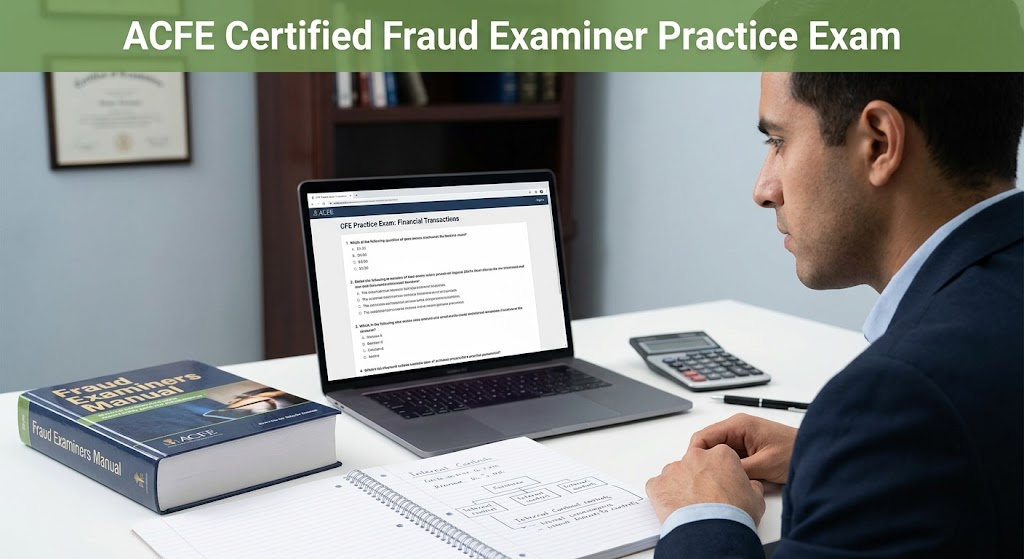
Additional Information
What the Course Entails and Exam Details
This practice exam focuses primarily on the knowledge base required for the Financial Transactions & Fraud Schemes section, which is one of the four mandatory domains of the CFE exam. To become a fully certified CFE, candidates must pass all four sections, which also include Law, Investigation, and Fraud Prevention & Deterrence.
This specific practice material covers critical topics such as:
Asset Misappropriation Schemes (e.g., skimming, larceny, billing schemes)
Corruption Schemes (e.g., bribery, conflicts of interest)
Financial Statement Fraud
Fraudulent Disbursements
Understanding Internal Controls and Red Flags
The Fraud Triangle and Fraudster Psychology
Mastering this content is essential for recognizing the subtle signs of fraudulent activity within financial records and business operations.
What to Expect in the Final Exam
While this is a study guide and practice test, it is modeled after the format of the official ACFE CFE Exam. The actual CFE Exam consists of four distinct sections, each with its own set of constraints.
Candidates should expect the following format for each section:
Format: Computer-based, multiple-choice questions.
Number of Questions: Approximately 100 questions per section.
Time Limit: Roughly 2 hours allowed per section.
Passing Score: A scaled score of 75 or higher is required to pass each section.
Specific Rules: The exams are closed-book, meaning candidates cannot refer to any study materials or resources during the test.
Preparation using practice exams like this one is crucial for building the stamina and speed necessary to complete the sections within the time limit.
How to Study and Exam Centers
Successfully passing the CFE exam requires a dedicated and structured study approach. Here are actionable strategies to prepare:
Utilize Official ACFE Resources: The Fraud Examiners Manual is the definitive source for all CFE exam content. It is highly recommended to study this manual thoroughly.
Practice Consistently: Engaging with practice questions, such as those provided in this course, is key. Use practice tests not just to gauge your knowledge, but to identify weak areas that require further review in the manual.
Simulate Exam Conditions: When taking practice tests, try to simulate the actual exam environment—take it in a quiet room without interruptions, strictly timing yourself to build pacing skills.
Focus on Understanding concepts: Rather than just memorizing answers, focus on understanding the logic behind the fraud schemes and the principles of detection and prevention.
Taking the Official Exam:
Once you are ready to take the actual certification exam, you must apply through the ACFE website. The CFE Exam is primarily administered via online proctoring, allowing candidates to take the test from the comfort of their home or office while being monitored remotely. Alternatively, some candidates may choose to take the exam at a physical Pearson VUE testing center.
Job Opportunities from the Course
Earning the CFE credential significantly enhances career prospects in a wide range of industries and sectors. This certification unlocks numerous career paths and job opportunities, including:
Certified Fraud Examiner (CFE)
Forensic Accountant
Internal Auditor
External Auditor
Fraud Investigator
Special Investigations Unit (SIU) Investigator
Compliance Officer
Corporate Security Manager
Risk Management Analyst
Law Enforcement (Specializing in Financial Crimes)
Organizations globally actively seek out CFEs to safeguard their assets and mitigate the devastating risks associated with fraud.
Frequently Asked Questions
Reviews
5.0
Based on 0 reviews
Leave a Review
No reviews yet. Be the first to review!