
ACF Certified Culinarian (CC) Practice Test
$69.00
- Buy to unlock unlimited access to all Quiz questions.
- After purchase you can print a PDF of the whole quiz at any point. The PDF will contain the questions and the correct answers.
About this Exam
The American Culinary Federation (ACF) Certified Culinarian (CC) certification is the foundational stepping stone for any ambitious culinary professional. It formally validates that you possess the essential skills and theoretical knowledge required for entry-level work in a professional kitchen. This certification is designed for culinary school graduates, apprentices, and early-career cooks who want to prove their proficiency in food safety, nutrition, and fundamental cooking techniques. Earning the CC designation is a clear signal to employers that you have met a national benchmark, setting you apart in the competitive food service industry and launching your career path toward becoming a head chef or kitchen manager.
Ready to test your knowledge?
Buy Now to Access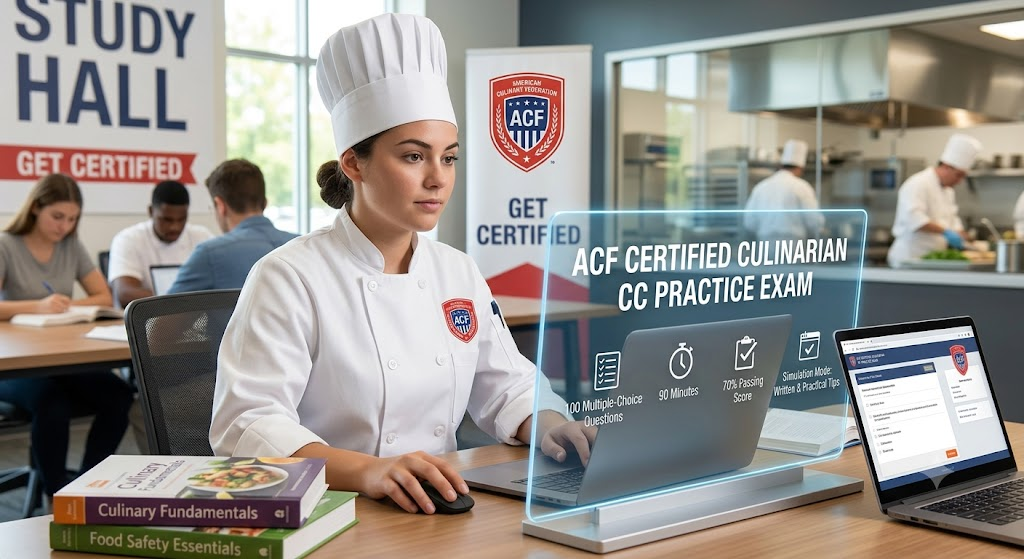
Additional Information
What the Course Entails and Exam Details
The pathway to Certified Culinarian status involves proving both your on-the-job experience and your commitment to foundational culinary education. Candidates generally need either two years of full-time entry-level work experience or to have completed an associate degree or a one-year certificate program in culinary arts. Additionally, the ACF requires documentation of successful completion of three mandatory 30-hour courses in critical areas: Food Safety and Sanitation, Culinary Nutrition, and Supervisory Management. The core competencies covered in this process include fundamental cooking techniques for various proteins, starches, and vegetables; basic baking and pastry methods; recipe conversion and scaling; and the principles of managing a team and understanding dietary guidelines.
What to Expect in the Final Exam
The final challenge to achieving your CC certification consists of two distinct parts: a comprehensive written exam and a hands-on practical exam. You must pass both components to earn the designation.
Written Exam: This part evaluates your theoretical knowledge with a series of 100 multiple-choice questions. It covers all the core educational topics, with a heavy emphasis on food safety, sanitation, nutrition, and kitchen math. You will generally have 90 to 120 minutes to complete this exam, and a minimum passing score of 70% is required.
Practical Exam: The practical exam is a rigorous test of your ability to execute culinary techniques under time pressure and before a panel of evaluators. You will be required to prepare multiple dishes from a set recipe or template, showcasing your proficiency in knife skills, diverse cooking methods, organization, and timing. Scoring is based on the quality of the final product, including taste and presentation, as well as your professionalism, food safety, and efficiency throughout the process.
How to Study and Exam Centers
Preparation is key to conquering both the theoretical and physical demands of this exam. Create a structured study plan that separates the written topics from your practical practice.
Study Strategies and Practice Methods: For the written exam, focus your efforts on the recommended ACF textbooks and online study guides. Utilize practice tests with detailed answer explanations to identify your weak areas and to become familiar with the style of multiple-choice questions you will encounter. Weave active study techniques like creating flashcards for safe temperature zones, recipe conversion formulas, and key culinary terms into your routine. For the practical exam, regular, focused practice is essential. First, master your knife skills—practice precise cuts (like julienne and brunoise) to achieve consistent size and shape. Next, repeatedly cook the items from the practical exam requirements, focusing on improving your organization, mis-en-place, and time management. It is crucial to simulate exam conditions: time yourself while cooking the required meal, and work in a methodical, organized manner, ensuring you follow proper safety and sanitation protocols at all times. If possible, ask a mentor chef to provide feedback on your speed, cleanliness, and the quality of your finished dishes.
Exam Centers: The process of taking the exams has evolved. The written exam is now taken online through the ACF Online Learning Center (OLC). This offers flexibility, as there is no specific geographical location requirement. However, you must have a high-speed internet connection and identify a local proctor—such as a school administrator, human resources manager, an ACF chapter officer, or a local librarian—who will verify your identity and monitor you while you take the test. The practical exam is still conducted in person at an ACF-approved testing facility. These are often culinary schools, community colleges, or large hotel/restaurant kitchens that have been designated as official practical exam sites. You can find a current schedule of upcoming practical exams and lists of approved sites across the country on the ACF’s official certification website.
Job Opportunities from the Course
Becoming an ACF Certified Culinarian unlocks multiple career paths and significantly increases your value to employers in all sectors of the hospitality and food service industry. While it is an entry-level credential, it serves as a robust platform for rapid advancement. Job opportunities that this certification can directly lead to or enhance include:
Prep Cook
Line Cook (Garde Manger, Saucier, Grill, etc.)
Commis Chef
Demi Chef de Partie
Kitchen Supervisor
Food Service Director (especially in institutional settings)
Account Manager for Food and Equipment Sales
With further experience, it paves the way to roles such as Sous Chef, Executive Sous Chef, and eventually, Executive Chef.
This credential is also the foundation for pursuing specialized certifications like Certified Pastry Culinarian (CPC) or higher-level culinary management roles.
Frequently Asked Questions
Reviews
5.0
Based on 0 reviews
Leave a Review
No reviews yet. Be the first to review!