
Accuplacer Reading Practice Test 2026
$69.00
- Buy to unlock unlimited access to all Quiz questions.
- After purchase you can print a PDF of the whole quiz at any point. The PDF will contain the questions and the correct answers.
About this Exam
The Accuplacer Reading test is a critical component of the College Board's assessment suite, widely used by colleges and universities to place incoming students into appropriate courses. This computer-adaptive test isn't designed for pass-fail purposes but rather to measure a student's reading comprehension skills across various text passages. For students and continuing education learners looking to enter higher education programs, performing well on this exam ensures they start their academic journey in the right reading-intensive composition or critical thinking classes. This article provides essential insights into preparing for and succeeding in the Accuplacer Reading practice exam, helping students approach the actual placement test with confidence.
Ready to test your knowledge?
Buy Now to Access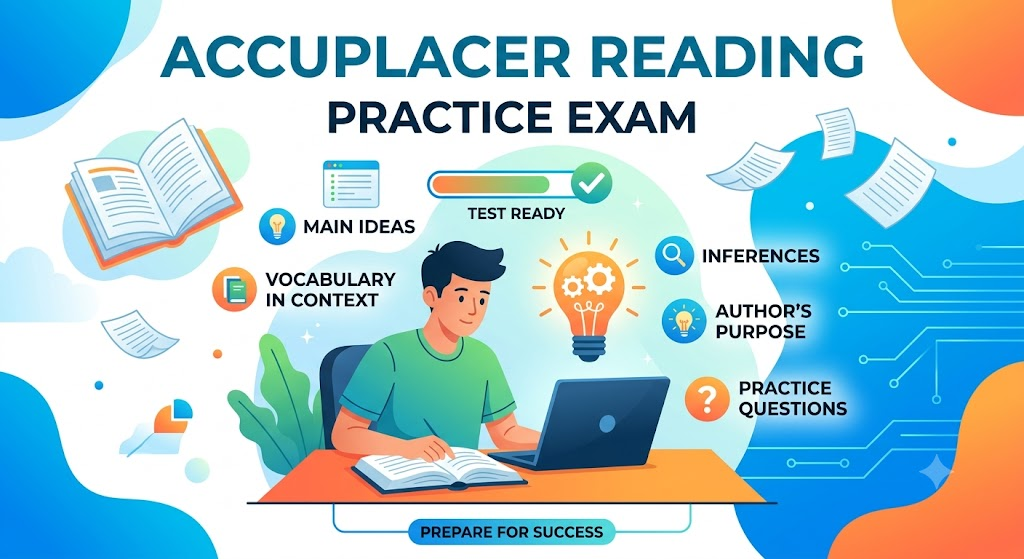
Additional Information
What the Course Entails and Exam Details
While the Accuplacer itself is not a traditional course with a syllabus, students preparing for the reading section will encounter content that measures a specific set of critical thinking and analytical reading skills. The exam covers four key areas. First, it assesses the ability to identify the main idea and supporting details within short and long passages. Second, it evaluates comprehension of explicit statements and details, and the ability to infer implicit meanings or perspectives. Third, students must demonstrate a strong command of vocabulary in context, understanding how words function within specific sentences. Finally, the test requires analyzing the author's purpose, tone, and the structure of arguments. Passage topics include literary fiction, essays, social studies, and natural science texts. Understanding these core skills is paramount to effective preparation.
What to Expect in the Final Exam
The Accuplacer Reading exam has several unique characteristics. First, it is computer-adaptive, meaning the difficulty of subsequent questions adjusts based on a student's previous answers, aiming to pinpoint their precise reading level efficiently. Students can typically expect to answer 20 to 25 multiple-choice questions. A crucial detail for many testers is that the exam is untimed, allowing for thorough reading and analysis without immediate time pressure, though this approach still encourages focused work. Scoring does not use traditional letter grades or "pass/fail" results. Instead, students receive a scaled score (usually between 200 and 300), which institutions use to determine placement into specific college-level reading or prerequisite courses. Strict rules exist for the testing environment, generally prohibiting outside resources like dictionaries, and ensuring a secure, proctored setting.
How to Study and Exam Centers
Effective preparation for the Accuplacer Reading section requires dedicated practice and targeted skill development.
First, engaging with official practice questions and practice exams from the College Board or reputable educational resources is essential. This helps students familiarize themselves with the question formats, text types, and computerized adaptive testing experience. Accuplacer practice tests are excellent tools for identifying weak areas.
Second, consistent reading of high-level materials, such as news articles, scholarly journals, and literature, can significantly improve comprehension speed and accuracy. Working on vocabulary expansion through context clues is another vital study habit.
Third, students should practice identifying key arguments, supporting evidence, and main ideas within varied texts, simulating the analytical process required during the actual exam.
To take the exam, students generally must register through the college or university they plan to attend. Most institutions use their own on-campus assessment centers to administer the computer-based Accuplacer tests, providing proctored environments and necessary resources. Some colleges may also offer remote testing options through approved third-party services, allowing students to take the exam securely from an authorized location, but physical test centers at the school remain the primary location.
Job Opportunities from the Course
While the Accuplacer Reading placement test itself is not a certification that leads directly to specific job titles, achieving a strong score allows students to enroll in appropriate college composition, communications, and critical thinking courses. Successfully completing a degree program sets the stage for numerous professional paths that heavily rely on advanced reading comprehension skills. Career opportunities often accessible after building these foundational abilities through college education include:
Writer and Author
Editor and Content Manager
Journalist and Reporter
Lawyer and Legal Assistant
Paralegal
Marketing and Communications Specialist
Market Research Analyst
Technical Writer
Educator (especially English, History, or Social Studies)
Librarian and Information Professional
A strong performance on the Accuplacer Reading assessment is a vital first step toward excelling in academic environments, which ultimately leads to diverse and rewarding career paths requiring sophisticated communication and analysis.
Frequently Asked Questions
Reviews
5.0
Based on 0 reviews
Leave a Review
No reviews yet. Be the first to review!