
ACCA Financial Management (F9) Certification Practice Exam
$69.00
- Buy to unlock unlimited access to all Quiz questions.
- After purchase you can print a PDF of the whole quiz at any point. The PDF will contain the questions and the correct answers.
About this Exam
The ACCA Financial Management (F9) certification is a vital milestone within the ACCA Applied Skills level, designed for aspiring finance professionals, accountants, and finance managers. It aims to equip individuals with the knowledge and practical skills required to make sound financial management decisions that contribute to organizational success.
This exam focuses on the essential principles and techniques that underpin financial management, preparing students to analyze investments, manage corporate risk, manage working capital, and understand the cost of capital. By simulating real-world scenarios and testing core competencies, this exam validates a candidate's ability to act as an effective financial manager or advisor within an organization. It is ideal for accounting trainees, financial analysts, and anyone moving into a corporate finance role.
The ACCA F9 exam is a stepping stone to senior financial positions, validating that the candidate has the necessary theoretical understanding and practical acumen required in today's dynamic financial landscape. The successful candidate understands how to manage capital, evaluate project viability, and navigate the complex financial environments of modern business.
Ready to test your knowledge?
Buy Now to Access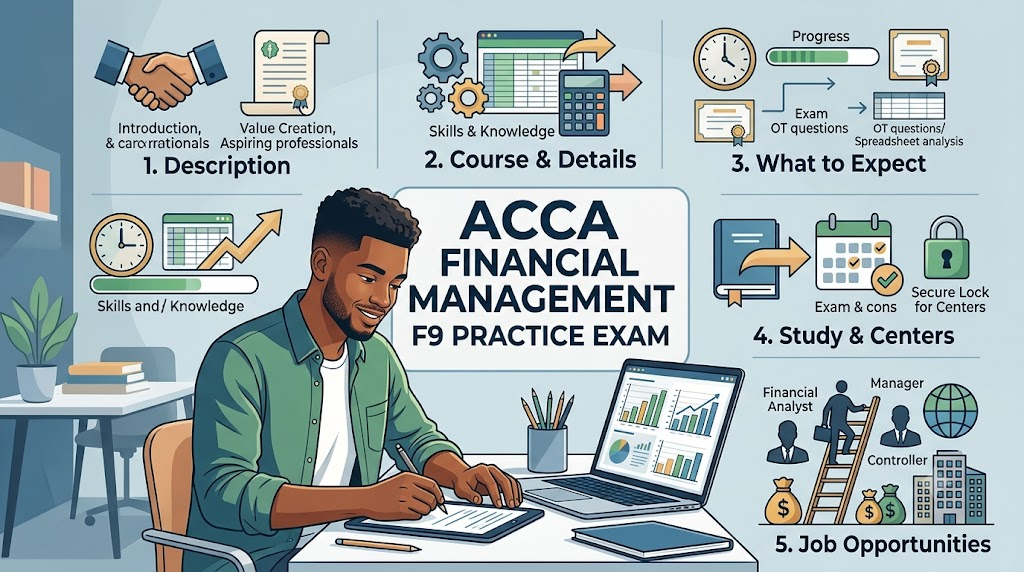
Additional Information
What the Course Entails and Exam Details
The ACCA Financial Management (F9) syllabus is structured across several key areas that form the foundation of effective corporate financial management. The course content is comprehensive and covers both theoretical frameworks and practical applications.
The specific topics covered are:
A: Financial Management Function: Understanding the role of the financial manager, the relationship with key stakeholders, and the overall context of financial management within a business.
B: Financial Management Environment: Knowledge of the various markets, institutions, and environments in which a financial manager operates.
C: Working Capital Management: Techniques for managing an organization's short-term assets and liabilities (cash, inventory, accounts receivable, and accounts payable).
D: Investment Appraisal: Methods for evaluating capital investment projects, including Net Present Value (NPV), Internal Rate of Return (IRR), Payback Period, and Accounting Rate of Return (ARR).
E: Business Finance: Understanding sources of finance, including debt and equity, and their implications.
F: Cost of Capital: Techniques for calculating and using the cost of capital for investment decisions.
G: Business Valuations: Methods and rationale for valuing businesses, including assets, income, and cash flow models.
H: Risk Management: Identifying, evaluating, and managing financial risks, particularly foreign exchange and interest rate risk.
The exam focuses heavily on numerical applications, calculation skills, and strategic interpretation. The syllabus blends fundamental financial theory with practical decision-making required in corporate settings.
What to Expect in the Final Exam
The actual ACCA Financial Management (F9) exam is a computer-based assessment (CBE) known for its rigorous testing and application of knowledge. Students should prepare for a demanding assessment that tests both computational skills and the ability to interpret and apply financial data to various business situations. The format includes:
Structure: The exam is 3 hours long. It consists of multiple-choice and multi-part questions (Case Study scenarios).
Sections: The exam generally has two main sections:
Section A: Typically contains 15 multiple-choice questions, worth 2 marks each, for a total of 30 marks.
Section B: Contains three case study scenarios, with five objective test questions (2 marks each) for each scenario, totaling 30 marks. These focus on practical application and computational skills based on the context.
Section C: Contains two larger questions, each worth 20 marks, that require extensive numerical calculation and interpretation (written and/or computational) based on specific scenarios.
Question Types: Includes traditional multiple-choice, input numbers/dates, dropdown selections, multiple response, hot spot, and hot area questions, along with larger written/computational tasks.
Passing Score: The pass mark is 50%.
Resources: Candidates are provided with basic data tables (tax tables, annuity tables, discount factor tables) and are permitted a non-programmable calculator. The entire exam is typically conducted online through a secure testing platform. There is no open-book element.
Candidates must be adept at both calculation and analysis, as well as being able to present their findings and justifications clearly, especially in Section C. Managing time effectively across the multiple sections is critical.
How to Study and Exam Centers
Successfully passing the ACCA F9 exam requires a combination of systematic study, practical application, and strategic exam technique. A dedicated and structured study plan is crucial. Here are proven strategies:
Study Strategies:
Use Approved Study Materials: Start with official ACCA approved learning materials, including study texts, revision kits, and practice papers from publishers like Kaplan or BPP. These ensure all syllabus areas are comprehensively covered.
Understand the Syllabus: Carefully review the entire syllabus to grasp the depth and breadth required. Do not skip smaller topics, as they can appear across various question types.
Focus on Practice: Numerical calculation is a huge part of F9. Practicing as many exam-standard questions as possible from past papers, study kits, and revision tools is essential. Focus heavily on practice exams and simulated question banks.
Apply to Scenarios: Practice interpreting financial data and applying formulas to a diverse range of business case scenarios, not just memorizing equations.
Time Management: When practicing full mock exams, always time yourself strictly to mimic exam conditions and practice allocating your time across the different sections.
Review and Self-Assessment: After each practice session or mock exam, carefully review the provided answers and marking schemes. Identify your mistakes and areas of weakness to focus subsequent study efforts.
Join Study Groups: Consider joining online or local ACCA study groups to discuss concepts and share tips with other candidates.
Exam Centers: The final ACCA F9 exam is administered as a dynamic CBE and must be taken at registered ACCA exam centers.
Exam Availability: Exams are typically available in specific sessions throughout the year (e.g., quarterly, in March, June, September, and December).
Registered Exam Centres: ACCA has a global network of registered CBE centers. These are typically Pearson VUE test centers or authorized college and university settings equipped with the necessary computer facilities and invigilation standards.
Online and Alternative Centres: In response to demand and environmental changes, ACCA has introduced remote invigilation (remote CBE), allowing students to take exams in suitable, pre-approved locations, including from home. However, availability and conditions are subject to ACCA guidelines. Physical centers are still the primary option for most.
How to Book: Candidates must book their exam date and choose a specific testing center (physical or remote, if applicable) well in advance through their online ACCA account. Be mindful of deadlines and availability, especially for popular centers and dates. All instructions, confirmation details, and requirements will be clearly stated on the ACCA website and during the booking process.
Job Opportunities from the Course
A strong performance in the ACCA Financial Management (F9) exam, along with eventual ACCA qualification, significantly boosts a candidate's profile and opens diverse and lucrative career opportunities in corporate finance and accounting. This certification signals to employers a high level of proficiency and strategic understanding in financial management. Here is a list of job titles and career paths directly accessible or strongly enhanced by this certification:
Financial Manager / Corporate Finance Manager
Financial Analyst / Investment Analyst
Accounting Manager / Controller
Working Capital Manager
Risk Management Analyst / Financial Risk Analyst
Business Analyst (Finance focus)
Project Manager (Finance / Capital Projects)
Taxation Specialist (Finance context)
Auditor (Internal / External)
Treasury Manager / Assistant Treasurer
Management Consultant (Finance specialization)
Investment Banker (Analyst / Associate level)
Finance Director (with significant experience)
Chief Financial Officer (CFO - with significant experience)
This list is just a starting point. The skills acquired are universally applicable across industries and open doors in multinational corporations, small to medium-sized enterprises, non-profit organizations, and government entities.
Frequently Asked Questions
Reviews
5.0
Based on 0 reviews
Leave a Review
No reviews yet. Be the first to review!