
ACCA Corporate and Business Law (F4) Certification Practice Exam
$69.00
- Buy to unlock unlimited access to all Quiz questions.
- After purchase you can print a PDF of the whole quiz at any point. The PDF will contain the questions and the correct answers.
About this Exam
The Association of Chartered Certified Accountants (ACCA) offers the Corporate and Business Law (F4) certification, a vital component for those pursuing the full ACCA qualification. This exam serves as a bridge between the general legal environment and the business world, focusing specifically on legal principles critical to accountants and business professionals. It is designed for students seeking global recognition in accounting and finance who need to understand the legal frameworks that govern business operations. By obtaining this qualification, candidates demonstrate their competence in identifying key legal implications within corporate and business contexts.
Ready to test your knowledge?
Buy Now to Access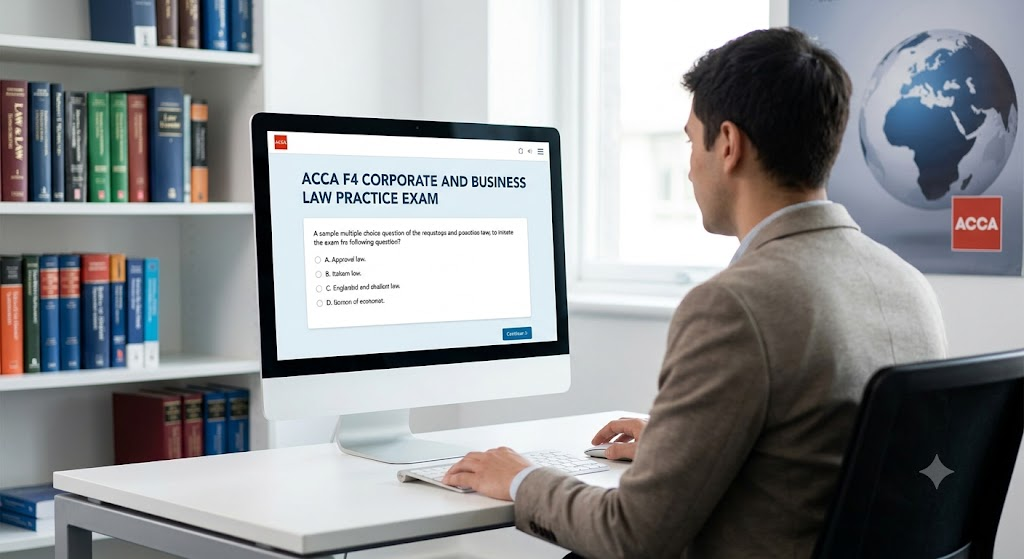
Additional Information
What the Course Entails and Exam Details
The ACCA Corporate and Business Law (F4) syllabus is comprehensive, providing a solid foundation in business law without deep diving into complex, specialist areas. The exam is divided into sections, typically assessing the following core areas:
Essential Elements of the Legal System: This foundational part covers the distinction between common law and statute law, the court structure, and legal professionals.
The Law of Obligations: This includes the formation of contracts, contract terms, performance and breach, remedies for breach of contract, and the law of tort, with a particular focus on negligence.
Employment Law: Key aspects of employment relationships, statutory rights of employees, and the termination of employment are covered.
The Formation and Constitution of Business Organizations: This area examines different business structures (e.g., sole traders, partnerships, and companies), the process of company formation, and the legal personality of companies.
Capital and the Financing of Companies: Topics include legal implications of share and loan capital, and rules relating to distributions of profit.
Management, Administration, and the Regulation of Companies: This covers the roles, powers, duties, and liabilities of company directors and other officers, and corporate governance.
Implications of Companies in Difficulty or in Crisis: Key concepts related to company voluntary arrangements, administrations, and liquidations.
Governance and the Ethical and Professional Responsibilities of Directors: Focuses on ethical behavior and legal duties, particularly relevant to accountants and advisors.
What to Expect in the Final Exam
The ACCA Corporate and Business Law (F4) exam is a two-hour Computer Based Exam (CBE). It consists of objective test questions, designed to assess understanding of legal principles rather than detailed case study application. The exam is out of 100 marks, with a pass mark of 50%. The structure often includes the following types of questions:
Multiple Choice Questions (MCQs)
Multiple Response Questions
Fill-in-the-blank questions (e.g., key legal terms or numbers)
Matching questions
True/False questions
Students are evaluated on their knowledge across the entire syllabus. Questions typically present practical scenarios requiring the application of relevant legal principles. There are no computational elements or detailed case studies expected. The computer-based format provides instant results upon completion in most centers.
How to Study and Exam Centers
Effective preparation for the ACCA F4 exam is critical for success. Consider the following strategies:
Utilize Approved Materials: Use official ACCA learning materials, study texts, and practice and revision kits from approved learning providers. These sources are aligned with the syllabus.
Focus on Key Terms: Law relies heavily on precise definitions. Master legal terminology and the core rules associated with each section.
Practice with Mock Exams: Take official ACCA mock exams. This helps get accustomed to the CBE format and time management, simulating the actual exam environment.
Create Structured Notes: Summarize complex legal concepts into bullet points, flowcharts, or mind maps for better retention and review.
Focus on Application: Understand how legal principles apply to business scenarios rather than simply memorizing them.
The ACCA F4 exam is predominantly administered through Computer Based Exam (CBE) centers globally. Students can book exams through specific ACCA-approved learning providers, designated computer-based exam centers, or recognized schools that are official centers. It is essential to check the ACCA website for the latest availability and location of approved exam centers in your region. Remote invigilation options may be available depending on the location and timing, so students are advised to confirm the current policy.
Job Opportunities from the Course
A strong understanding of corporate and business law is highly valued across various industries. While this exam is part of the full ACCA qualification, completing it enhances a candidate's profile for roles including:
Financial Accountant: Interpreting legal requirements for financial statements.
Management Accountant: Providing legal context for strategic decisions.
Auditor (Internal and External): Assessing legal compliance and governance risks.
Compliance Officer: Ensuring organizations adhere to legal regulations.
Business Analyst: Considering legal factors in market analysis and growth strategies.
Risk Manager: Identifying and mitigating legal risks associated with business operations.
Corporate Secretarial Professional: Managing company law requirements and regulatory compliance.
Company Director or Officer: Leading with an understanding of statutory duties and liabilities.
Completing the ACCA Corporate and Business Law (F4) certification demonstrates a practical command of the essential legal principles that shape the modern corporate landscape, opening doors to diverse and rewarding career paths.
Frequently Asked Questions
Reviews
5.0
Based on 0 reviews
Leave a Review
No reviews yet. Be the first to review!