
Academic Challenge Practice Test
$69.00
- Buy to unlock unlimited access to all Quiz questions.
- After purchase you can print a PDF of the whole quiz at any point. The PDF will contain the questions and the correct answers.
About this Exam
Welcome to the ultimate guide for mastering the Academic Challenge Practice Test. This comprehensive resource is designed specifically for ambitious students eager to excel in this rigorous academic assessment. Whether you are preparing for regional competitions, state-level finals, or a national championship, understanding the structure and content of the Academic Challenge is your first step toward victory. This exam evaluates a student's comprehensive knowledge across core subjects, testing quick recall, critical thinking, and the ability to synthesize information under pressure. It is designed for high-achieving students who thrive on intellectual competition and are ready to prove their academic prowess on a larger stage.
Ready to test your knowledge?
Buy Now to Access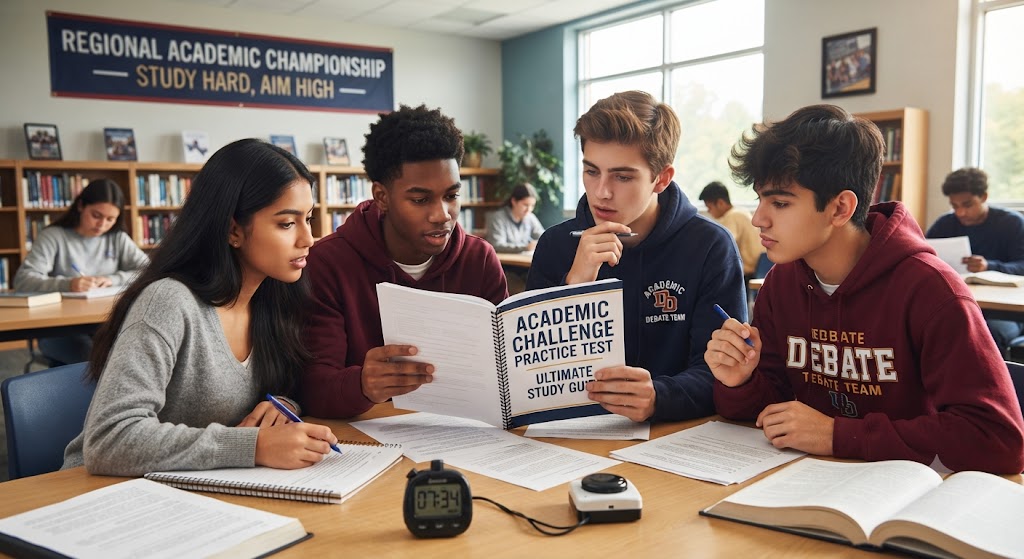
Additional Information
What the Course Entails and Exam Details
The Academic Challenge is not defined by a single textbook;
rather, it encompasses the broad spectrum of a rigorous middle or high school
curriculum. While specific topics may vary slightly by the organizing body, the
core curriculum generally focuses on six main categories: Mathematics
(including Algebra, Geometry, and statistics), Science (Biology, Chemistry,
Physics, and Earth Science), Language Arts (Grammar, Literature, Vocabulary,
and literary analysis), Social Studies (World History, U.S. History, Geography,
and Government), Fine Arts (Music theory, Art history, and cultural studies),
and Potpourri (Current events, computer science, and general knowledge). The
practice test reflects this diversity, presenting questions that range from
factual recall to complex problem-solving. Success requires a broad knowledge
base and the ability to make rapid connections between seemingly unrelated
concepts.
What to Expect in the Final Exam
The final Academic Challenge exam is typically a fast-paced,
multi-round competition, often utilizing a quiz-bowl format. Individual written
preliminary rounds may precede the main event to determine team seeding or
individual advancement. In the main competition, students face rapid-fire oral
questions, usually answered by buzzing in before the opposing team or
individual. The exam tests not only what you know but how fast
you can retrieve that information. Points are awarded for correct answers
within a strict time limit (often 5-10 seconds), with penalties for
interrupting the question or answering incorrectly. Perfecting the practice
test under timed conditions is crucial to building the mental stamina and
quick-reflex skills required for the actual competition environment.
How to Study and Exam Centers
Preparing for the Academic Challenge requires a strategic
and disciplined approach. Cramming is ineffective; instead, focus on
consistent, broad-based review. Effective study strategies include using
flashcards for rapid recall of key facts (dates, formulas, authors), reviewing
previous years' competition questions, and forming study groups to practice
buzzer techniques. Familiarize yourself with common question patterns and
frequently recurring topics. Utilize reputable online resources, academic quiz
databases, and subject-specific review books. Regarding exam centers and
registration, the Academic Challenge is typically administered through
participating schools, regional educational service centers, or specific
hosting universities. Consult your school's academic coach, gifted coordinator,
or the official Academic Challenge organizing committee website for specific
registration deadlines, practice test availability, and the location of your
designated regional competition site.
Job Opportunities
from the Course
While the Academic Challenge itself is a competition rather
than a certification that directly confers a job title, the skills and
discipline developed through rigorous preparation unlock numerous prestigious
career paths. Success in this arena demonstrates exceptional intellectual
capability, rapid information processing, effective teamwork, and high-pressure
performance—qualities highly sought after by top universities and employers.
Excelling in the Academic Challenge can pave the way toward future careers as a
Physician or Surgeon, Research Scientist, Software Engineer, Attorney,
Economist, University Professor, or any field requiring advanced analytical
skills and a broad knowledge foundation. The journey begins with dedicated
practice.
Frequently Asked Questions
Reviews
5.0
Based on 0 reviews
Leave a Review
No reviews yet. Be the first to review!