
Academic Block 2 – Systems 1 (SY190), UPT 2.5 Practice Test
$69.00
- Buy to unlock unlimited access to all Quiz questions.
- After purchase you can print a PDF of the whole quiz at any point. The PDF will contain the questions and the correct answers.
About this Exam
Welcome to the comprehensive guide for the Academic Block 2 – Systems 1 (SY190) exam, a critical milestone in the UPT 2.5 (Undergraduate Pilot Training) curriculum. This rigorous examination is designed specifically for Student Naval Aviators (SNAs) and Air Force student pilots currently undergoing primary flight training. It serves as the foundational academic assessment for understanding the complex architecture and emergency procedures of the primary training aircraft. Passing this exam is mandatory for progression to the subsequent phases of flight training, ensuring that every aviator possesses the necessary systems knowledge to operate the aircraft safely and effectively in both routine and high-pressure scenarios.
Ready to test your knowledge?
Buy Now to Access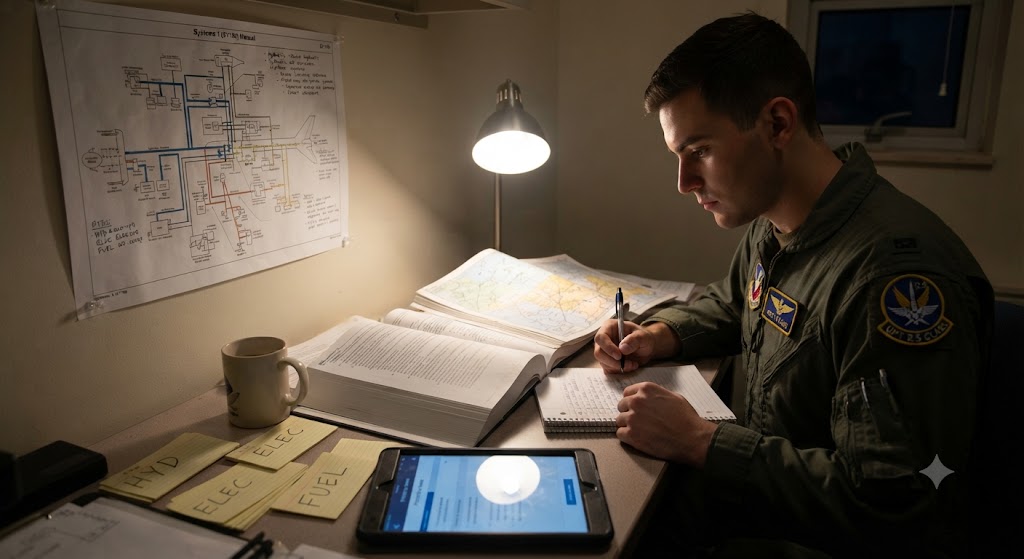
Additional Information
What the Course Entails and Exam Details
The SY190 Systems 1 course delves deeply into the anatomy of
the assigned training aircraft. This module moves beyond basic familiarization,
requiring students to master the intricate workings of all major aircraft
systems. The curriculum typically covers the Electrical Power Supply and
Distribution Systems, Hydraulic Systems, Fuel Systems, Powerplant (Engine)
Operation, Landing Gear and Braking Systems, Flight Control Systems,
Environmental Control Systems (ECS), and the complex Avionics and Navigation
suites. The exam itself rigorously tests a student's ability to recall specific
facts, understand system interdependencies, and apply this knowledge to
diagnose malfunctions presented in written scenarios.
What to Expect in the Final Exam
The Academic Block 2 – Systems 1 exam is a high-stakes,
proctored assessment administered via the military’s secure testing network or
authorized testing centers. The format is predominantly multiple-choice,
designed to test both rote memorization of critical limits and operational
knowledge of system theory. You should anticipate questions that require you to
identify the immediate "Boldface" (critical memory) actions
associated with specific in-flight emergencies, as well as questions that test
your understanding of the "Clean-up" (supplemental) actions. A
passing score, typically 90% or higher, is strictly enforced, reflecting the
zero-defect mentality required in naval and air force aviation. There is a
strict time limit, usually allowing approximately one minute per question, necessitating
rapid recall and efficient test-taking strategies.
How to Study and
Exam Centers
Success in SY190 requires a disciplined and multifaceted
study approach. Begin by thoroughly reviewing the official Flight Training
Instructions (FTIs) and systems manuals; these are the source documents for all
exam questions. Active recall is essential: utilize flashcards for memorizing
limitations, warning lights, and emergency procedures. Group study is highly
effective; practice explaining complex systems to your peers to identify gaps
in your own understanding. Furthermore, utilizing a high-quality UPT 2.5
Practice Test is crucial. These practice tests simulate the format, difficulty,
and time constraints of the actual exam, allowing you to gauge your readiness
and identify areas requiring further review. The final exam is administered in
a designated, secure academic testing facility on base, monitored by authorized
proctors. Ensure you are familiar with the testing center's regulations
regarding identification and prohibited items.
Job Opportunities
from the Course
While the Academic Block 2 – Systems 1 exam is an internal
milestone within the military flight training pipeline, passing it is the
gateway to a rewarding career as a military aviator. This certification
validates the foundational knowledge required to proceed through advanced
training and ultimately earn your "Wings of Gold" or Air Force
aeronautical rating. Successful completion of UPT 2.5 and follow-on advanced
training pipelines unlocks diverse and challenging career paths across the
Naval Air Force and Air Force, including roles as a Fixed-Wing Multi-Engine
Pilot, Jet Fighter Pilot, Rotary-Wing (Helicopter) Pilot, or Electronic Warfare
Officer. This rigorous academic training is the first step toward commanding
advanced aircraft and serving as a commissioned officer in the world's premier
air services.
Frequently Asked Questions
Reviews
5.0
Based on 0 reviews
Leave a Review
No reviews yet. Be the first to review!