
ACA Corporate Reporting Practice Exam
$69.00
- Buy to unlock unlimited access to all Quiz questions.
- After purchase you can print a PDF of the whole quiz at any point. The PDF will contain the questions and the correct answers.
About this Exam
The ACA (Associate Chartered Accountant) qualification, awarded by the ICAEW (Institute of Chartered Accountants in England and Wales), is globally recognized as a premier designation in accountancy and finance. The ACA Corporate Reporting module is a Advanced Level exam, representing one of the final hurdles in the qualification process. It is designed for ambitious finance professionals who are aiming for senior leadership, advanced advisory roles, or technical specialist positions. This exam tests your ability to synthesize complex information, apply technical knowledge to intricate scenarios, and exercise professional judgment in financial reporting.
Ready to test your knowledge?
Buy Now to Access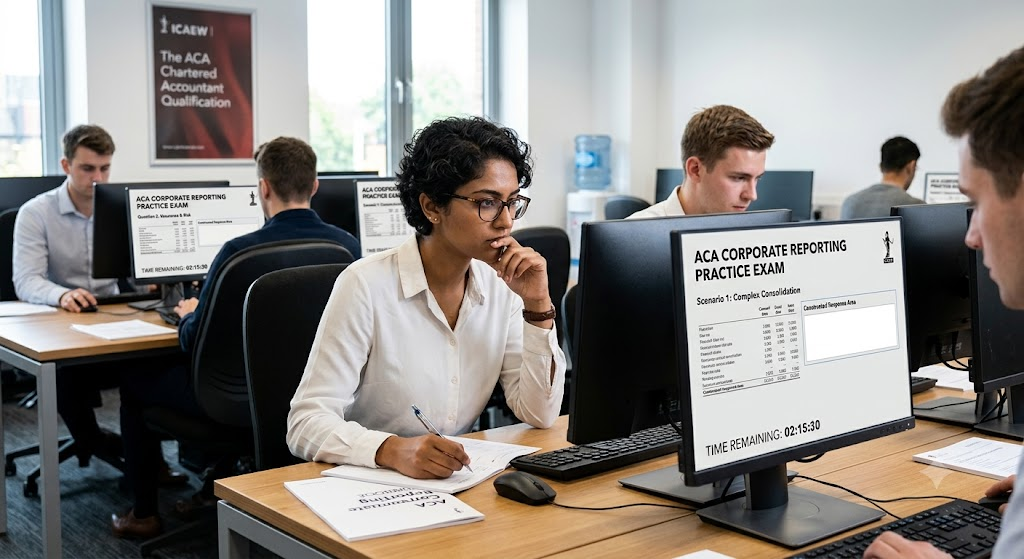
Additional Information
What the Course Entails and Exam Details
The Corporate Reporting module dives deep into advanced financial reporting, encompassing both complex technical applications and strategic considerations.
The syllabus covers several core technical areas:
Financial Statement Analysis: Mastering the preparation and critical interpretation of complex financial statements for single entities and groups, including consolidated accounts involving foreign subsidiaries, associates, and joint ventures.
Corporate Reporting Frameworks: An in-depth application of International Financial Reporting Standards (IFRS), including specialized standards on revenue recognition, financial instruments, leases, and employee benefits.
Professional Ethics: Navigating complex ethical dilemmas in financial reporting, applying ICAEW's Code of Ethics to maintain public trust.
Current Issues: Understanding emerging trends, exposure drafts, and recent developments in standard-setting, and their practical implications for corporate reporting.
Evaluation and Strategic Advice: Moving beyond computation to evaluate accounting policies and provide strategic advice to stakeholders based on a deep understanding of corporate performance.
This is an open-book exam, but students are limited to the permitted texts (the relevant IFRS blue books) and must demonstrate efficiency and critical reasoning, not just retrieval.
What to Expect in the Final Exam
The ACA Corporate Reporting final exam is renowned for being challenging and demanding of technical competence.
Format: The exam consists of two to three main questions, which are typically based on complex, detailed case studies or scenarios. These require candidates to integrate multiple technical topics to form a coherent solution. There are no simple multiple-choice questions; every answer requires extensive numerical calculation and critical written analysis.
Time Limit: You will have 3.5 hours to complete the exam. While this may sound substantial, the time is often the biggest pressure point, given the length of the scenarios and the complexity of the requirements.
Passing Score: The passing mark for the ACA Advanced Level, including Corporate Reporting, is usually 50%. It is important to note that achieving 50% on these advanced exams often requires significantly more comprehensive and well-justified responses than at the Professional Level.
How to Study and Exam Centers
Effective preparation is essential for success in Corporate Reporting.
Master the Technical: Start early. Dedicate significant time to thoroughly studying the study manuals provided by your training provider. Build a strong foundation in complex IFRS standards and group accounts. Practice applying standards to small examples before moving to complex questions.
Past Papers and Question Bank: This is the single most critical study strategy. Practice as many past papers and Question Bank questions as possible under timed conditions. Pay attention to how the marking schemes allocate marks. Learn how to draft concise, well-structured, and technically accurate responses that answer the specific question asked.
Mastering the Open Book: You must know your IFRS manuals inside out. Flag key pages and understand where to find answers efficiently. The exam is not about learning IFRS during the 3.5 hours; it's about referencing and applying it accurately and quickly.
Exam Technique: Time management is vital. Practice dividing your time appropriately based on the marks available. Ensure you address every part of the question.
Exam Centers and Booking:
You must book the exam directly through your ICAEW student account portal. When booking, you will have several options for locations, which are facilitated via Pearson VUE:
Physical Testing Centers: Pearson VUE operates a large network of authorized, secure testing centers across the UK and internationally in most major cities.
Authorized School or Employer: In some cases, major accountancy firms or specific training schools are authorized to host ACA exams for their own students. Check with your training contract or employer.
Remote Invigilation: ICAEW does offer remote invigilation for many Advanced Level exams, allowing you to take the test securely at home or a private office, provided you meet strict technical and environmental requirements.
Job Opportunities from the Course
Successfully completing the ACA qualification, with the mastery demonstrated in Corporate Reporting, unlocks elite career opportunities across the globe. Some key job titles and career paths include:
Senior Financial Controller: Overseeing the entire accounting function for major multi-national corporations.
Group Reporting Manager: Responsible for consolidating the financial statements of complex global groups.
Audit Senior Manager or Director: Leading large-scale audits of public interest entities.
Technical Accounting Specialist: Providing advanced IFRS advisory services within a Big 4 or large advisory firm.
Finance Director (FD) or Chief Financial Officer (CFO): Reaching the highest level of executive leadership within a corporation.
Investment Banker: Applying deep financial analysis skills in corporate finance and M&A.
Financial Analyst or Equity Researcher: Utilizing complex valuation and analysis for institutional investors.
Frequently Asked Questions
Reviews
5.0
Based on 0 reviews
Leave a Review
No reviews yet. Be the first to review!