
ABYC Marine Corrosion Certification Practice Exam
$69.00
- Buy to unlock unlimited access to all Quiz questions.
- After purchase you can print a PDF of the whole quiz at any point. The PDF will contain the questions and the correct answers.
About this Exam
The ABYC Marine Corrosion Certification is a prestigious credential designed for dedicated marine professionals who possess a strong foundation in marine technology, typically requiring a minimum of three to five years of practical experience. This certification is intended for marine technicians, installers, surveyors, and other industry specialists seeking to master the complexities of understanding, preventing, and mitigating corrosion on recreational and commercial vessels. The course and final exam assume foundational knowledge, often recommending or strongly encouraging the completion of the ABYC Marine Electrical Certification, as electrical systems are intricately linked to corrosion. By earning this certification, you demonstrate to employers and clients a high level of expertise in a critical aspect of boat safety and longevity.
Ready to test your knowledge?
Buy Now to Access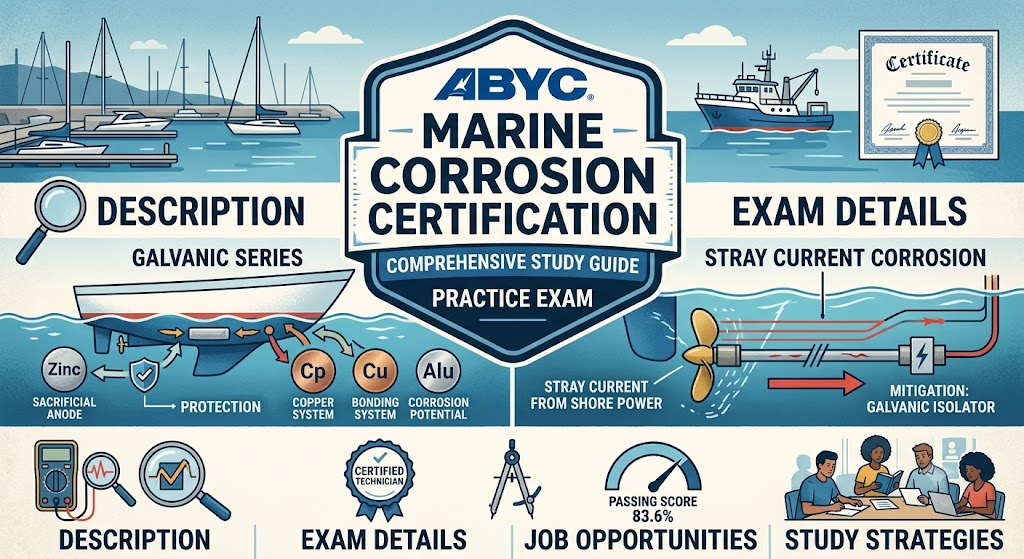
Additional Information
What the Course Entails and Exam Details
The comprehensive certification course covers a wide spectrum of essential topics, combining theoretical knowledge with practical applications and a review of crucial industry standards. Key areas of study include:
Foundational Science: Understanding atomic theory, chemistry basics, pH, and electrochemical reactions in the marine environment.
The Galvanic Series: Deep analysis of the relative potential of various metals in seawater and how it predicts galvanic corrosion.
Corrosion Types: Differentiating single-metal, galvanic, crevice, pitting, stray-current (electrolytic), erosion, and other specialized forms of corrosion.
Mitigation Strategies: Learning to implement effective prevention, including cathodic protection systems (sacrificial anodes and impressed current), protective coatings, and material selection.
ABYC Standards Review: A specific and deep-dive review of key standards, including ABYC E-2 (Cathodic Protection), A-28 (Galvanic Isolators), E-11 (AC and DC Electrical Systems), and T-1 (Aluminum Applications).
Conducting a Corrosion Survey: Mastering step-by-step procedures for identifying, analyzing, and reporting corrosion risks on a vessel, and analyzing real-world case studies.
What to Expect in the Final Exam
The final certification exam is designed to be rigorous and comprehensive, validating your expertise against the curriculum and ABYC Standards. The current exam consists of approximately 189 multiple-choice questions, which must be completed within a timed 3.5-hour period. To earn the certification, you must achieve a minimum passing score of 83.6%. The content is typically weighted, with roughly 15% focusing directly on standard-based questions and 85?ing experiential, testing your ability to apply concepts to real-world marine corrosion scenarios. It is generally a closed-book exam, so thorough preparation is essential.
How to Study and Exam Centers
Effective preparation is key to succeeding on the ABYC Marine Corrosion Certification exam. The official ABYC Marine Corrosion Study Guide is considered an indispensable resource and is typically included with course registration or can be purchased for self-study. Actionable study strategies include:
Reviewing Class Materials: If taking a live or online-demand course, thoroughly review all lecture notes, handouts, and recorded sessions.
Practicing Standards Application: Get familiar with how to locate and interpret the specific requirements of ABYC Standards E-2, A-28, E-11, and T-1.
Chapter Quizzes: Leverage the quizzes available with official ABYC online courses to test your retention and understanding of each chapter.
Formative and Practice Tests: While there isn't a single, official, free full-length 'practice exam' provided by ABYC, some online platforms and training organizations offer preparatory quizzes, pre-tests, and simulation questions to help identify areas of weakness.
The actual certification exam can be taken through flexible online third-party proctoring services, allowing you to schedule a convenient time within a designated testing window. This offers flexibility to test from anywhere with a stable internet connection. Alternatively, some physically designated testing centers and authorized schools also offer proctored ABYC exams.
Job Opportunities from the Course
Earning the ABYC Marine Corrosion Certification unlocks a variety of specialized and well-regarded career paths in the marine industry. Professionals with this credential are in high demand to ensure boat safety, compliance, and reduced maintenance costs. The certification opens doors to roles such as:
Marine Corrosion Technician / Corrosion Specialist
Marine Systems Technician
Marine Surveyor (Corrosion Specialist)
Marina Service Manager
Boat Builder Quality Control Specialist
Yacht Restoration Project Manager
Marine Claims Adjuster
Authorised Manufacturer Service Provider
Corrosion Advisor
Frequently Asked Questions
Reviews
5.0
Based on 0 reviews
Leave a Review
No reviews yet. Be the first to review!