
ABYC Air Conditioning & Refrigeration Certification Practice Exam.
$69.00
- Buy to unlock unlimited access to all Quiz questions.
- After purchase you can print a PDF of the whole quiz at any point. The PDF will contain the questions and the correct answers.
About this Exam
The ABYC Air Conditioning & Refrigeration Certification is a premier, nationally recognized credential for marine service professionals. It validates a technician’s expertise in installing, troubleshooting, and repairing both AC and DC electrical systems specifically for marine refrigeration, air management, related plumbing, and mechanical components, including reverse-cycle A/C systems.
This certification is designed for marine technicians, installers, marine surveyors, and fleet maintenance personnel. It is widely considered the gold standard for demonstrating competency in applying ABYC Standards to keep passengers comfortable and vessel systems operating safely.
Ready to test your knowledge?
Buy Now to Access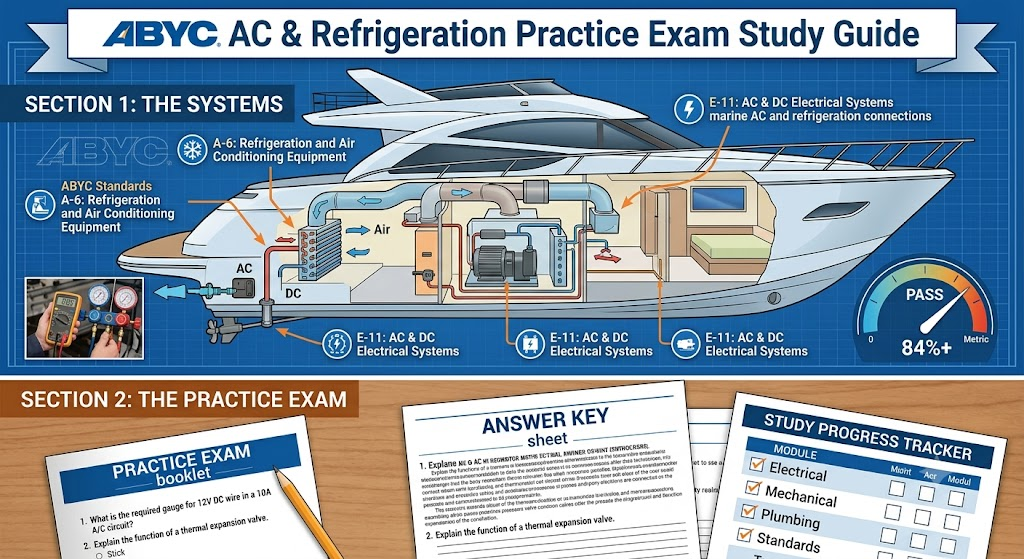
Additional Information
What the Course Entails and Exam Details
The path to certification generally involves a comprehensive study course (available in various formats) that covers a blend of technical knowledge and practical application, all referenced against the strict ABYC Standards.
Core topics and skills you will encounter include:
ABYC Standards Compliance: Mastery of key standards, including A-6 (Refrigeration and A/C Equipment), E-11 (AC & DC Electrical Systems on Boats), H-22 (Electric Bilge Pump Systems), and H-27 (Seacocks, Through-Hull Fittings, and Drain Plugs).
System Components: Understanding the design, common components, and cycle of operation for marine refrigeration and air conditioning systems.
Electrical Systems: Specific considerations for both AC and DC electrical troubleshooting, wiring, and installation within these comfort systems.
Plumbing & Mechanics: Installation and troubleshooting of cooling-water circulation systems, mechanical components, and related plumbing.
Specialized Systems: Installation and troubleshooting of reverse-cycle A/C systems, ducting, and air-flow management.
What to Expect in the Final Exam
The final certification exam is a comprehensive assessment of the knowledge and skills covered in the course. Here is what you can expect:
Format: The exam is typically comprised of 176 multiple-choice questions.
Passing Score: You must achieve a score of 84% or higher to pass.
Time Limit: The exam is timed and must be completed within 3.5 hours.
Rules: The actual certification exam must be taken through an online proctoring service. Specific ID requirements and environmental rules will apply.
How to Study and Exam Centers
Preparation is key to succeeding on the ABYC Air Conditioning & Refrigeration Certification exam. We recommend a structured study approach:
Actionable Study Strategies:
Utilize the ABYC Study Guide: Purchase and thoroughly study the official ABYC A/C & Refrigeration Certification study guide. This is your primary resource.
Take Pre-Test Quizzes: ABYC offers free "pre-tests" or "knowledge quizzes." While these do not guarantee success, scoring well (e.g., at least 12/15) is a good indicator of readiness for the full course.
Enroll in a Preparation Course: ABYC offers preparation courses in multiple formats, including Online Live (instructor-led via Zoom), Self-Study, and On-Demand options. Reviewing recorded live sessions can be extremely beneficial.
Practice with Real Standards: Access to and familiarity with the actual ABYC Standards is crucial.
Focus on weak areas: Use any practice questions or pre-test results to identify areas where your knowledge is less robust and dedicate extra study time there.
Exam Centers and Testing Methods:
Online Proctoring (Primary): The standard method for taking the certification exam is through an online proctoring service, allowing you to test from your location, provided you meet the proctoring environment requirements.
Authorized Schools/Centers: Rare in-person opportunities may be available at specific maritime colleges (e.g., Kodiak College) or through authorized ABYC partners who have established certified testing centers. These options require separate registration and facility fees.
Job Opportunities from the Course
Obtaining this ABYC certification significantly enhances your professional credibility and can lead to a variety of career paths within the marine industry.
Specific Job Titles and Career Paths:
Marine Service Technician: Specializing in A/C and Refrigeration.
Marine HVAC/R Installer: Dedicated to system installation on new or refit vessels.
Fleet Maintenance Technician: Responsible for maintaining comfort systems for commercial or charter fleets.
Marine Surveyor: Validating system compliance and condition during vessel surveys.
Yacht Service Manager: Overseeing technical departments that service comfort systems.
Marine Appliance Specialist: Focusing on refrigeration and comfort system components.
Frequently Asked Questions
Reviews
5.0
Based on 0 reviews
Leave a Review
No reviews yet. Be the first to review!