
Absolutism and Enlightenment Practice Test
$69.00
- Buy to unlock unlimited access to all Quiz questions.
- After purchase you can print a PDF of the whole quiz at any point. The PDF will contain the questions and the correct answers.
About this Exam
Welcome to the ultimate preparation resource for the Absolutism and Enlightenment Practice Exam. This assessment is specifically designed for students of high school AP European History, IB History, and introductory college Western Civilization courses. Mastering this critical period is essential for academic success, as it bridges the gap between early modern Europe and the modern world.
This practice test allows you to evaluate your understanding of how powerful monarchs consolidated state control and how revolutionary thinkers challenged that power with new ideas about rights, reason, and government. By engaging with this material, you are not just preparing for a test; you are preparing to understand the intellectual origins of modern democracy and the dangers of unchecked authority.
Ready to test your knowledge?
Buy Now to Access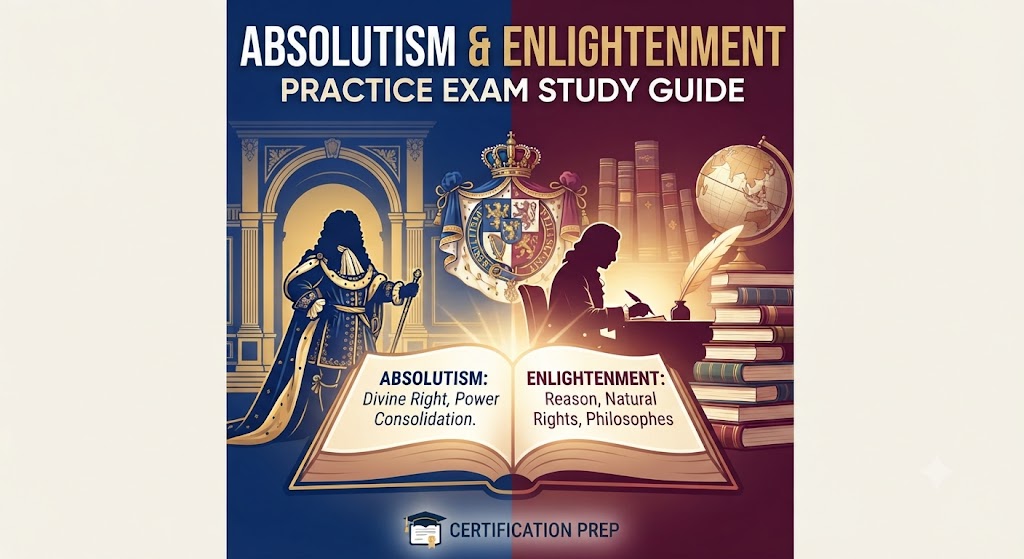
Additional Information
What the Course Entails and Exam Details
The course and exam cover a transformative era in European
history, typically spanning the mid-17th century through the late 18th century.
The curriculum is structured around two core, often conflicting, themes: the
rise of absolutist monarchies and the intellectual revolution of the
Enlightenment.
Students must demonstrate a deep understanding of the
following key topics:
- The
Age of Absolutism: This section focuses on the theory of divine right
and the practical application of absolute power. Key case studies include
the reign of Louis XIV in France (the "Sun King") and the
modernization of Russia under Peter the Great. You will explore how these
monarchs weakened the nobility, controlled the church, and centralized
state power.
- Constitutionalism:
In contrast to absolutism, this topic examines the development of limited
government in England. This includes the English Civil War, the Glorious
Revolution, and the establishment of the English Bill of Rights, which
laid the foundation for modern constitutional democracy.
- The
Scientific Revolution: Often considered the precursor to the
Enlightenment, this topic covers the shift from an Earth-centered universe
to a sun-centered one. Key figures you must know include Copernicus,
Galileo, Kepler, and Isaac Newton, and their impact on empirical reasoning.
- The
Enlightenment: This is the intellectual heart of the curriculum. The
exam will test your knowledge of philosophes and their core ideas. You
must be familiar with John Locke (natural rights), Voltaire (civil
liberties), Montesquieu (separation of powers), Rousseau (social
contract), and Adam Smith (economic liberalism).
- Enlightened
Absolutism: A fascinating synthesis of the two themes, this topic
explores how rulers like Frederick the Great of Prussia, Catherine the
Great of Russia, and Joseph II of Austria attempted to apply Enlightenment
reforms while maintaining their absolute authority.
What to Expect in
the Final Exam
The Absolutism and Enlightenment Final Exam is designed to
test not only your factual recall but also your historical thinking skills,
such as causation, continuity and change over time, and source analysis.
While the specific format may vary depending on your
instructor or institution (e.g., AP, IB, or college course), a typical exam
structure includes:
- Multiple-Choice
Questions (MCQs): These questions will assess your understanding of
terminology, the chronology of events, and the significance of key
figures. Some MCQs may require you to analyze a short primary source text
or a visual image to answer the question.
- Short-Answer
Questions (SAQs): These questions often require you to identify a
historical claim, provide specific evidence to support it, and explain the
connection. For example, you might be asked to explain one difference
between the political philosophies of Thomas Hobbes and John Locke.
- Document-Based
Question (DBQ): This is often the most challenging section. You will
be provided with 5-7 historical documents (text, images, charts) and asked
to construct a cohesive essay that answers a specific prompt, using both
the provided documents and your own outside knowledge of the period.
- Long
Essay Question (LEQ): Similar to the DBQ but without the documents,
this essay requires you to demonstrate deep conceptual understanding and
make a complex historical argument. You might be asked to compare the
effectiveness of absolutist rule in France and Russia.
How to Study and Exam Centers
Effective preparation for this exam requires a multi-layered
approach. Rote memorization of dates and names is insufficient; you must
understand the connections between the events and ideas.
Actionable Study Strategies:
- Create
a Chronological Timeline: Map out the key events of the Scientific
Revolution, Absolutism, and the Enlightenment side-by-side. This helps you
visualize how intellectual shifts influenced political changes.
- Create
"Idea Cards": For each major figure (e.g., Voltaire,
Rousseau, Louis XIV, Peter the Great), create a study card with their key
accomplishment, their major work (if applicable), and their historical
significance.
- Practice
Source Analysis: Find primary sources from the era—excerpts from Leviathan,
The Two Treatises of Government, or Candide—and practice
identifying the author's argument, intended audience, and point of view.
- Take
Timed Practice Tests: Utilize the Absolutism and Enlightenment
Practice Test to simulate the actual exam environment. Time yourself
carefully, especially on the essay sections.
- Form
a Study Group: The best way to solidify your understanding is to
explain complex concepts to others. Challenge each other with practice
questions.
Where and How to Take the Exam:
The location of your exam depends entirely on the context of
your course:
- AP
European History Students: This exam is a standardized test
administered by the College Board. You will take it at an assigned, authorized
testing center (usually your own high school) on a specific date and time
set by the College Board.
- IB
History Students: This exam is part of the IB Diploma Programme. Like
AP, it is administered at your authorized IB World School during the May
or November examination sessions.
- College/University
Students: If you are taking a Western Civilization course, the exam
will be administered by your professor, typically in your regular
classroom or a designated campus testing center, during the final exam
period.
Job Opportunities
from the Course
While this exam is an academic assessment, mastering the
content of the Absolutism and Enlightenment course unlocks a wide array of
career paths that value critical thinking, historical analysis, and strong
communication skills.
This certification/coursework provides a foundational
understanding essential for the following professions:
- Attorney/Lawyer:
The study of the Enlightenment—specifically the development of natural
rights and constitutionalism—is the bedrock of modern legal systems.
- Educator/Professor:
Share your passion for history by teaching this critical period at the
middle school, high school, or university level.
- Policy
Analyst: Understanding the history of state power (absolutism) and
civil rights (Enlightenment) is crucial for analyzing modern political and
social policies.
- Journalist/Technical
Writer: The ability to synthesize complex information, analyze
different perspectives, and communicate clearly is paramount in media and
communications.
- Archivist/Museum
Curator: This course provides the historical context necessary to
manage, preserve, and interpret historical artifacts and documents.
- Foreign
Service Officer/Diplomat: A deep understanding of European history and
the development of the nation-state system is vital for careers in
international relations.
- Researcher/Historical
Consultant: Many historians work outside of academia, providing
research for documentaries, films, historical sites, or public history
projects.
Frequently Asked Questions
Reviews
5.0
Based on 0 reviews
Leave a Review
No reviews yet. Be the first to review!