
ABRSM Grade 8 Music Theory Practice Test
$69.00
- Buy to unlock unlimited access to all Quiz questions.
- After purchase you can print a PDF of the whole quiz at any point. The PDF will contain the questions and the correct answers.
About this Exam
The Associated Board of the Royal Schools of Music (ABRSM) Grade 8 Music Theory certification represents the pinnacle of theoretical achievement in its graded system.
This advanced qualification is designed for dedicated musicians, including students, teachers, and performers, who wish to demonstrate a comprehensive, mastery-level understanding of musical language, grammar, and notation.
It serves as a benchmark of excellence, often a prerequisite for entry into university music programs and conservatoires, and required for taking some ABRSM diplomas.
The exam confirms your ability to analyze complex musical structures, realize harmony from figured bass, and compose coherent, expressive music within established styles.
Ready to test your knowledge?
Buy Now to Access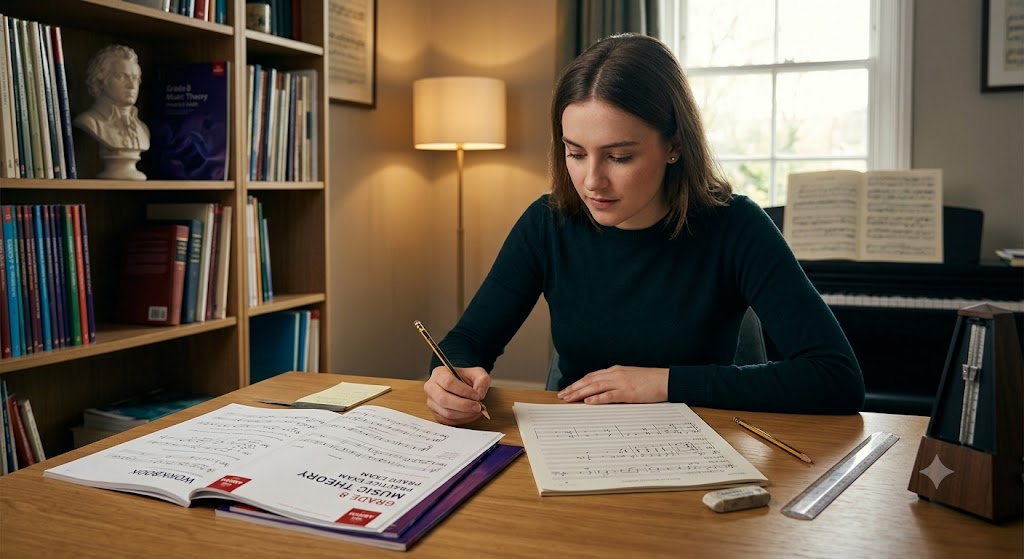
Additional Information
What the Course Entails and Exam Details
The ABRSM Grade 8 Music Theory syllabus demands a deep understanding of harmony, melody, and musical analysis. It builds upon all previous grades, requiring candidates to show advanced creativity and analytical skills.
Core areas of study include:
Realization of Figured Bass: Candidates must complete a four-part harmony extract from a Baroque trio sonata, adding a bass line, inner parts, and proper figured bass notation, demonstrating stylistic awareness.
Continuation of a Given Opening: This creative question requires completing an extract for piano, following a given stylistic opening (often from the Romantic period), ensuring the voice-leading and harmonic structure are both pianistic and grammatically correct.
Melodic Composition: Writing a melody for a specific instrument (like a clarinet, flute, or cello), spanning up to 16 bars. Candidates must integrate modulations to related keys and apply performance directions and dynamics to create a coherent piece.
Reconstruction of a Keyboard Part: Recreating a keyboard part where elements like the bass line, harmony, or figuration are partially missing, following the style of a provided extract.
Music in Context: This section asks several detailed analytical questions based on a full, printed musical score. Topics include identifying instruments and their families, understanding transposition, interpreting complex performance terms, analyzing harmony, and identifying historical musical periods and common stylistic features of composers.
What to Expect in the Final Exam
The ABRSM Grade 8 Music Theory exam is a traditional, paper-based assessment, which distinguishes it from the online format of Grades 1 through 5.
Format: A 3-hour written exam consisting of five detailed, equally weighted questions that cover the entire syllabus.
Scoring: The exam is marked out of 100.
Passing Requirements: To achieve a "Pass," candidates must score a minimum of 66 marks. For those seeking higher validation, a score of 80 earns a "Merit," and 90 or above is a "Distinction."
Rules: The exam must be taken under strict supervision at a designated, authorized ABRSM exam center.
How to Study and Exam Centers
Preparation for Grade 8 must be comprehensive and methodical. It is strongly recommended that you have already passed or have a similar level of understanding to Grade 7 before attempting Grade 8.
Actionable study strategies include:
Official Resources: Make the official ABRSM Grade 8 "Theory Workbook," "Harmony in Practice," and "First Steps in Theory" your core texts. These are designed to align directly with the syllabus.
Past Papers: This is the most crucial step. ABRSM publishes "Practice Papers" and "Past Papers" from recent exam sessions, which are essential for familiarizing yourself with the complex layout and timing of the five long questions.
Creative Practice: Practice writing four-part harmony, completing keyboard extracts, and composing melodies daily. Learn to follow stylistic rules, avoid common grammatical errors like consecutive fifths, and develop a sense of natural musical flow.
Analytical Skills: Study diverse orchestral and chamber music scores to enhance your 'Music in Context' skills. Focus on learning to read all types of clefs and identifying key modulation techniques.
Expert Instruction: Given the advanced nature of the content, seeking guidance from a qualified music theory teacher is highly beneficial for receiving detailed feedback on your creative work.
Exam Centers: The Grade 8 exam cannot be taken online. Candidates must register through the official ABRSM website to take the test at a physical, designated ABRSM exam center. These authorized locations, including music schools, colleges, and specific testing centers, are located in over 90 countries worldwide.
Job Opportunities from the Course
A qualification in ABRSM Grade 8 Music Theory is a high-level academic achievement that significantly strengthens a musical career path. While it does not guarantee a specific job title, it unlocks and supports advanced career opportunities.
This certification is essential for:
Private Music Teacher: Demonstrates the pedagogical depth required to teach advanced theory to others.
Orchestrator and Arranger: A core skill for adapting music for different ensembles or modern media.
Music Editor and Publisher: Enables critical proofreading and preparation of musical scores.
Composer: Provides the essential technical toolkit for creating sophisticated and coherent music.
Music Theory Lecturer: An essential stepping stone towards teaching at a higher educational level.
Conductor and Music Director: Facilitates the critical score analysis required to lead performances effectively.
Advanced Practical Exams and Diplomas: Acts as the required prerequisite for higher-level performance and teaching qualifications within the ABRSM.
Frequently Asked Questions
Reviews
5.0
Based on 0 reviews
Leave a Review
No reviews yet. Be the first to review!