
ABRET Performing Study Practice Test
$69.00
- Buy to unlock unlimited access to all Quiz questions.
- After purchase you can print a PDF of the whole quiz at any point. The PDF will contain the questions and the correct answers.
About this Exam
The American Board of Registration of Electroencephalographic and Magnetoencephalographic Technologists (ABRET) provides the industry-standard certification for neurodiagnostic technologists. This Performing Study Practice Exam is an invaluable tool for candidates preparing for ABRET certification exams, such as the Registered EEG Technologist (R.EEG T.) exam. It specifically targets the practical skills and knowledge required to safely, effectively, and professionally set up and perform a range of neurodiagnostic studies, primarily Electroencephalograms (EEG). This practice exam is designed for both students completing their training and experienced technologists looking to validate their skills and ensure exam readiness for their formal credentialing. It acts as a final rehearsal, helping professionals build confidence and identify areas needing further review before their definitive examination. Successfully achieving an ABRET credential signifies a high level of expertise, making this practice a critical step in a career dedicated to helping patients through advanced neurodiagnostics.
Ready to test your knowledge?
Buy Now to Access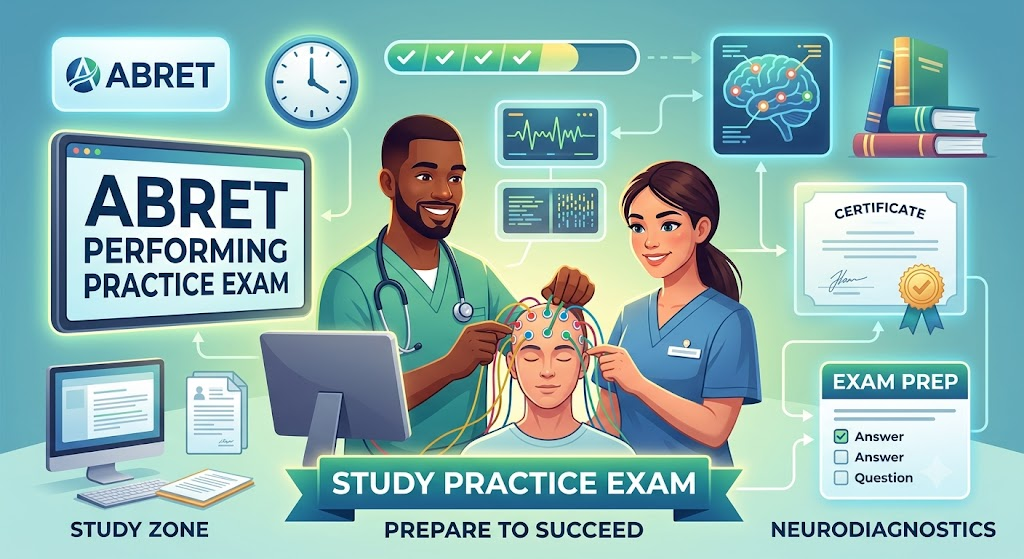
Additional Information
What the Course Entails and Exam Details
The topics covered in the ABRET Performing Study Practice Exam align closely with the real-world responsibilities and exam components for neurodiagnostic technologists. Mastery in these areas is crucial for accurate data collection and patient care. The course, as practiced, typically entails:
Patient Preparation: Elements of history taking, patient communication, and ensuring comfort and understanding.
Safety and Infection Control: Strict adherence to electrical safety, patient safety protocols, and proper disinfection of electrodes and equipment.
Electrode Application: Accurate measurement and application of electrodes according to the International 10-20 System, achieving low impedances.
Instrumentation and Recording: Comprehensive understanding of EEG equipment, filters, montages, and essential recording parameters.
Troubleshooting: Identifying and resolving artifact, technical issues, and ensuring data integrity throughout the study.
Waveform Identification and Analysis: Recognition of normal variants, common abnormal patterns, and basic sleep stages.
Specific Study Protocols: Familiarity with standard operating procedures and specific protocols for different patient populations and recording goals.
Activation Techniques: Proper execution and understanding of techniques like hyperventilation and photic stimulation.
Ethics and Professionalism: Understanding ABRET's code of ethics and maintaining professional conduct.
The "exam details" for a typical online practice test generally include a timed or untimed series of multiple-choice questions, simulations, or practical scenarios, with immediate feedback and performance breakdown. These results highlight strengths and weaknesses relative to the actual ABRET exam content.
What to Expect in the Final Exam
It is crucial to understand that the Performing Study Practice Exam is a preparation tool, not the actual final ABRET registration or certification exam. However, this practice test is designed to mimic the scope and, potentially, the type of practical or theory-based questions related to performing a study that a candidate will encounter in their true final examination.
The actual final ABRET exams (like the R.EEG T.) are comprehensive, often computer-based and primarily multiple-choice. The content is rigorously tested across several hours, with specific passing score requirements that are not publicly disclosed and may vary. These full exams are highly detailed, challenging, and strictly monitored. The practice exam helps candidates acclimatize to the content, potential question structures, and the mental stamina required, but does not award the final credential. Success on the practice exam indicates strong readiness but does not replace the requirement of passing the official exam. Candidates should expect the actual final exam to be significantly more extensive and administered under specific physical or secure online conditions.
How to Study and Exam Centers
Effectively preparing for the ABRET Performing Study Practice Exam (and by extension, the real certification exam) requires a dedicated, multi-faceted approach:
Review Official Resources: Begin with the official ABRET examination handbooks and blueprints, ensuring familiarity with all listed task and content areas.
Utilize Study Guides: Leverage study guides and online courses provided by ABRET or reputable organizations like ASET - The Neurodiagnostic Society.
Hands-on Practice: For the practical performance aspects, consistent, hands-on practice in a clinical or educational setting is irreplaceable. Practice electrode application, patient interactions, and running studies with actual equipment and diverse subjects (including peers, under supervision).
Identify Weak Areas: Use the immediate feedback from your practice exam to pinpoint topics where your knowledge is lacking.
Time Management: Consider taking the practice exam under timed conditions to improve speed and focus.
Peer Study: Collaborate with other students or professionals preparing for the same certification.
Stay Current: Keep up to date with the latest guidelines (like those from the ACNS) and industry best practices.
Regarding access, the Performing Study Practice Exam is typically accessed online through a secure portal provided by ABRET or authorized education/training providers. For the actual final ABRET exams, candidates are required to register and take the test at authorized professional testing centers, such as Pearson VUE. These centers are located globally and offer a secure, standardized environment. Candidates must check ABRET's official website for current eligibility requirements, registration processes, and approved testing locations for the certification exam, as the practice test is a preparatory resource rather than the official examination itself.
Job Opportunities from the Course
Achieving ABRET certification, supported by rigorous practice including tests like the Performing Study Practice Exam, opens doors to various fulfilling and highly respected career paths in the neurodiagnostic field. Successful certified technologists can pursue roles such as:
Registered EEG Technologist (R.EEG T.)
Neurodiagnostic Technologist
EEG Technologist
Clinical Neurophysiology Technologist
Sleep Technologist
Intraoperative Monitoring (IONM) Technologist
Lead EEG Technologist
Neurodiagnostic Department Manager
Clinical Instructor in Neurodiagnostics
EEG Analyst/Reviewer
Healthcare Facility or Medical Device Company Representative specializing in neurodiagnostic equipment
By dedicating time to prepare effectively, using tools like the practice exam as a stepping stone, and achieving ABRET registration, you will demonstrate a commitment to excellence and significantly enhance your career trajectory in a critical area of healthcare.
Frequently Asked Questions
Reviews
5.0
Based on 0 reviews
Leave a Review
No reviews yet. Be the first to review!