
ABRET Neurological Disorders Practice Test
$69.00
- Buy to unlock unlimited access to all Quiz questions.
- After purchase you can print a PDF of the whole quiz at any point. The PDF will contain the questions and the correct answers.
About this Exam
The [ABRET Neurological Disorders Practice Test] is a vital educational resource designed for neurodiagnostic technologists and students who are aiming for credentialing through the American Board of Registration of Electroencephalographic and Neurodiagnostic Technologists (ABRET). This practice test specifically targets understanding, identifying, and interpreting various neurological disorders.
It is ideal for candidates preparing for the R.EEG.T., R.EP.T., or CLTM exams, allowing them to assess their clinical knowledge and readiness for the neurological conditions section of the final certification. By focusing on disorders ranging from epilepsy to acute stroke, this guide helps bridge the gap between classroom theory and practical clinical application.
Ready to test your knowledge?
Buy Now to Access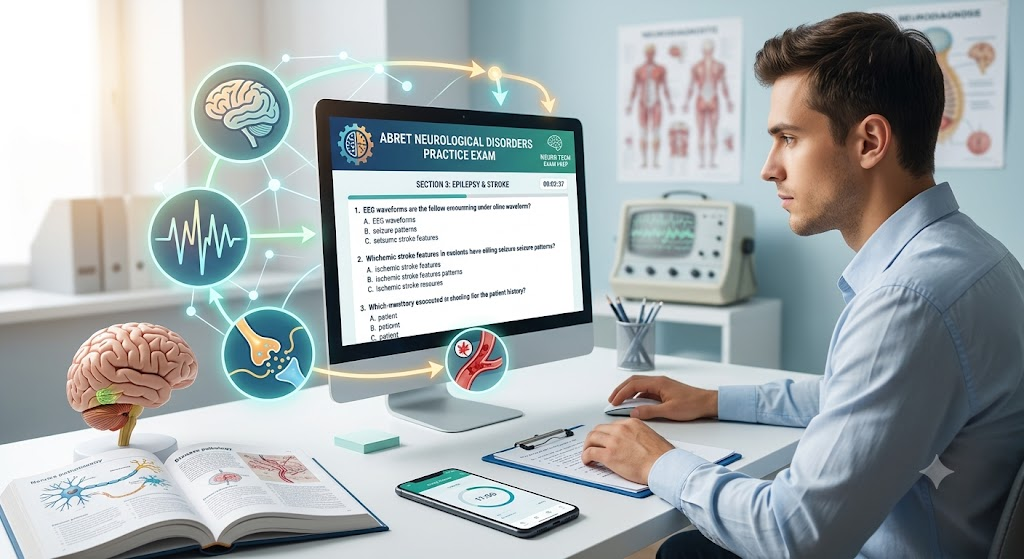
Additional Information
What the Course Entails and Exam Details
This practice test curriculum is designed to simulate the depth of knowledge required by professional neurodiagnostic certifying bodies. It encompasses comprehensive knowledge of the central and peripheral nervous systems, with a particular focus on abnormal pathology.
Core topics and skills covered in this content area include:
Epilepsy and Seizure Classifications: Distinguishing between focal, generalized, and unknown onset seizures, and understanding their typical EEG presentations.
Vascular Disorders: Recognizing the clinical signs of ischemic and hemorrhagic stroke, Transient Ischemic Attacks (TIAs), and vascular dementia.
Infectious Diseases: Understanding the neurodiagnostic implications of meningitis, encephalitis, and Creutzfeldt-Jakob Disease (CJD).
Structural and Traumatic Injuries: Assessing the impact of Traumatic Brain Injuries (TBI), brain tumors, and hydrocephalus.
Neurodegenerative and Metabolic Disorders: Identifying patterns associated with Alzheimer’s disease, Parkinson's disease, and various encephalopathies.
Nerve and Muscle Disorders: Understanding neuropathies, myopathies, and disorders of the neuromuscular junction.
What to Expect in the Final Exam
While a practice test allows for review, the actual ABRET certification exams follow a strict structure.
Exam Format: The formal R.EEG.T. and related credentialing exams are typically computer-based and consist of multiple-choice questions (often ranging from 200 to 250 questions), of which a portion relates directly to neurological disorders.
Time Limit: Candidates are generally allotted 3 to 4 hours to complete the examination.
Passing Score: ABRET uses scaled scoring. The raw score (number of correct answers) is converted into a scaled score ranging from 0 to 100, with a score of 70 typically required to pass the credentialing exam.
Rules: The final exam is proctored. No outside materials, references, or electronic devices are allowed in the testing room.
How to Study and Exam Centers
Effective preparation requires a combination of rote memorization and clinical application.
Actionable Study Strategies:
Utilize ABRET Practice Material: Take the [ABRET Neurological Disorders Practice Test] repeatedly. Do not just focus on the correct answers; understand why the incorrect answers are wrong.
Cross-Reference with Waveforms: For every disorder studied, find example EEG or EP waveforms associated with that condition. Visual recognition is key.
Create Flashcards: Use flashcards for definitions, classic seizure presentations, and the effects of specific medications on EEG.
Use Standard Textbooks: Rely on authoritative sources, such as "Blume's Atlas of Pediatric and Adult EEG" or ASET guidelines.
How to Take the Exam:
Practice Tests: The practice test is usually administered online through the official ABRET portal upon purchase.
Official Credentialing Exam: The formal, proctored ABRET certification exams are administered through Pearson VUE. Candidates must create an account, register, pay fees, and select a time slot at an authorized physical testing center.
Job Opportunities from the Course
Successfully mastering the content within the [ABRET Neurological Disorders Practice Test] is a critical step toward earning full credentialing. Obtaining an ABRET R.EEG.T., R.EP.T., or CLTM credential unlocks significant job opportunities and career advancement in the neurodiagnostic field.
Key job titles and career paths this knowledge unlocks include:
Registered EEG Technologist (R.EEG.T.)
Evoked Potential Technologist (R.EP.T.)
Certified Long-Term Monitoring Technologist (CLTM)
Neurodiagnostic Department Lead/Supervisor
Intraoperative Neuromonitoring (IONM) Technologist
Epilepsy Monitoring Unit (EMU) Specialist
Clinical Neurodiagnostic Educator
EEG Lab Manager
Good luck with your studies! By focusing on the details provided in this guide, you are on your way to certification success.
Frequently Asked Questions
Reviews
5.0
Based on 0 reviews
Leave a Review
No reviews yet. Be the first to review!