
Abr Practice Test & Exam Prep
$69.00
- Buy to unlock unlimited access to all Quiz questions.
- After purchase you can print a PDF of the whole quiz at any point. The PDF will contain the questions and the correct answers.
About this Exam
The American Board of Radiology (ABR) serves as a vital gatekeeper in the medical field, certifying physicians who have demonstrated exceptional knowledge and skill in radiology and its related subspecialties. These certifications—covering Diagnostic Radiology, Interventional Radiology/Diagnostic Radiology, Radiation Oncology, and Medical Physics—are more than just professional milestones. They represent a commitment to the highest standards of patient care and are often required for hospital privileges, licensure, and employment. The ABR’s exams are rigorous and comprehensive, designed to ensure that certified practitioners are fully prepared for the complexities of modern medical imaging and radiation therapy. Achieving ABR certification is a significant achievement, marking you as an expert in your chosen field.n
Ready to test your knowledge?
Buy Now to Access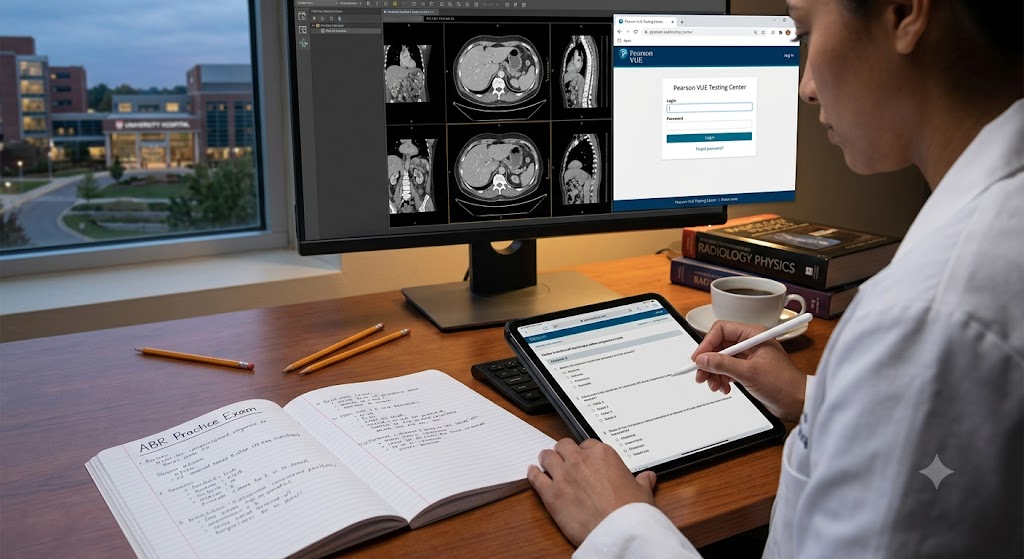
Additional Information
What the Course Entails and Exam Details
The ABR offers a range of certification pathways. The path
to initial certification usually involves multiple steps, beginning with a
qualifying exam and concluding with a certifying exam. While there is no single
"course," candidates typically spend years in residency and
fellowship training, which forms the core of their preparation. The subject
matter covered is vast and depends on the specific subspecialty. For example,
the Diagnostic Radiology path focuses on various organ systems and modalities, including
breast imaging, cardiac radiology, gastrointestinal radiology, nuclear
medicine, pediatric radiology, and musculoskeletal imaging, alongside a strong
emphasis on the physics of medical imaging. For Medical Physics, subspecialties
include Therapeutic Medical Physics, Diagnostic Medical Physics, and Nuclear
Medical Physics, each with its own specific curriculum. All candidates must
demonstrate proficiency in image interpretation, clinical decision-making, and
safety principles.
What to Expect in the Final Exam
The format of ABR exams varies by certification and stage.
Many Qualifying Exams are computer-based, multiple-choice tests
administered at testing centers. These exams assess fundamental knowledge
across all core areas. The Certifying Exams are designed to evaluate
clinical skill and judgment. In the past, many of these were in-person oral
examinations; however, the ABR has recently transitioned to remote oral
exams for several specialties, using online platforms to conduct real-time
interactions with examiners. These sessions often use clinical case studies to
assess your ability to analyze images, make diagnoses, and manage patient care
scenarios. You should also expect a strong component on medical physics
throughout. Passing scores and exact time limits are specific to each exam and
are communicated by the ABR well in advance. The atmosphere is formal and
requires careful time management and concise, clear communication, especially
in oral formats.
How to Study and Exam Centers
Preparation for ABR exams is a long-term process. Candidates
rely heavily on knowledge gained during their residency and fellowship. To
supplement this, effective study strategies include:
- Utilizing
Official Resources: Regularly consult the ABR website for the most
up-to-date exam blueprints, schedules, and official guides.
- Practice
with Question Banks: Dedicated practice question banks specifically
designed for ABR exams are invaluable for reinforcing knowledge and
familiarizing yourself with the question style and content.
- Reviewing
Textbooks: Key, comprehensive textbooks in your subspecialty and
medical physics are essential reference material.
- Case
Review: In preparation for certifying and oral exams, spend extensive
time reviewing clinical cases, practice dictating reports, and
articulating your reasoning.
- Study
Groups: Collaborating with peers can provide support, different
perspectives, and opportunities for mock oral examinations.
- Review
Courses: Many professional societies and institutions offer
specialized ABR review courses.
For computer-based exams, the ABR often utilizes
Pearson VUE testing centers located worldwide. For remote oral exams,
you will take the test from a location of your choice that meets specific
technical and privacy requirements defined by the ABR, using a stable internet
connection and necessary audiovisual equipment.
Job Opportunities from the Course
Earning ABR certification opens doors to prestigious and
critical roles across the medical landscape. Certified individuals are in high
demand and typically work in hospitals, private practices, academic
institutions, and research facilities. Key career paths and job titles include:
- Board-Certified
Radiologist
- Diagnostic
Radiologist
- Interventional
Radiologist
- Radiation
Oncologist
- Board-Certified
Medical Physicist
- Therapeutic
Medical Physicist
- Diagnostic
Medical Physicist
- Nuclear
Medical Physicist
- Neuroradiologist
- Pediatric
Radiologist
- Breast
Imaging Specialist
Frequently Asked Questions
Reviews
5.0
Based on 0 reviews
Leave a Review
No reviews yet. Be the first to review!