
Abp Practice Test & Exam Prep
$69.00
- Buy to unlock unlimited access to all Quiz questions.
- After purchase you can print a PDF of the whole quiz at any point. The PDF will contain the questions and the correct answers.
About this Exam
The American Board of Orthopaedic Surgery (ABOS) certification is the cornerstone credential for orthopaedic surgeons in the United States. This rigorous certification process demonstrates a surgeon's comprehensive knowledge, clinical skills, and dedication to the highest standards of patient care within the field of musculoskeletal medicine. It is primarily designed for individuals who have completed an accredited orthopaedic residency and are looking to achieve board-certified status. The ABOS Practice Test & Exam Prep resources are crucial for candidates, providing targeted material to refine their understanding and boost their confidence leading up to the challenging examination. Achieving this certification signals professional excellence to peers, patients, and institutions, opening doors to advanced career opportunities and ensuring high quality standards in orthopaedic practice.
Ready to test your knowledge?
Buy Now to Access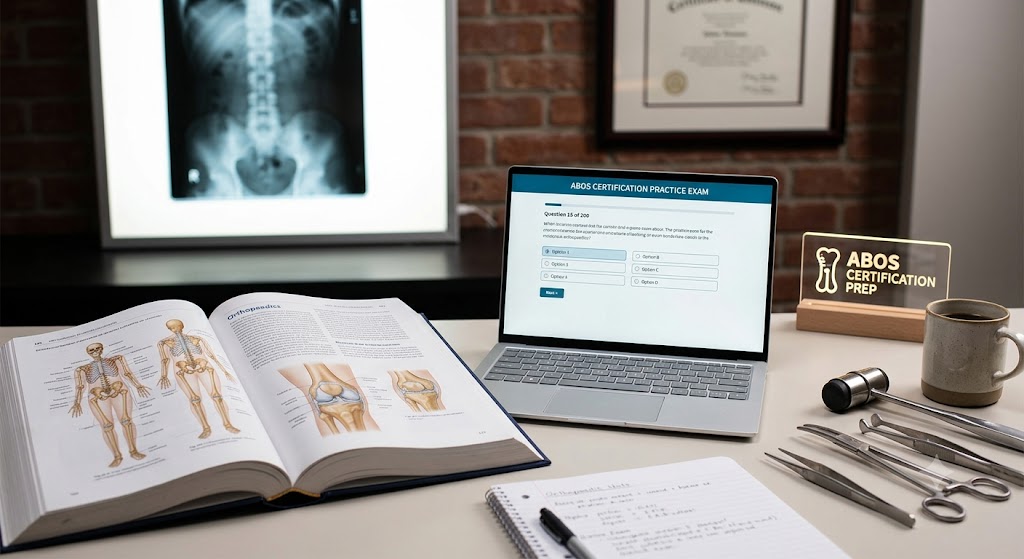
Additional Information
What the Course Entails and Exam Details
ABOS exam preparation courses and practice tests cover a
comprehensive syllabus reflecting the broad scope of orthopaedic surgery.
Candidates will delve into essential topics such as basic sciences (anatomy,
physiology, pathology, biomechanics), musculoskeletal trauma, adult
reconstructive surgery involving major joints, spine disorders, sports medicine
principles, pediatric orthopaedics, and hand surgery. The content also includes
specific details on foot and ankle surgery, shoulder and elbow conditions,
musculoskeletal oncology, and rehabilitative techniques. A critical component
involves understanding ethical considerations and professional practices within
the field. Prep resources are structured to reinforce theoretical knowledge and
apply clinical reasoning to complex cases.
What to Expect in the Final Exam
The primary written component of the ABOS certification,
often referred to as Part I, is a comprehensive multiple-choice examination.
Candidates can expect several hundred questions covering the full spectrum of
orthopaedic surgery and basic musculoskeletal science. The exam is typically
computer-administered and takes nearly a full day to complete, often structured
with multiple blocks and designated breaks. There isn't a simple percentage for
a passing score; results are reported as a scaled score relative to a standard,
with the minimum passing score determined annually. Strict rules apply during
the examination, including prohibited access to electronic devices, standard
test center protocols, and the use of authorized testing services like Pearson
VUE.
How to Study and Exam Centers
Effective study strategies are paramount for success on the
ABOS examination. Utilize a combination of reputable resources, including
official ABOS-endorsed materials, extensive question banks, and authoritative
orthopaedic textbooks. Focus heavily on identifying and addressing knowledge
gaps through targeted practice exams that simulate the timing and content of
the real test. Create a structured study schedule that prioritizes consistent
review over cramming and incorporates group study or discussions with mentors. Candidates
typically register for and schedule the computer-based written exam through
authorized online portals provided by the American Board of Orthopaedic
Surgery. The actual test is administered at designated professional testing
centers, such as Pearson VUE facilities, which provide a standardized, secure
environment. Ensure you verify specific scheduling requirements and location
details well in advance.
Job Opportunities
from the Course
Achieving ABOS certification opens the door to numerous
advanced professional opportunities within the healthcare sector. Many of these
require being board-certified as a key credential. Some of the career paths and
job titles this certification unlocks include:
- Board-Certified
Orthopaedic Surgeon
- Orthopaedic
Spine Surgeon
- Pediatric
Orthopaedic Surgeon
- Orthopaedic
Trauma Surgeon
- Hand
Surgeon
- Sports
Medicine Orthopaedic Surgeon
- Musculoskeletal
Oncologist
- Chief
of Orthopaedics at a medical institution
- Medical
Director of an orthopaedic clinic
- Academic
position at a medical school, combining research, teaching, and clinical
practice
Frequently Asked Questions
Reviews
5.0
Based on 0 reviews
Leave a Review
No reviews yet. Be the first to review!