
Ablation Energy Sources Practice Test
$69.00
- Buy to unlock unlimited access to all Quiz questions.
- After purchase you can print a PDF of the whole quiz at any point. The PDF will contain the questions and the correct answers.
About this Exam
The Ablation Energy Sources Certification is a specialized credential designed for medical professionals, biomedical engineers, and clinical specialists working directly with advanced minimally invasive surgical technologies. This rigorous exam validates your comprehensive understanding of the physical principles, safety protocols, and clinical applications of various energy modalities used in ablation therapy.
As the field of interventional oncology and cardiology rapidly evolves, the demand for skilled operators who understand the nuances of tissue interaction—from radiofrequency (RF) and microwave (MW) to cryoablation and irreversible electroporation (IRE)—has never been higher. This certification is essential for professionals aiming to demonstrate expertise, enhance patient safety, and improve procedural outcomes in the operating room or catheterization lab.
Ready to test your knowledge?
Buy Now to Access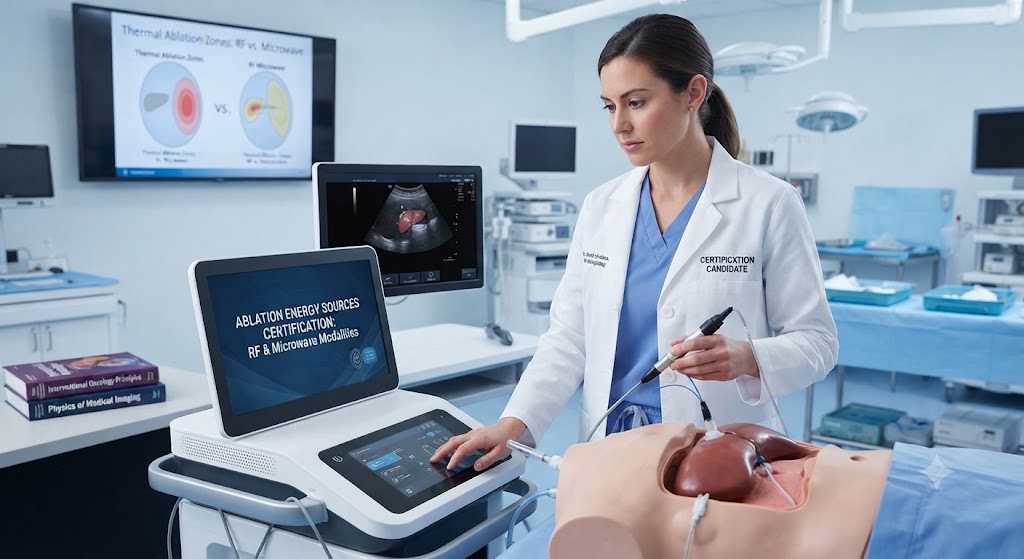
Additional Information
What the Course Entails and Exam Details
The preparatory coursework for this exam is extensive, covering
the fundamental physics of energy delivery and the practical aspects of
clinical application. You must master several core domains to pass the final
assessment.
Core Syllabus and Knowledge Areas:
- Fundamental
Physics of Ablation: Understanding impedance, thermal conductivity,
electromagnetic radiation, and thermodynamics as they apply to biological
tissue.
- Energy
Modalities: In-depth study of Radiofrequency (RFA), Microwave (MWA),
Cryoablation, Laser Ablation, and Electroporation (IRE/NanoKnife). This
includes the mechanisms of cell death (coagulation necrosis vs.
apoptosis).
- Tissue
Interaction: How different tissue types (liver, lung, cardiac, renal)
respond to specific energy sources and how to predict ablation zone size
and shape.
- Device
Technology: Operation and troubleshooting of specific generator
systems, catheters, probes, and grounding pads.
- Safety
and Regulatory Compliance: Critical standards for patient grounding,
preventing thermal injury to adjacent structures, sterile technique, and
equipment maintenance.
- Imaging
Guidance: Understanding how ultrasound, CT, and MRI are used to
monitor ablation zones in real-time.
What to Expect in
the Final Exam
The Ablation Energy Sources Certification Exam is a
proctored, high-stakes assessment. It is designed to test not just recall of
facts, but the application of knowledge in complex clinical scenarios.
Exam Format and Structure:
- Question
Types: The exam primarily consists of multiple-choice questions,
single-best-answer questions, and scenario-based questions that require
analyzing patient data or equipment readings.
- Number
of Questions: Typically, the exam contains between 100 and 150 scored
questions.
- Time
Limit: Candidates are usually given 3 to 3.5 hours to complete the
examination.
- Passing
Score: The passing scaled score is generally set around 70% to 75%,
depending on the specific certifying body and the difficulty form of the
exam.
- Delivery
Method: The exam is administered via secure, computer-based testing
centers globally (often through partners like Pearson VUE) or via live
remote proctoring.
Candidates must agree to a strict non-disclosure agreement
(NDA) before beginning the test.
How to Study and Exam Centers
Earning this certification requires disciplined study and
strategic preparation. Relying solely on professional experience is rarely
sufficient due to the technical depth of the exam.
Actionable Study Strategies:
Review Official Course Materials: Thoroughly study
the official candidate handbook, textbook, and any modules provided by the
certifying body. These are the primary sources for exam questions.
Master the Physics: Do not
neglect the physics chapters. You must understand the formulas and
relationships between power, impedance, time, and temperature.
Utilize a Practice Test:
The most effective study tool is a realistic Ablation Energy Sources
Practice Test. Taking timed practice exams helps you identify knowledge
gaps, get accustomed to the complex question format, and manage your time
effectively during the actual test. Ensure your practice questions cover all
modalities (RF, MW, Cryo, IRE).
Case Study Analysis:
Review clinical case studies that focus on complication management and
troubleshooting equipment errors.
Where and How to Take the Exam:
- Registration:
You must register and pay for the exam through the official website of the
certifying organization (e.g., the International Society for
Hepato-Pancreato-Biliary Association - IHPBA, or a specific medical device
manufacturer's training portal).
- Scheduling:
Once your eligibility is confirmed, you will receive an Authorization to
Test (ATT) number. Use this number to schedule your exam date and location
via the testing vendor's website (e.g., Pearson VUE).
- Testing
Centers: Secure testing centers are located worldwide in major cities.
Alternatively, many organizations now offer live online proctoring, allowing
you to take the exam from your home or office, provided you meet strict
technical and environmental requirements.
Job Opportunities
from the Course
Achieving the Ablation Energy Sources Certification
significantly enhances your professional credentials and opens doors to
specialized, high-impact roles within the medical device industry and clinical
practice.
This certification validates that you possess the
specialized knowledge required for the following career paths:
- Clinical
Application Specialist (CAS): Work for medical device manufacturers
(e.g., Medtronic, Boston Scientific, AngioDynamics) providing expert
clinical support, training, and troubleshooting for ablation systems in
hospitals.
- Field
Clinical Engineer (FCE): Provide technical and engineering support
during complex ablation procedures, ensuring equipment functions
optimally.
- Interventional
Radiology (IR) Technologist: Specialize in assisting physicians during
image-guided ablation procedures.
- Cardiac
Electrophysiology (EP) Specialist: Focus on the use of ablation energy
sources to treat cardiac arrhythmias.
- Biomedical
Engineer (R&D or Sales): Leverage deep technical knowledge of
energy delivery systems in product development or technical sales roles.
- Ablation
Program Coordinator: Manage the clinical, operational, and educational
aspects of an interventional ablation program within a hospital system.
Frequently Asked Questions
Reviews
5.0
Based on 0 reviews
Leave a Review
No reviews yet. Be the first to review!