
Abdominal Ultrasound Registry Practice Test
$69.00
- Buy to unlock unlimited access to all Quiz questions.
- After purchase you can print a PDF of the whole quiz at any point. The PDF will contain the questions and the correct answers.
About this Exam
The Abdominal Ultrasound Registry Exam is a pivotal certification step for aspiring diagnostic medical sonographers and vascular technologists specializing in abdominal imaging. Administered by certifying bodies like the ARDMS (American Registry for Diagnostic Medical Sonography) or APCA (Alliance for Physician Certification & Advancement), this rigorous examination validates your expertise. Passing this registry exam grants you the coveted Registered Diagnostic Medical Sonographer (RDMS) credential in the Abdomen (AB) specialty. This certification is specifically designed for healthcare professionals who have completed formal ultrasound education and clinical training, demonstrating they possess the critical knowledge and technical skills required to perform safe and accurate abdominal ultrasound examinations.
Ready to test your knowledge?
Buy Now to Access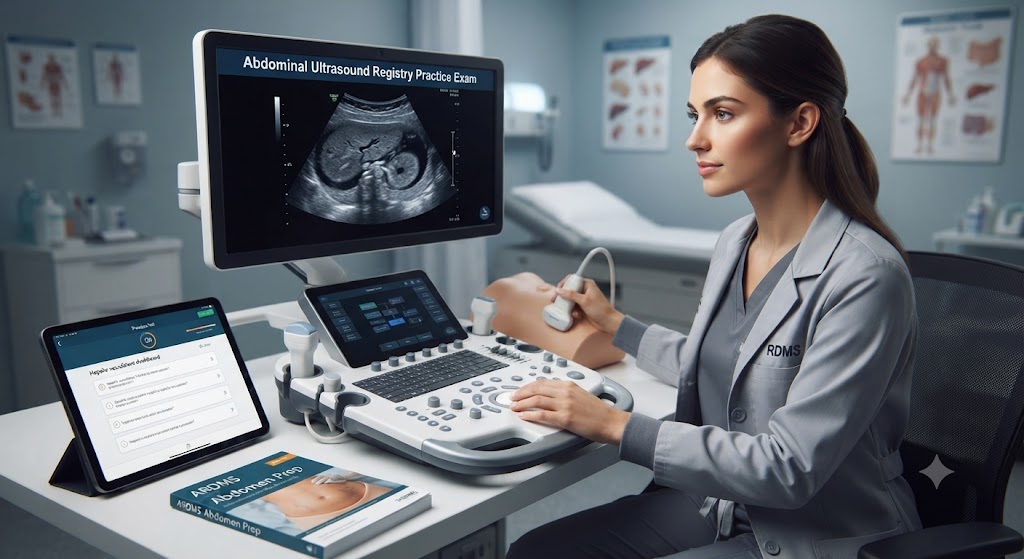
Additional Information
What the Course Entails and Exam Details
Before sitting for the registry exam, candidates must master
a comprehensive body of knowledge related to abdominal anatomy, pathology, and
instrumentation. The course of study typically covers the normal anatomy,
variants, and pathologies of key abdominal structures, including the liver, gallbladder,
biliary system, pancreas, spleen, kidneys, and major abdominal vasculature
(like the aorta and IVC). Furthermore, candidates must be proficient in
scanning techniques, patient preparation, and the principles of ultrasound
physics. The exam assesses your ability to recognize normal sonographic
appearances, differentiate between various pathological states (such as masses,
cysts, stones, and inflammatory processes), and understand the clinical
correlation of ultrasound findings.
What to Expect in the Final Exam
The Abdominal Ultrasound Registry Exam is a comprehensive,
timed, computer-based examination administered under strict security protocols.
The exam format typically consists of approximately 170–200 multiple-choice
questions, and candidates are usually given around three to four hours to
complete it. The questions are weighted to cover specific content areas, such
as the biliary system (15-20%), liver (25-30%), and genitourinary tract
(20-25%). To pass, you must achieve a scaled score of at least 555 out of a
potential 800. It is important to understand that the exam is
"adaptive," meaning the difficulty of subsequent questions may adjust
based on your previous answers, requiring a deep and consistent understanding
of all subject areas.
How to Study and
Exam Centers
Effective preparation for the Abdominal Ultrasound Registry
Exam requires a strategic, multi-faceted approach that goes beyond simple
memorization. Start by thoroughly reviewing the official exam content outline
provided by your certifying body (e.g., ARDMS). Utilize comprehensive review
books (like the Davies series), attend specialized registry review seminars, and
dedicate significant time to reviewing high-quality sonographic images and
pathology cases. The most critical component of your study plan must be
utilizing realistic Abdominal Ultrasound Registry Practice Tests. These
practice exams familiarize you with the question style, format, and pressure of
the actual test, helping you identify knowledge gaps and build stamina. When
you are ready, you will schedule your exam through the designated testing
provider, such as Pearson VUE, which operates secure testing centers globally,
ensuring a standardized and monitored testing environment.
Job Opportunities
from the Course
Successfully passing the Abdominal Ultrasound Registry Exam
and earning the RDMS (AB) credential opens the door to a wide range of
rewarding and stable career opportunities within the healthcare field. This
certification is the gold standard and is often required by employers for
specialized sonographer roles. With this credential, you are qualified for the
following positions:
- Staff
Sonographer (Abdomen Specialist): Working in hospitals or outpatient
imaging centers, performing a wide variety of abdominal ultrasound scans.
- General
Ultrasound Technologist: Utilizing your abdominal expertise alongside
other specializations (like OB/GYN or Vascular) in diverse clinical
settings.
- Mobile
Ultrasound Technologist: Traveling to nursing homes, clinics, or
remote locations to perform critical abdominal studies.
- Ultrasound
Applications Specialist: Training clinical staff and demonstrating the
use of new ultrasound equipment for medical device companies.
- Clinical
Instructor/Program Director: Educating the next generation of
sonographers in accredited ultrasound programs.
- Lead
Sonographer: Supervising a team of technologists and managing an
ultrasound department's daily operations.
Frequently Asked Questions
Reviews
5.0
Based on 0 reviews
Leave a Review
No reviews yet. Be the first to review!