
Abdominal Focused Assessment with Sonography for Trauma (AFAST) Practice Exam
$69.00
- Buy to unlock unlimited access to all Quiz questions.
- After purchase you can print a PDF of the whole quiz at any point. The PDF will contain the questions and the correct answers.
About this Exam
The Abdominal Focused Assessment with Sonography for Trauma (AFAST) is a critical, point-of-care ultrasound (POCUS) examination designed to rapidly identify free fluid—typically blood—within the peritoneal cavity of trauma patients. Originally adapted for veterinary medicine from human medicine's FAST exam, AFAST has become the standard of care in emergency and critical care settings.
This certification is primarily designed for veterinarians and credentialed veterinary technicians specializing in emergency medicine, critical care, or surgery. Mastering AFAST allows clinicians to make rapid, life-saving triage decisions without the risks associated with transporting unstable patients for radiographs or CT scans. By achieving AFAST certification, you demonstrate proficiency in performing and interpreting this vital diagnostic tool, significantly elevating the standard of care you can provide to trauma cases.
Ready to test your knowledge?
Buy Now to Access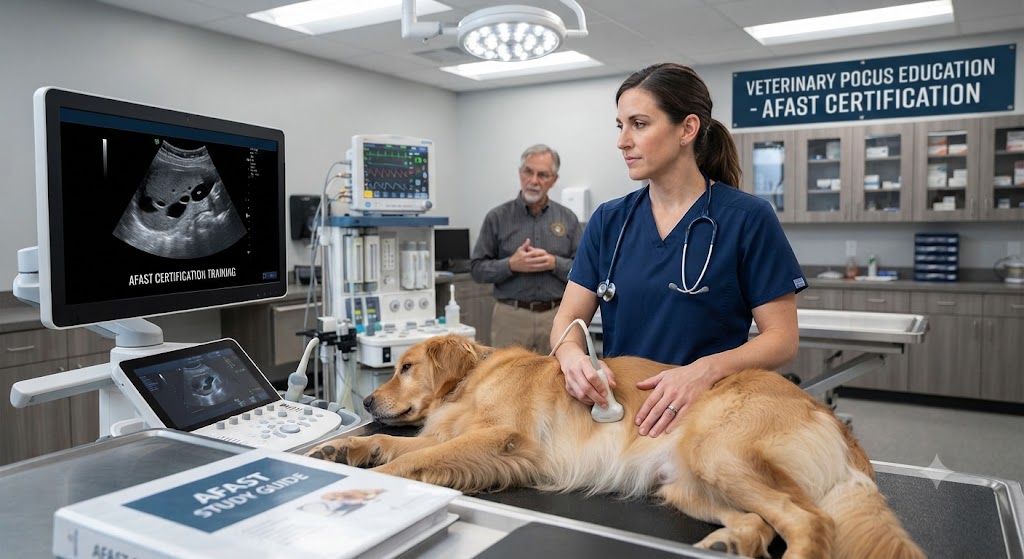
Additional Information
What the Course
Entails and Exam Details
The AFAST course and subsequent certification exam are
structured to build both cognitive knowledge and hands-on technical skills. The
curriculum typically covers several core competencies essential for accurate
diagnostic ultrasonography.
Core Topics Covered:
- Principles
of Ultrasound Physics: Understanding how ultrasound waves interact
with tissues, recognizing artifacts (such as the "mirror image"
artifact crucial for AFAST), and adjusting machine settings (gain, depth,
focus) for optimal imaging.
- AFAST
Anatomical Views: Mastery of the four standardized acoustic windows.
Candidates must learn the precise probe positioning for the
Diaphragmatico-Hepatic (DH), Splenic-Renal (SR), Cysto-Colic (CC), and
Hepato-Renal (HR) views.
- Target
Organ Identification: Recognizing the normal sonographic appearance of
the liver, spleen, kidneys, urinary bladder, and intestines, as well as
identifying the potential spaces where fluid accumulates.
- Fluid
Recognition: Identifying anechoic (black) areas representing free
fluid in the dependent regions of the abdomen.
- The
AFAST Scoring System: Learning how to apply a standardized scoring
system (e.g., a 4-point scale) based on the number of positive quadrants
to quantify the severity of effusion.
- Integration
into Triage: Understanding when and how to perform AFAST within the
larger context of the A-B-C (Airway, Breathing, Circulation) trauma triage
algorithm.
What to Expect in
the Final Exam
The AFAST certification exam is rigorous, typically divided
into two distinct sections to ensure comprehensive competency: a theoretical
component and a practical component. Both sections must be passed to earn full
certification.
Theoretical Exam (Cognitive Assessment):
- Format:
Usually composed of multiple-choice questions, true/false questions, and
image-based identification questions.
- Content:
Questions will test your knowledge of ultrasound physics, anatomy,
pathophysiology of trauma, indications for AFAST, and image
interpretation. You may be presented with static ultrasound images or
short video loops and asked to identify the view, normal vs. abnormal
findings, or artifacts.
- Time
Limit: Varies by certifying body, but typically ranges from 60 to 90
minutes.
- Passing
Score: Generally requires a score of 70% or higher, though this is
determined by the specific certifying organization (e.g., VetCOT, or
specific veterinary imaging academies).
Practical Exam (Hands-on Skills Assessment):
- Format:
This is a direct observation or simulation. Candidates must demonstrate
the ability to acquire diagnostic-quality images on a live, cooperative
animal or a high-fidelity simulator.
- Content:
You will be evaluated on patient preparation, probe selection, proper
transducer manipulation (sliding, rocking, fanning), and the ability to
rapidly obtain all four standardized AFAST views. Proctors will assess
your workflow, ergonomic technique, and your ability to recognize and
point out key anatomical landmarks and any simulated abnormalities.
- Passing
Score: Often graded on a pass/fail basis, requiring demonstration of
safe, efficient, and accurate scanning technique within a set time limit.
How to Study and
Exam Centers
Preparing for the AFAST exam requires a blend of didactic
study and dedicated hands-on practice. Because AFAST is a procedural skill,
passive learning is insufficient.
Actionable Study Strategies:
Review Foundational Anatomy:
Before diving into ultrasound, ensure your knowledge of canine and feline
abdominal anatomy is sharp. Use anatomical atlases to visualize where organs
lie relative to the body wall.
Invest in Quality Didactic
Material: Utilize textbooks dedicated to veterinary point-of-care
ultrasound, online e-learning modules, and recorded lecture series from
veterinary conferences. Focus specifically on sections covering AFAST
techniques and interpretation.
The "Knobology" is
Crucial: Spend time practicing with an ultrasound unit (even a simulator)
without a patient. Learn what every knob and setting does so that adjusting
gain or depth becomes second nature during a high-stress trauma scan.
High-Volume Hands-On Scanning:
This is the most critical component. You need to scan as many patients as
possible under the supervision of an experienced mentor. Practice finding the
views repeatedly until you can locate them instantly. Do not limit yourself to
trauma cases; scan stable wellness patients to build muscle memory and
recognize normal variations.
Image Review and Critique:
Save static images and video clips from your practice scans and review them
with a boarded radiologist or an experienced AFAST practitioner. Ask them to
critique your image quality and interpretation.
Utilize AFAST Practice Exams:
If available, take online practice tests. These familiarize you with the
question style and pressure of the theoretical exam.
Where and How to Take the Exam:
The AFAST certification is not administered by a single
global board; rather, it is offered by various recognized veterinary
organizations, academic institutions, and sometimes private training companies.
- Professional
Veterinary Organizations: Major organizations like the Veterinary
Committee on Trauma (VetCOT) or specialty colleges (ACVECC, ACVS) may
offer certification pathways, often in conjunction with large veterinary
conferences (e.g., IVECCS, VMX, WVC).
- Authorized
Training Centers and Wet Labs: Many hands-on AFAST workshops conclude
with an optional certification exam. These are typically multi-day
intensive courses held at specific host hospitals or conference centers.
- Academic
Institutions: University veterinary teaching hospitals occasionally
offer AFAST certification courses for alumni or external practitioners.
- Online
Portals: While the practical exam must be done in person, the
theoretical component is increasingly administered via secure online
testing platforms following the completion of an online course module.
To register, visit the websites of the organizations
mentioned above, search for "Veterinary POCUS Workshop and
Certification," and verify that their program includes the AFAST exam.
Job Opportunities from the Course
Earning AFAST certification is a direct investment in your
career trajectory within veterinary medicine. It proves you possess a
high-demand, specialized skill set that directly impacts patient survival
rates. This certification validates your expertise to employers and peers.
Specific Job Titles and Career Paths Unlocked:
- Emergency
Veterinarian: AFAST is an absolute requirement in modern high-volume
emergency practices. Certification makes you a highly competitive
candidate.
- Criticalist
(DACVECC): While AFAST is often taught during residency, advanced
certification demonstrates a mastery that aligns perfectly with the
requirements of a boarded critical care specialist.
- Small
Animal Surgeon: Surgeons utilize AFAST for rapid post-operative
assessment (e.g., checking for hemorrhage after a splenectomy) and
pre-operative triage.
- High-Level
Emergency Veterinary Technician (VTS - ECC): Veterinary Technicians
with VTS in Emergency and Critical Care are increasingly expected to
perform AFAST under veterinary supervision. Certification elevates your
role and earning potential.
- Shelter
Medicine Veterinarian: In high-intake shelters dealing with trauma or
cruelty cases, AFAST provides a cost-effective, rapid diagnostic tool.
- Mobile
Veterinary Ultrasonographer: Offering AFAST services to local general
practices that do not have in-house specialists can be a lucrative
entrepreneurial path.
- Continuing
Education Instructor: Once certified and experienced, you can become
an instructor for AFAST wet labs and workshops, teaching the next
generation of veterinarians.
Frequently Asked Questions
Reviews
5.0
Based on 0 reviews
Leave a Review
No reviews yet. Be the first to review!