
ABAA Certified Air Barrier Specialist Practice Test
$69.00
- Buy to unlock unlimited access to all Quiz questions.
- After purchase you can print a PDF of the whole quiz at any point. The PDF will contain the questions and the correct answers.
About this Exam
The ABAA Certified Air Barrier Specialist (CABS) certification is the premier, person-focused accreditation offered by the Air Barrier Association of America (ABAA). It is specifically designed for individuals who seek to be recognized as industry experts in the science, design, installation, and inspection of air barrier systems. This comprehensive program validates your knowledge and competency across five major air barrier methods: board stock, fluid applied, mechanically attached, self-adhered, and spray foam. The certification is aimed at a wide range of building professionals, including architects, engineers, consultants, building owners, inspectors, auditors, and trade contractors, positioning them as an expert resource for building stakeholders. Achieving CABS status demonstrates your commitment to quality and understanding of building code requirements, drawings and specifications, job-site testing procedures, material selection, and proper installation.
Ready to test your knowledge?
Buy Now to Access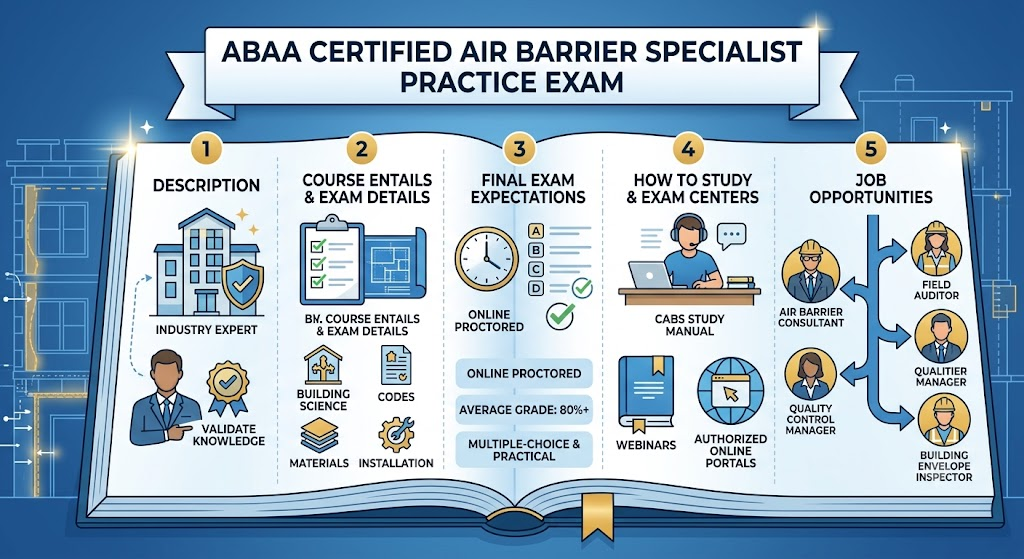
Additional Information
What the Course Entails and Exam Details
To prepare for the CABS exam, individuals typically engage with the ABAA’s CABS program materials. While specific preparatory course structures can vary (including self-study), the core curriculum is covered in the CABS Study Manual and relevant industry standards. The program covers an extensive syllabus, ensuring comprehensive knowledge.
Core Topics Covered:
Building Science Fundamentals: Understanding the principles of air leakage, heat transfer, moisture management, and vapor control within the building envelope.
Air Barrier Systems and Components: Detailed knowledge of different air barrier types (e.g., board stock, fluid-applied, mechanically attached, self-adhered, spray foam) and their specific properties.
Building Code Requirements: A clear understanding of national and local building codes related to air barriers and energy efficiency.
Drawings and Specifications: The ability to interpret architectural drawings and project specifications relevant to air barrier installation and continuity.
Material Selection and Compatibility: Selecting the appropriate air barrier materials for a project, considering substrate conditions and ensuring component compatibility.
Proper Installation Techniques: Detailed knowledge of installation methods for all major air barrier systems, including transition and detailing at penetrations and interfaces.
Quality Assurance and Control: Implementing a robust QA/QC program, including the ABAA Site Quality Assurance Program (QAP).
Field Testing and Inspection Procedures: An understanding of various testing standards and methods (e.g., adhesion, thickness, whole-building airtightness, ASTM standards) and how to conduct a proper inspection.
Safety Standards: Knowledge of relevant job-site safety practices for air barrier application.
What to Expect in the Final Exam
The actual ABAA Certified Air Barrier Specialist (CABS) certification assessment is an online proctored exam.
Exam Format:
The final CABS exam primarily consists of multiple-choice questions designed to test both theoretical knowledge and practical application of the core topics. You can expect questions that require you to interpret scenarios, select appropriate solutions, and demonstrate an understanding of standards and best practices.
Time Limit and Specific Rules:
The exam is time-limited, though the exact time allowed can vary by current ABAA policy. It is conducted via an online platform and requires a quiet environment, a stable internet connection, and a web camera for proctoring. You will likely need to schedule your session through an authorized testing portal. You must have a photo ID available for verification. The exam is closed-book, unless specified otherwise by ABAA current guidance for a specific part.
Passing Score Requirements:
While specific passing percentages can be adjusted, a rigorous standard is required to demonstrate specialist-level proficiency, typically an average passing grade of 80% or higher across the exam components (similar to the installer program, which requires a passing grade on both multiple choice and practical to be averaged).
How to Study and Exam Centers
Effective preparation is key to success on the CABS exam. ABAA provides official resources to guide your studies.
Actionable Study Strategies:
Purchase and Thoroughly Review the CABS Study Manual: This is the primary curriculum document. Create a study plan, take detailed notes, and understand every section.
Utilize the CABS Certification Handbook: This document outlines the entire certification process, requirements, and policy, which is vital for understanding what to expect.
Leverage Online Webinars and Articles: ABAA provides a library of online articles and a live webinar schedule. These resources often dive deeper into specific topics, such as building codes and the QAP.
Take a Practice Exam: Using a resource like this practice exam guide will help you understand the question format and identify areas where you need further study. Focus on the reason for correct answers.
Study ASTM and Related Standards: Familiarize yourself with key standards referenced in the manual, such as ASTM E2178 (material), ASTM E2357 (assembly), and whole-building airtightness testing methods.
Understand the QAP: Pay special attention to the role of field auditors, accredited contractors, and the documentation trail.
Exam Centers and Testing Portals:
The CABS exam is an Online CABS Proctored Exam, accessible globally. Once you have purchased the CABS Digital Study Manual and registered for the exam with ABAA, you will receive instructions on how to access the exam portal, which often uses third-party proctoring software. There are no specific physical "testing centers" required; you can take the exam from a suitable personal or professional location that meets the proctoring requirements.
Job Opportunities from the Course
A CABS certification is a powerful credential that differentiates you from your peers and opens numerous career paths across the architectural, engineering, construction, and building enclosure industries.
Career Paths Unlocked:
Air Barrier Consultant
Building Envelope Specialist
Building Enclosure Consultant
Field Auditor (within the QAP)
Architect or Engineer with a focus on sustainable and efficient building design
Quality Assurance Manager (for contractors)
Project Manager for a specialized air barrier contractor
Owner Representative or Building Inspector with building envelope expertise
Material Manufacturer Technical Representative
Third-Party Testing and Inspection Specialist
Sustainability Consultant
Disclaimer: This guide is a practice aid. Always refer to the official Air Barrier Association of America (ABAA) website for the most accurate and current certification requirements, fees, and exam policies.
Frequently Asked Questions
Reviews
5.0
Based on 0 reviews
Leave a Review
No reviews yet. Be the first to review!