
AAPC A/P Certified Inpatient Coder (CIC) Practice Exam
$69.00
- Buy to unlock unlimited access to all Quiz questions.
- After purchase you can print a PDF of the whole quiz at any point. The PDF will contain the questions and the correct answers.
About this Exam
The AAPC Certified Inpatient Coder (CIC) credential is the gold standard for medical coders working specifically in the inpatient hospital setting.
While many coders begin with outpatient certification (like the CPC), the CIC demonstrates mastery over the complexities unique to facility-based coding, which involves managing complete patient stays, multiple procedures, and complex diagnoses.
This certification is designed for experienced medical coders, medical records auditors, and healthcare professionals who wish to validate their expertise in ICD-10-CM and ICD-10-PCS coding systems as they apply to hospital inpatient cases. Earning the CIC credential signifies that a coder can accurately assign codes that determine hospital reimbursement and track public health data.
Ready to test your knowledge?
Buy Now to Access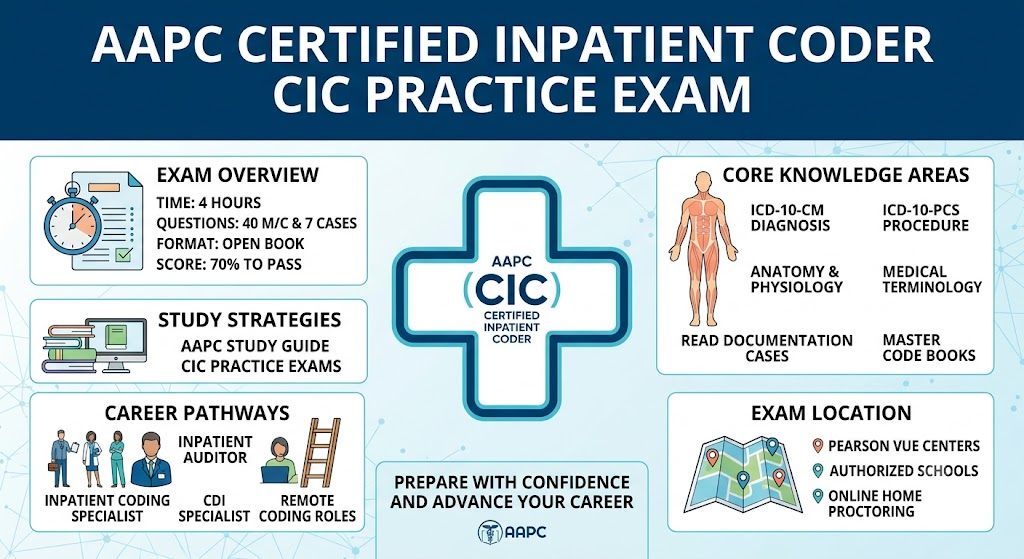
Additional Information
What the Course Entails and Exam Details
Preparing for the CIC exam requires a deep understanding of facility reimbursement methodologies and the specific coding systems used for inpatient cases.
The core syllabus and skills covered by the practice exam and the official certification include:
ICD-10-CM Coding: Expert-level application of the International Classification of Diseases, 10th Revision, Clinical Modification, focusing on assigning diagnoses and complications (CC/MCC) relevant to inpatient stays.
ICD-10-PCS Coding: Masterful use of the Procedure Coding System for classifying inpatient procedures, including complex surgical cases and root operation definitions.
Inpatient Prospective Payment System (IPPS): Understanding how DRGs (Diagnosis-Related Groups) are calculated and assigned based on coded data.
Uniform Hospital Discharge Data Set (UHDDS): Knowledge of official guidelines for reporting inpatient data elements.
Medical Terminology and Anatomy: A strong foundation in anatomy, physiology, and pharmacology is essential for correctly interpreting complex clinical documentation.
Compliance and Regulations: Awareness of official coding guidelines, HIPAA regulations, and fraud/abuse prevention in the hospital setting.
What to Expect in the Final Exam
The actual CIC certification exam is a rigorous test of speed and accuracy, designed to simulate the demands of a real-world hospital environment.
Format: The exam consists of 100 multiple-choice questions. It includes multiple-part scenarios where coders must assign both ICD-10-CM diagnoses and ICD-10-PCS procedures for comprehensive inpatient encounters.
Time Limit: You are allowed a total of 4 hours to complete the exam.
Passing Score: A passing score of 70% or higher is required to earn the credential.
Rules: The CIC exam is open-book, allowing the use of approved code books (ICD-10-CM and ICD-10-PCS) during the test.
Attempts: AAPC typically offers one free retake if you do not pass on your first attempt.
How to Study and Exam Centers
Preparation is critical. Because the CIC is an advanced certification, a systematic study approach is necessary.
Actionable Study Strategies:
Utilize AAPC Official Resources: Start with the official CIC Study Guide and take multiple AAPC CIC Online Practice Exams. These practice tests are essential for acclimating to the format and identifying weak points.
Master the Code Books: You must know your ICD-10-CM and ICD-10-PCS code books inside and out. Practice navigating the tabular and alphabetic indexes quickly and understanding the specific coding guidelines within each section.
Focus on DRG Logic: Understand how secondary diagnoses (CCs and MCCs) impact DRG assignment and hospital reimbursement.
Practice Case Studies: Work through complex, real-world inpatient scenarios, focusing on sequencing guidelines and procedure identification.
Exam Centers and Location:
The CIC exam is administered through several secure methods:
Live Online Proctoring (LOP): The most common option, allowing you to take the exam from a secure, private location (like a home office) while being monitored remotely via webcam by a certified proctor.
Physical Testing Centers: You can take the exam at an authorized Meazure Learning (formerly Scantron) testing center, located globally.
AAPC Local Chapters/Authorized Schools: Occasionally, exams may be proctored in person through specific AAPC local chapters or approved educational institutions.
Job Opportunities from the Course
Earning the CIC credential significantly expands career opportunities within hospital systems and healthcare organizations.
The certification unlocks specific roles, including:
Inpatient Medical Coder
Facility Coding Specialist
DRG Validator / DRG Analyst
HIM (Health Information Management) Coding Auditor
Clinical Documentation Improvement (CDI) Specialist
Coding Manager / Coding Supervisor
Hospital Compliance Officer
Frequently Asked Questions
Reviews
5.0
Based on 0 reviews
Leave a Review
No reviews yet. Be the first to review!