
Aaoifi Islamic Finance Practice Test & Exam Prep
$69.00
- Buy to unlock unlimited access to all Quiz questions.
- After purchase you can print a PDF of the whole quiz at any point. The PDF will contain the questions and the correct answers.
About this Exam
The Accounting and Auditing Organization for Islamic Financial Institutions (AAOIFI) offers world-renowned certifications that serve as the gold standard for professionals in the Islamic finance industry. These programs are meticulously designed for accountants, auditors, bankers, legal professionals, and regulators seeking to validate their expertise in Shari'ah compliance and global Islamic financial standards. Achieving an AAOIFI certification, often preceded by rigorous practice exams, demonstrates a deep understanding of the ethical and practical frameworks that govern modern Islamic financial transactions.
Ready to test your knowledge?
Buy Now to Access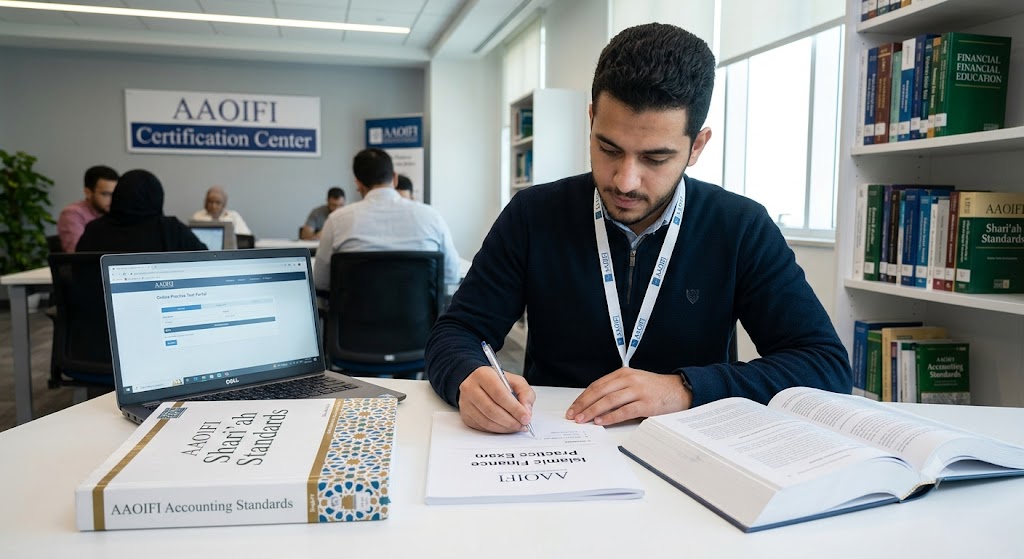
Additional Information
What the Course Entails and Exam Details
Preparing for an AAOIFI certification exam requires a
comprehensive grasp of the organization's extensive standards. The core
syllabus generally encompasses a thorough study of fundamental Islamic
financial contracts and products. This includes detailed modules on Shari’ah
Standards, which outline the foundational rules of permissible
transactions; Accounting Standards, focusing on the unique reporting
requirements of Islamic financial institutions; Auditing Standards,
covering compliance verification; and Governance Standards, detailing
the corporate structures and ethical guidelines necessary for the industry.
Specific topics often highlight contracts such as Murabaha, Ijarah, Musharakah,
Mudarabah, Takaful (Islamic insurance), and Sukuk (Islamic bonds). Candidates
are expected to not just memorize definitions but understand the application
and interpretation of these standards in complex financial scenarios.
What to Expect in the Final Exam
While specific exam details may vary depending on the exact
certification (e.g., CIPA, CS AA), most AAOIFI final exams are highly
challenging and structured to test both theoretical knowledge and practical
application. Candidates can typically expect a computer-based test consisting
primarily of Multiple-Choice Questions (MCQs), which may include scenario-based
questions designed to assess critical thinking and standards interpretation.
The exams often have a duration of 2 to 3 hours, requiring swift and accurate
responses. The passing score is rigorous, often requiring mastery of the
material (e.g., typically a minimum of 70% proficiency). Given the depth of the
content, time management is crucial, and candidates are strongly advised to
utilize a dedicated AAOIFI Islamic Finance Practice Test to familiarize
themselves with the question format, pacing, and overall exam structure before
attempting the final assessment.
How to Study and
Exam Centers
Effective preparation for AAOIFI exams demands a strategic
and disciplined approach. Successful candidates generally combine the study of
official AAOIFI standards publications with professional training workshops and
extensive self-assessment.
- Study
Official Materials: The core requirement is studying the official
AAOIFI standards (Shari’ah, Accounting, Auditing, etc.).
- Utilize
Practice Exams: Regularly taking mock exams and practice tests is
essential. This builds stamina, identifies knowledge gaps, and improves
familiarity with the MCQ format. Focus on understanding why an
answer is correct rather than just memorizing it.
- Join
Study Groups: Collaboration with other students or professionals can
provide diverse perspectives and enhance understanding of complex topics.
- Focus
on Application: Practice interpreting and applying the standards to
real-world financial situations, as many exam questions will test this
ability.
Exam Centers and Delivery: AAOIFI exams are usually
delivered globally through established computer-based testing networks or
authorized educational centers. Candidates typically register for the exam via
online portals provided by AAOIFI or its testing partners (such as Pearson VUE,
if applicable to the specific program). Exams may also be conducted at AAOIFI’s
own authorized training centers or occasionally via online proctoring
solutions, depending on the current guidelines and the specific certification
program.
Job Opportunities from the Course
Earning a certification from AAOIFI significantly enhances
career prospects within the global Islamic finance sector, opening doors to
various specialized and highly respected roles. Potential job opportunities
include:
- Shari’ah
Auditor
- Islamic
Banker / Finance Officer
- Shari’ah
Compliance Officer
- Islamic
Finance Consultant
- Accounting
Manager in Islamic Financial Institutions
- Regulator
/ Policy Maker in Islamic Finance Jurisdictions
- Islamic
Investment Analyst
- Academic
/ Researcher in Islamic Finance
- Risk
Manager in Islamic Banks
Frequently Asked Questions
Reviews
5.0
Based on 0 reviews
Leave a Review
No reviews yet. Be the first to review!