
AAMI Science Practice Exam.
$69.00
- Buy to unlock unlimited access to all Quiz questions.
- After purchase you can print a PDF of the whole quiz at any point. The PDF will contain the questions and the correct answers.
About this Exam
The AAMI Science Practice Exam is an essential preparatory tool designed for students and entry-level professionals aiming to achieve certification from the Association for the Advancement of Medical Instrumentation (AAMI).
This practice exam serves as a simulation for candidates preparing for foundational AAMI certifications, such as the Certified Associate in Biomedical Technology (CABT) and the Certified Biomedical Equipment Technician (CBET), which require a strong grasp of scientific principles.
It is tailored for individuals looking to validate their knowledge in the core sciences—including anatomy, physiology, basic electronics, and healthcare safety—before sitting for their final, high-stakes proctored exam.
By utilizing this resource, examinees can identify knowledge gaps, familiarize themselves with the question format, and build the confidence necessary to succeed in their biomedical career path.
Sample Questions
Explanation:
Explanation:
Explanation:
Explanation:
Explanation:
Ready to test your knowledge?
Buy Now to Access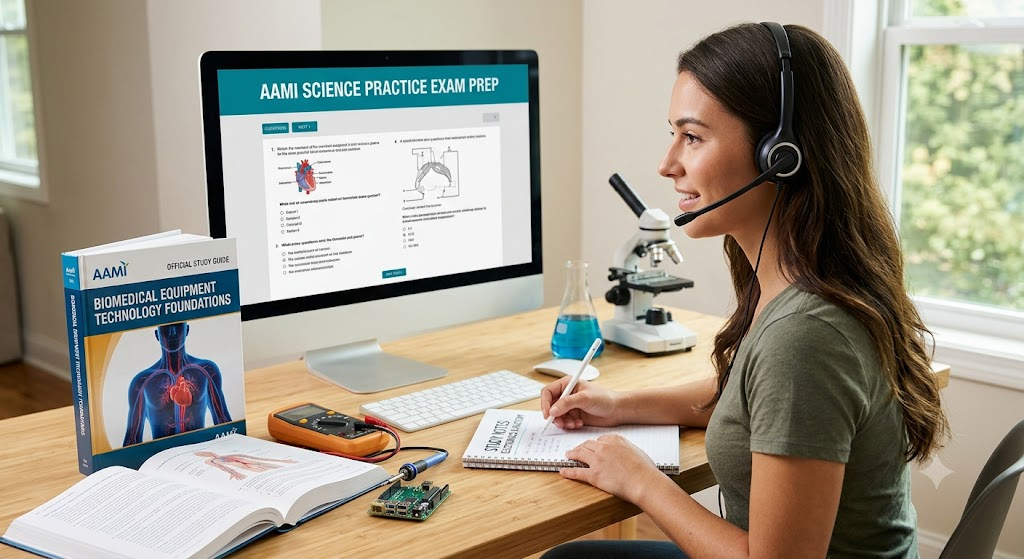
Additional Information
What the Course Entails and Exam Details
The AAMI Science Practice Exam is a comprehensive review covering a broad spectrum of fundamental concepts crucial to the healthcare technology management (HTM) field.
While specific content may vary by practice form, the core topics and skills you can expect to encounter include:
Anatomy and Physiology: Fundamental knowledge of human body systems, major organ functions, and basic medical terminology.
Fundamentals of Electricity and Electronics: Concepts of voltage, current, resistance, power, and basic circuit components and their symbols.
Healthcare Technology and Safety: Recognition of common medical devices and their basic functions, proper laboratory procedures, infection control, and standard safety protocols within a healthcare environment.
Scientific Problem Solving: Application of scientific methods to basic technical issues, interpretation of technical diagrams, and basic troubleshooting logic.
The practice exam typically consists of a predetermined number of multiple-choice questions, structured to mimic the complexity and distribution found on official AAMI certification exams.
It is crucial to note that this is a practice exam; the syllabus for the final CABT or CBET will cover these areas in greater depth and weight, including healthcare information technology and more complex problem-solving.
What to Expect in the Final Exam
When you move from the practice phase to the formal AAMI certification exam (e.g., CABT or CBET), you will encounter a more rigid testing environment.
The final, official exams, administered by the AAMI Credentials Institute (ACI), are computer-based and must be taken at a secure, proctored testing center or via an authorized online proctoring service.
Key details to keep in mind for the final exam include:
Format: The actual certification exams typically feature between 100 and 165 multiple-choice questions.
Time Limit: Candidates are generally given approximately 2 to 3 hours to complete the test, depending on the specific certification.
Passing Score: A passing score must be achieved, which is often a scaled score or a minimum number of correct answers (e.g., 116 correct out of 165 for the CBET).
Testing Windows: Some AAMI exams are administered during specific testing windows (e.g., May and November), while others like the CABT may be available year-round.
Rules: Strict security measures are enforced; you will need to provide government-issued photo identification, and no personal items, reference materials, or unauthorized electronic devices are allowed in the testing area. A simple 5-function calculator is often permitted.
How to Study and Exam Centers
Effective preparation is the key to passing your AAMI certification exam. Utilizing the AAMI Science Practice Exam is a major step, and a proactive study strategy will maximize its value.
Follow these actionable methods:
Simulate Test Conditions: Take your practice exam in a quiet, distraction-free environment, mimicking the strict time limits and rules of the real testing center to build your pacing and endurance.
Analyze Your Results: Do not just look at your score. Meticulously review every question, especially those you answered incorrectly or found difficult. Understand why the correct answer is correct and revise those specific topics.
Focus on Weak Areas: Use the score report to identify the domains (e.g., anatomy, electronics) where you are least proficient and dedicate a significant portion of your study time to mastering those subjects.
Use Official AAMI Resources: Supplement your practice with official AAMI study guides, webinars, and training courses, which provide in-depth content tailored directly to the current exam objectives.
Create Flashcards and Diagrams: Create study aids for medical terminology, physiological systems, electronic formulas, and circuit symbols to reinforce recall.
For information on taking the official final exam, you must register with the AAMI Credentials Institute (ACI).
The official proctored exams are generally taken at authorized physical testing centers, such as those provided by Kryterion Global Testing Solutions, which have locations worldwide, or through specified proctored online testing platforms as detailed in the AAMI Candidate Handbook.
Job Opportunities from the Course
Successfully preparing for and achieving an AAMI certification unlocks numerous specialized and rewarding career paths within the healthcare technology management (HTM) field.
The industry-recognized validation positions you as a qualified professional to employers. Potential job opportunities include:
Biomedical Equipment Technician (BMET)
Biomedical Engineering Technologist
Biomedical Equipment Specialist
Clinical Engineering Technician
Healthcare Technology Management (HTM) Professional
Field Service Engineer for Medical Devices
Medical Device Sales Representative (Technical Support)
Medical Equipment Repair Technician
Achieving certifications like the CABT or CBET can directly lead to increased job security, higher salary potential, and opportunities for advancement into leadership or management roles within hospital systems, third-party service organizations, and medical device manufacturers.
Frequently Asked Questions
Reviews
5.0
Based on 0 reviews
Leave a Review
No reviews yet. Be the first to review!