
AAMC Critical Analysis and Reasoning Skills (CARS) Full-Length (FL) 1 Practice Test
$69.00
- Buy to unlock unlimited access to all Quiz questions.
- After purchase you can print a PDF of the whole quiz at any point. The PDF will contain the questions and the correct answers.
About this Exam
Welcome to your essential first step in conquering the critical thinking challenge of the Medical College Admission Test (MCAT)! The AAMC CARS Full-Length (FL) 1 Practice Test is a cornerstone tool for students preparing for one of the exam's most demanding and unique sections. The Critical Analysis and Reasoning Skills section isn't about factual knowledge; it's about evaluating your ability to analyze intricate arguments, understand subtle nuance, and synthesize information from a diverse range of complex humanities and social science passages. This practice test is specifically designed by the makers of the MCAT—the AAMC—to provide the most representative experience possible. Aspiring medical students will find FL 1 invaluable for gauging their current performance, identifying skill gaps, and building the essential stamina required for the real exam day. This guide and practice material are for you if you're dedicated to achieving a competitive MCAT score and unlocking your path to medical school.
Ready to test your knowledge?
Buy Now to Access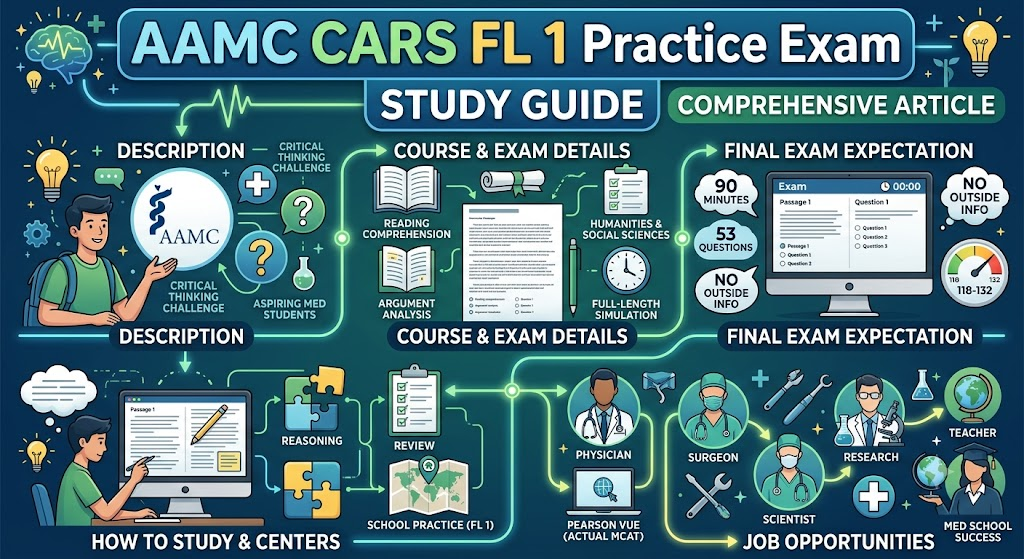
Additional Information
What the Course Entails and Exam Details
This practice test is an entire, simulated 90-minute CARS section, mirroring the real MCAT in length, format, and passage types. It covers a full range of topics including philosophy, logic, social studies, ethics, literature, cultural studies, and historical analysis. The skills tested within this FL include advanced reading comprehension, the ability to identify an author’s argument and supporting evidence, reasoning both within the text and beyond to new scenarios, and analyzing cross-cultural and intricate perspectives. While it is not a "course" in the traditional sense, preparing for and reviewing FL 1 demands a deep dive into active reading strategies, understanding logic and argumentative structure, and refining passage annotation techniques. Crucially, FL 1 offers a detailed scoring breakdown and comprehensive answer explanations, allowing you to learn from your successes and mistakes. The entire simulation is passage-based, presenting you with approximately 53 multiple-choice questions across 9 complex readings.
What to Expect in the Final Exam
While the AAMC CARS FL 1 is a practice test and not the official exam itself, it is designed to precisely simulate the environment of the actual MCAT. You should expect nine distinct passages, each roughly 500-600 words long. Following each passage is a set of carefully crafted multiple-choice questions. These questions are not designed to test outside knowledge but rather your raw analytical and reasoning abilities based only on the provided text. They typically fall into three categories: Foundations of Comprehension, Reasoning Within the Text, and Reasoning Beyond the Text. There is no official "passing score" for this practice test, but you will receive a raw score (questions correct out of 53) and an estimated scaled score on the MCAT scale (118-132). Success here is measured by your performance relative to your goals and improvement over time. The entire simulated CARS section will have a strict 90-minute time limit, and standard test-taking rules apply: manage your time effectively, read actively, and select the single best answer for each question.
How to Study and Exam Centers
Effective study for CARS requires a dynamic and skill-focused approach, and the AAMC CARS FL 1 should be the centerpiece of this effort.Study Strategies:
Practice Active Reading: Engage deeply with everyday and complex texts outside of MCAT materials. Focus on understanding the central theme, tone, structure, and main arguments. Annotate actively by highlighting and mentally summarizing each passage.
Master Reasoning Skills: Dedicate time to understanding the different CARS question types and developing distinct strategies for each. Learn to differentiate between evidence presented, inferences required, and potential applications to new scenarios.
Take it under Full-Length Conditions: To get the most accurate simulation, take the FL 1 in a single, timed session, without distractions, and in a quiet environment that mimics the test center experience.
Conduct a Thorough Review: This is the most critical step. Go through every question—both correct and incorrect. Understand why you chose the wrong answer and why the correct answer is right according to the AAMC’s reasoning. Classify your errors (e.g., timing, comprehension error, reasoning error). This practice will refine your thinking for the next attempt.
Utilize All AAMC Resources: The AAMC provides a wealth of official practice materials; integrate them with your use of FL 1.
Exam Centers: This specific AAMC FL 1 Practice Test is administered online through the official AAMC portal. You can take it from any computer with a stable internet connection, typically from the comfort of your own home, library, or study space. This contrasts with the actual MCAT, which is a standardized computer-based test taken in-person on scheduled dates at designated Pearson VUE professional test centers. Remember, while you take the FL online, your preparation and performance are crucial practice for the high-stakes environment of the eventual test day at an official center.
Job Opportunities from the Course
A strong performance on the MCAT CARS section is a pivotal factor for admission to allopathic (MD) and osteopathic (DO) medical schools. Your journey through medical school and residency, enabled by a competitive MCAT score (of which CARS is a key component), unlocks an incredibly diverse and rewarding range of career paths. High CARS scores demonstrate the sophisticated critical analysis and reasoning skills highly valued by medical school admissions committees, indicating potential for success in rigorous academic programs and subsequent clinical practice.
Career Paths and Opportunities Opened by Medical School:
Physician (various specialties): Family Medicine, Internal Medicine, Pediatrics, OB/GYN, Emergency Medicine, Anesthesiology, Radiology, Psychiatry, etc.
Surgeon: General Surgery, Orthopedic Surgery, Neurosurgery, Cardiac Surgery, Plastic Surgery, etc.
Medical Research & Academia: Physician-scientist, academic mentor, clinical research lead, medical school faculty.
Healthcare Administration & Leadership: Chief Medical Officer, Hospital Administrator, Medical Director.
Public Health & Policy: Epidemiologist, Public Health Official, Healthcare Consultant.
Medical Educator: Training the next generation of physicians and healthcare providers.
A competitive CARS score is more than just a number; it’s a strong indicator to medical schools that you have the refined reasoning and analytical skills needed to thrive in medical school and become a successful, compassionate physician.
Frequently Asked Questions
Reviews
5.0
Based on 0 reviews
Leave a Review
No reviews yet. Be the first to review!