
AAMC Biological and Biochemical Foundations of Living Systems (BB) Full-Length (FL) 2 Practice Test
$69.00
- Buy to unlock unlimited access to all Quiz questions.
- After purchase you can print a PDF of the whole quiz at any point. The PDF will contain the questions and the correct answers.
About this Exam
The AAMC Biological and Biochemical Foundations of Living Systems (BB) Full-Length (FL) 2 Practice Test is an official resource designed to simulate the actual MCAT experience, specifically focusing on one of its most challenging sections. This practice exam is created by the Association of American Medical Colleges (AAMC), the same organization that develops and administers the MCAT, making it the most representative and predictive tool available.
It is intended for students preparing for medical school admission in the United States and Canada who need to test their knowledge and reasoning skills in biology and biochemistry. Successfully utilizing this practice test helps candidates gauge their readiness, identify knowledge gaps, and refine their test-taking strategies under timed, realistic conditions, which is crucial for achieving a competitive score on the official exam.
Ready to test your knowledge?
Buy Now to Access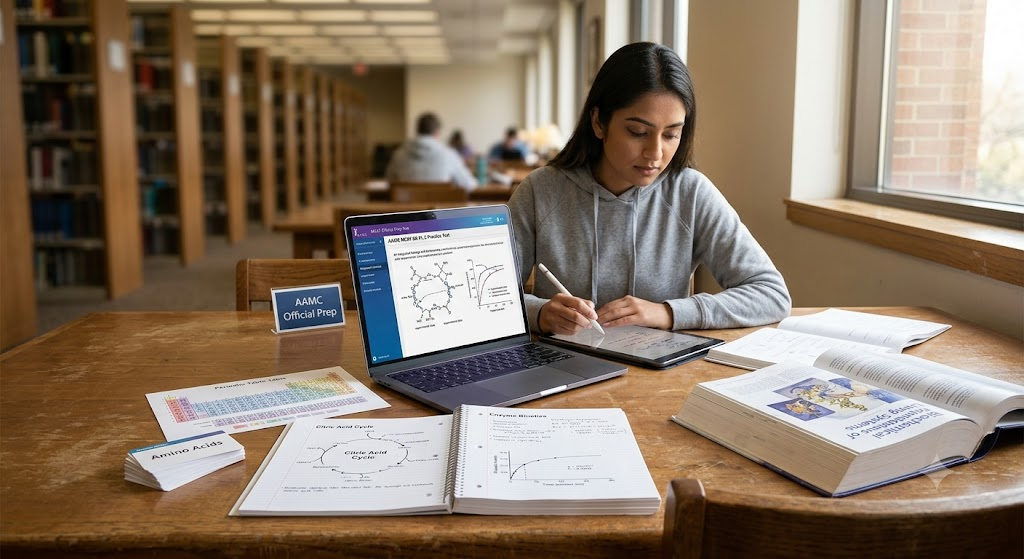
Additional Information
What the Course Entails and Exam Details
This practice test assesses fundamental concepts in the life sciences and your ability to apply scientific inquiry and reasoning. The core areas covered within the BB section include molecular biology, cellular biology, human physiology, genetics, and introductory biochemistry. Students must demonstrate proficiency in understanding complex biological systems, interpreting data from scientific passages, and connecting basic principles to novel problems.
The official MCAT BB section structure, which this practice test replicates, focuses on four foundational concepts: (1) highly organized assemblies of molecules, cells, and organs that interact to carry out functions, (2) highly organized interactions and processes unique to living organisms, (3) how energy and matter are processes by organisms, and (4) how organisms sense, respond to, and interact with their environments. While 65% of the section content is based on introductory biology and 25% on first-semester biochemistry, 5% comes from general chemistry and 5% from organic chemistry, demanding an integrated approach to studying.
What to Expect in the Final Exam
When you sit for the AAMC BB FL 2 Practice Test, you will encounter 59 multiple-choice questions to be completed within 95 minutes. The questions are a mix: approximately 10 passage-based sets, each with 4–6 questions, and 15 independent or discrete questions. Passage-based questions require you to analyze data, read experimental methods, and apply knowledge to unfamiliar scenarios.
Unlike professional certifications with a clear "passing" score, the MCAT BB section is scored on a scale from 118 to 132. Your performance on FL 2 provides a predictive section score, which, alongside the other three MCAT sections, contributes to a total score ranging from 472 to 528. A total score around 500 is the 50th percentile, while competitive applicants for medical school typically aim for total scores above 510, with 127+ in the BB section often considered strong. While there is no strict time rule beyond the total 95 minutes for the section, managing your time is critical, as you must average approximately 96 seconds per question, including reading passages.
How to Study and Exam Centers
Effective use of AAMC FL 2 requires meticulous review, not just completion. First, take the entire practice test, including all four MCAT sections, in a single, undisturbed setting that mimics actual test conditions, starting at 8:00 AM, with timed breaks. After completion, review every question, including the ones you got right. Classify each mistake into three buckets: content gap (you didn't know the material), reasoning error (you couldn't connect the pieces), or timing (you ran out of time).
Create a "Gold Notes" document to summarize the learning points from your errors and key passage insights. Focus on mastering high-yield biochemistry topics like enzyme kinetics, metabolic pathways (glycolysis, citric acid cycle, ETC), protein structure, and amino acids, as these reward deep understanding over isolated memorization. The AAMC BB FL 2 Practice Test is a digital resource taken through the official AAMC MCAT Official Prep Hub online portal. For the official MCAT, you will schedule and take the exam at an authorized Pearson VUE testing center, which can be located on the Pearson VUE or AAMC website.
Job Opportunities from the Course
A strong performance on the MCAT, supported by effective practice on resources like AAMC BB FL 2, is the essential first step toward a medical career. This path leads to various job titles and specializations:
Medical Doctor (MD): Diagnosing and treating illnesses in a wide range of specialties (e.g., family medicine, surgery, pediatrics).
Doctor of Osteopathic Medicine (DO): Practicing medicine with a whole-person approach to healthcare, often focusing on primary care.
Medical Researcher: Conducting clinical or basic science research to develop new treatments, drugs, or diagnostics in academia, government, or private industry.
Physician Assistant (PA): Practicing medicine on teams with physicians, surgeons, and other healthcare workers.
Pharmacist: Dispensing prescription medications and offering expertise in their safe use.
Veterinarian: Diagnosing and treating diseases and injuries in animals.
Dentist: Diagnosing and treating problems with patients' teeth, gums, and related parts of the mouth.
Biomedical Engineer: Combining engineering principles with medical sciences to design and create equipment, devices, computer systems, and software.
Genetic Counselor: Assessing individual or family risk for a variety of inherited conditions.
Epidemiologist: Investigating patterns and causes of disease and injury in humans.
Frequently Asked Questions
Reviews
5.0
Based on 0 reviews
Leave a Review
No reviews yet. Be the first to review!