
AAFM Boards Dermatology Practice Test
$69.00
- Buy to unlock unlimited access to all Quiz questions.
- After purchase you can print a PDF of the whole quiz at any point. The PDF will contain the questions and the correct answers.
About this Exam
The AAFM Boards Dermatology Practice Test is a high-level self-assessment tool designed for medical practitioners, particularly family physicians and primary care providers, who have extensive experience or advanced study in dermatology. This comprehensive practice test, though not representing an official board certification in itself (such as the American Board of Dermatology), is structured to simulate the rigor, style, and essential medical knowledge required for advanced dermatological qualifications, including various subspecialty examinations or Certificates of Added Qualifications (CAQs) associated with different primary care bodies. Successful completion of this type of thorough practice indicates a readiness for advanced studies and can validate expertise in managing complex skin conditions within a primary care setting, serving as a powerful credential on a professional path.
Ready to test your knowledge?
Buy Now to Access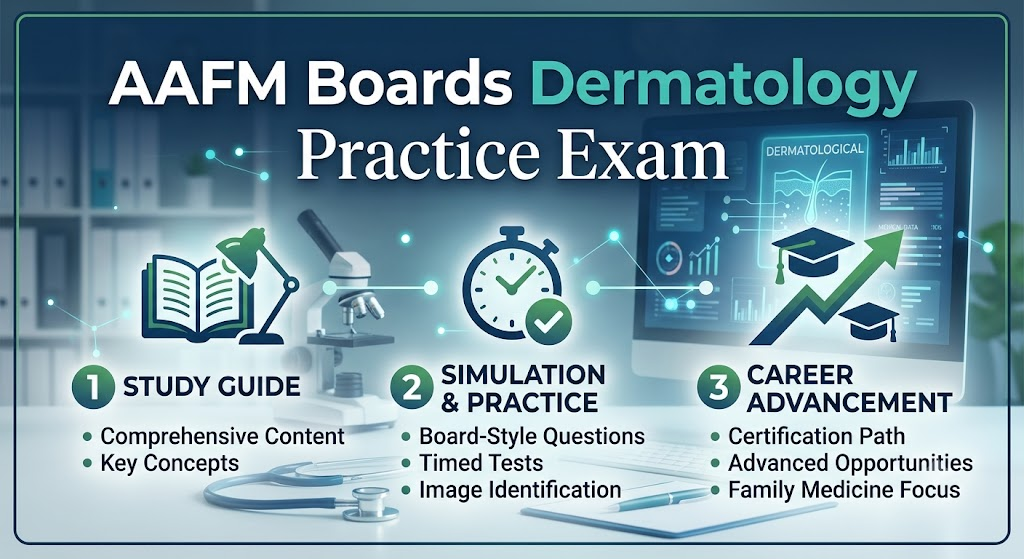
Additional Information
What the Course Entails and Exam Details
The course of study and the associated practice test focus on a wide spectrum of dermatological topics relevant to an advanced practitioner. This includes, but is not limited to: detailed knowledge of skin anatomy and function; accurate visual diagnosis and management of common skin conditions like acne, psoriasis, eczema, and skin infections; proficiency in identifying benign and malignant skin tumors (such as basal cell carcinoma, squamous cell carcinoma, and melanoma); fundamentals of dermatopathology; basic procedural dermatology techniques (e.g., biopsies, cryosurgery); and the broader integration of dermatology into comprehensive patient care. As a simulated exam, the content is curated to mirror typical board questions, often presented in a multiple-choice format with clinical scenarios, high-resolution images, and diagnostic and therapeutic management challenges.
What to Expect in the Final Exam
When approaching a practice or simulated board exam for dermatology like this, candidates should anticipate an online, time-limited testing experience. A typical structure may include numerous multiple-choice questions (MCQs), often totaling over a hundred. A significant portion of the test will be case-based, requiring the interpretation of patient histories, clinical symptoms, and, crucially, high-quality images of dermatological conditions to make accurate diagnoses and recommend appropriate treatment plans. The passing score for a practice test is generally set to challenge the student, often mirroring standard board expectations (which can vary) or aiming for a high percentile, encouraging a focus on deep understanding and visual recognition skills, rather than just simple recall.
How to Study and Exam Centers
Effective study for a challenging dermatology test involves a multifaceted approach. Essential methods include: thorough review of comprehensive medical dermatology textbooks and official study materials from recognized medical academies; active participation in specialized dermatology Continuing Medical Education (CME) courses and workshops; a strong emphasis on visual recognition through atlases and online clinical databases; study groups with peers for collaborative review; and, most importantly, consistent practice with multiple practice exams and case scenarios to become familiar with question formats and identify knowledge gaps. Regarding exam centers, official medical specialty boards and certifications typically require in-person attendance at specific authorized test centers like Pearson VUE or board-specific testing facilities. However, a dedicated practice test like this is frequently offered through specialized educational websites and portals, allowing candidates to simulate the exam experience from the convenience of their own location.
Job Opportunities from the Course
Successfully completing this kind of rigorous practice and, by extension, achieving the corresponding advanced proficiency and actual certifications, unlocks multiple advanced career paths for a primary care physician:
Specialized Family Physician: Integrate advanced dermatology into a private or group practice, attracting patients specifically for skin concerns.
Dermatology Focus Practitioner: Dedicate a significant portion of practice within a multispecialty clinic or community health center.
Community Health Center Leader: Provide expertise in dermatology to underserved populations, reducing the need for specialist referrals.
Academic Clinician/Faculty: Teach advanced dermatology topics and visual diagnosis in medical schools or residency programs.
Research & Consulting: Advise on dermatological services, procedures, or product development, drawing on specialized primary care insights.
Ultimately, this level of focused study and validation is a crucial step towards distinguishing oneself as a leader in comprehensive primary care dermatology.
Frequently Asked Questions
Reviews
5.0
Based on 0 reviews
Leave a Review
No reviews yet. Be the first to review!