
AAFCS Credential Practice Test
$69.00
- Buy to unlock unlimited access to all Quiz questions.
- After purchase you can print a PDF of the whole quiz at any point. The PDF will contain the questions and the correct answers.
About this Exam
The American Association of Family and Consumer Sciences (AAFCS) offers professional credentialing to validate the knowledge and skills of individuals across the comprehensive field of Family and Consumer Sciences (FCS). This practice test is a vital preparation tool designed for aspiring and current professionals, including educators, extension agents, human services specialists, nutritionists, and consumer advocates, who intend to pursue one of the official AAFCS certifications. The official credentials, such as the Certified in Family and Consumer Sciences (CFCS) or specialized concentrations, demonstrate a commitment to professional excellence and rigorous standards in the field. This practice test helps candidates gauge their readiness and identify areas for further study.
Ready to test your knowledge?
Buy Now to Access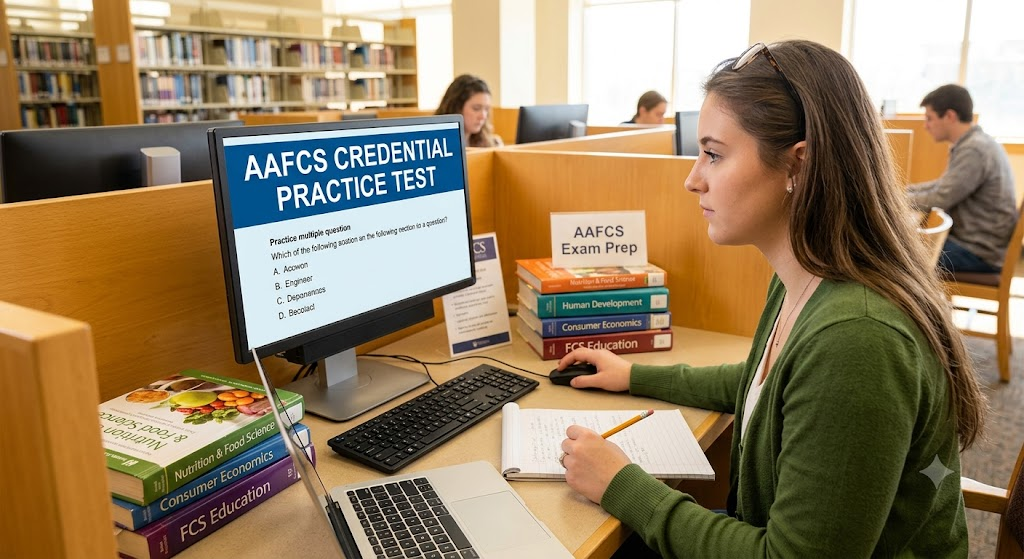
Additional Information
What the Course Entails and Exam Details
This comprehensive practice test aligns with the core competency areas assessed in the overall AAFCS credentialing program, specifically reflecting the breadth of the Family and Consumer Sciences Composite Examination. The exam covers six primary domains that are integral to the FCS profession. These domains include: Human Development and Family Studies, which focuses on lifespan development, family dynamics, and relationships; Nutrition, Wellness, and Food Science, covering principles of food science, human nutrition, and health; Consumer and Family Resources, detailing consumer economics, resource management, and financial literacy; Textiles and Apparel, including textile science, product analysis, and design; Housing and Interior Design, focusing on environment, design principles, and housing issues; and Family and Consumer Sciences Education and Communications, which includes curriculum development, teaching strategies, and professional communication.
What to Expect in the Final Exam
While a specific practice test might vary slightly, candidates taking an official AAFCS credentialing exam can expect a computer-based test consisting of approximately 100 to 150 multiple-choice questions, depending on the specific certification title. For example, the FCS Composite and HDFS examinations typically feature 100 items, while the Nutrition and Wellness Educator (NWE) and Personal and Family Finance Educator (PFFE) exams contain 150 items. Candidates generally have a strict three-hour time limit to complete the test. AAFCS exams use a scaled scoring system to ensure consistency across different test versions; the passing standard is a scaled score of 240 out of a maximum 300 points. Candidates receive an immediate, unofficial score report at the test center upon completion.
How to Study and Exam Centers
Preparation for an AAFCS credentialing exam requires a combination of reviewing foundational knowledge and mastering test-taking strategies. The most critical step is to obtain the "Candidate Information Bulletin" and "Study Guide" for your specific exam title directly from the official AAFCS website. These documents contain detailed test specifications, lists of recommended study references, and sample questions. Create a structured study plan that dedicates time to each content domain, focusing on areas where your knowledge is less robust. Leverage standard university-level textbooks and professional resources in FCS subject areas. Finally, taking multiple practice tests is essential. Utilize practice exams to get comfortable with the multiple-choice format, identify content gaps, and practice managing your time within the three-hour constraint. When you are ready to take the official exam, you will register online through the MyAAFCS portal. The exams are administered via a network of computer-based testing centers across the nation, typically operated by third-party testing services such as Prometric or Pearson VUE, or sometimes through authorized universities.
Job Opportunities from the Course
Earning an AAFCS credential significantly enhances professional credibility and opens doors to a wide range of career paths. This certification validates expertise that is highly valued by employers across various sectors. Potential job opportunities and career paths for certified individuals include:
Family and Consumer Sciences Educator (Middle and High School Levels)
University Professor or Lecturer in FCS Domains
Cooperative Extension Agent or Specialist (focusing on Family & Consumer Sciences)
Consumer Advocate or Consumer Affairs Specialist
Nutritionist or Health and Wellness Educator (non-dietitian roles)
Family Life Educator or Human Services Professional
Child Development or Early Childhood Education Specialist
Personal Financial Educator or Counselor
Textile and Apparel Product Analyst or Retail Manager
Residential Interior Design or Housing Consultant
Frequently Asked Questions
Reviews
5.0
Based on 0 reviews
Leave a Review
No reviews yet. Be the first to review!