
AAFC Aviation Proficiency Practice Exam.
$69.00
- Buy to unlock unlimited access to all Quiz questions.
- After purchase you can print a PDF of the whole quiz at any point. The PDF will contain the questions and the correct answers.
About this Exam
The AAFC Aviation Proficiency qualification is a key milestone for members of the Australian Air Force Cadets (AAFC), a premier youth development organization with an aviation focus. This proficiency program is specifically designed to provide young Australians with a structured introduction to the world of aviation, moving beyond simple air experience flights. It equips cadets with a foundational level of both theoretical knowledge and practical understanding, which can then be used to progress towards a first solo flight and the attainment of a pilot license. Ultimately, the AAFC Aviation Proficiency exam serves to validate that a cadet is ready to undertake more advanced, formal flight training within the AAFC's flying pathways, such as Powered Flying Training or Gliding Training courses. This assessment ensures that a cadet is suitable, enthusiastic, and committed to a future in aviation, filtering for those who can maintain high standards of discipline and safety.
Sample Questions
Explanation:
Explanation:
Explanation:
Explanation:
Explanation:
Ready to test your knowledge?
Buy Now to Access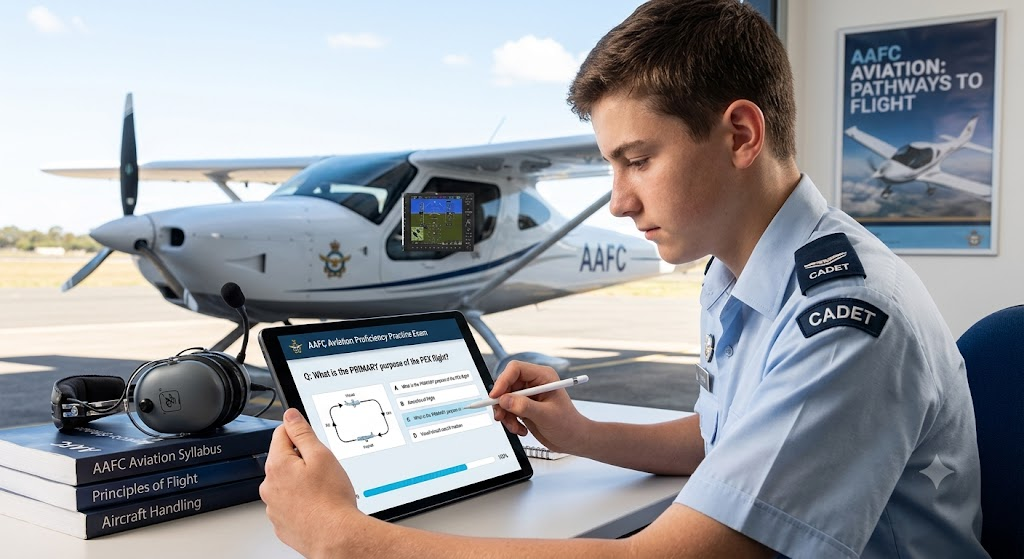
Additional Information
What the Course Entails and Exam Details
This proficiency course encompasses both comprehensive theoretical modules and practical hands-on experience, aimed at fostering an all-encompassing understanding of the aviation environment. Cadets progress through a curriculum that covers a wide spectrum of essential topics, including:
Aviation Theory: Flight mechanics, aerodynamics, aircraft performance, and basic meteorology.
Aircraft Handling: Primary aircraft controls, maneuvers (take-offs, landings, turns), and energy management.
Navigation and General Knowledge: Air Law, basic chart reading, and standard operating procedures.
Aviation Engineering: An introduction to aircraft systems, maintenance principles, and safety inspections.
Flight Operations and Safety: Situational awareness, crew resource management (CRM), risk assessment, and abnormal/emergency procedures.
Service Knowledge: Familiarization with Australian Defence Force (ADF) aircraft and military aviation history. The theoretical components are often delivered through the home training curriculum and specific phase missions, utilizing diverse, experiential learning methods to make complex concepts engaging.
What to Expect in the Final Exam
While the final assessment method can vary based on specific wing requirements and course delivery, the AAFC Aviation Proficiency Practice Exam serves as a direct mirror of what cadets will face. You can expect a multi-component assessment:
Written/Computer-Based Exam: The theoretical component typically takes the form of a supervised multiple-choice or short-answer exam. This will test retention across all the core areas outlined in the course curriculum. A solid passing score, often around 70-80% or a ranking within a certain percentile, is usually required to demonstrate sufficiency.
Practical Assessment/Review: Depending on whether a pilot trajectory is sought, a cadet's suitability may also be assessed through:
Flight Instructor Review: For CFT (Cadet Flying Training) recommendation, a commanding officer and a qualified flying instructor will review the cadet's performance and attitude during instructional and pilot experience flights.
Interview: An interview with AAFC aviation personnel to assess suitability, enthusiasm, and commitment to a serious aviation pathway.
Skill Demonstration: Although the final exam is primarily academic and behavioral, the practical training in simulators or light aircraft directly leads to this assessment. You must demonstrate safe aircraft handling, the ability to manage aircraft systems, and safe decision-making.
How to Study and Exam Centers
Preparation for the AAFC Aviation Proficiency exam requires a combination of disciplined academic study and active participation in practical sessions.
Actionable Study Strategies:
Review AAFC Syllabus and Missions: The absolute best source of information is your home squadron training materials, including phase mission handouts and specific aviation proficiency workbooks.
Create a "Checklist" Study Plan: Organize your study by core topics, creating detailed checklists for knowledge areas like 'Air Law,' 'Flight Theory,' and 'Aircraft Systems.'
Practice with the 'STAR+R' Method for Behavioral Scenarios: For questions on decision-making or interviews, use the Situation, Task, Action, Result, and Reflection method to structure comprehensive, reflective responses.
Simulate Flight Operations: Use flight simulators (even PC-based software) to practice procedures and visualize concepts like visual circuits and navigation.
Utilize Online Learning Portals: If your wing uses them, engage with the online learning platforms and specific computer-based modules, paying close attention to any section-specific practice exams.
Form Study Groups: Collaborate with fellow cadets to review materials, quiz each other, and practice 'readback accuracy' for communication scenarios.
Exam Centers and Methods:
The theoretical multiple-choice exam is typically administered in-person at authorized locations, such as AAFC Squadron home bases during weekly parade nights, or at dedicated Elementary Flying Training School (EFTS) hubs ( Amberley Flight, QLD; Richmond Flight, NSW; or Point Cook Flight, VIC). In some cases, aspects of the theoretical test may be available through authorized online portals.
The interview and practical assessment components are always conducted at a suitable AAFC-authorized location or flying hub.
Job Opportunities from the Course
Earning the AAFC Aviation Proficiency qualification is not a direct job qualification on its own, but it is the foundational step that directly unlocks various significant career and training pathways. It proves a cadet's capability to progress towards formal piloting licenses and higher roles within the aviation industry, both military and civilian:
Recreational Pilot License (RPL) Trainee
Solo Glider Pilot
Cadet Flying Instructor
Australian Defence Force (ADF) Pilot Candidate
Commercial Pilot Trainee
Aviation Engineering Apprentice
Aviation Communications Officer
Air Traffic Control Specialist Trainee
Drone (UAV) Operator / Build Specialist
Aerospace Project Manager
Gliding/Powered Flying Experience Instructor
Frequently Asked Questions
Reviews
5.0
Based on 0 reviews
Leave a Review
No reviews yet. Be the first to review!