
AAERT Equipment Practice Test
$69.00
- Buy to unlock unlimited access to all Quiz questions.
- After purchase you can print a PDF of the whole quiz at any point. The PDF will contain the questions and the correct answers.
About this Exam
Welcome to your essential guide for the AAERT Equipment Practice Test. This resource is meticulously designed for current and aspiring electronic court reporters and transcribers who aim to achieve or maintain AAERT certification. The American Association of Electronic Reporters and Transcribers (AAERT) represents a benchmark of professional excellence in the digital reporting industry. This practice test focuses on validating your practical and theoretical knowledge of the sophisticated equipment and software that underpin modern, accurate digital court reporting and transcription.
Whether you're aiming for CER®, CET®, or CDR® certification, this test provides crucial readiness and skill-checking for the equipment-related components. It offers a unique opportunity to assess your familiarity with the exact tools and procedures that are fundamental to recording proceedings, managing digital files, and ensuring the absolute accuracy of the legal record. Passing this practice test is an invaluable indicator that you have the essential equipment competencies demanded by the AAERT and a thriving career in electronic legal services.
Ready to test your knowledge?
Buy Now to Access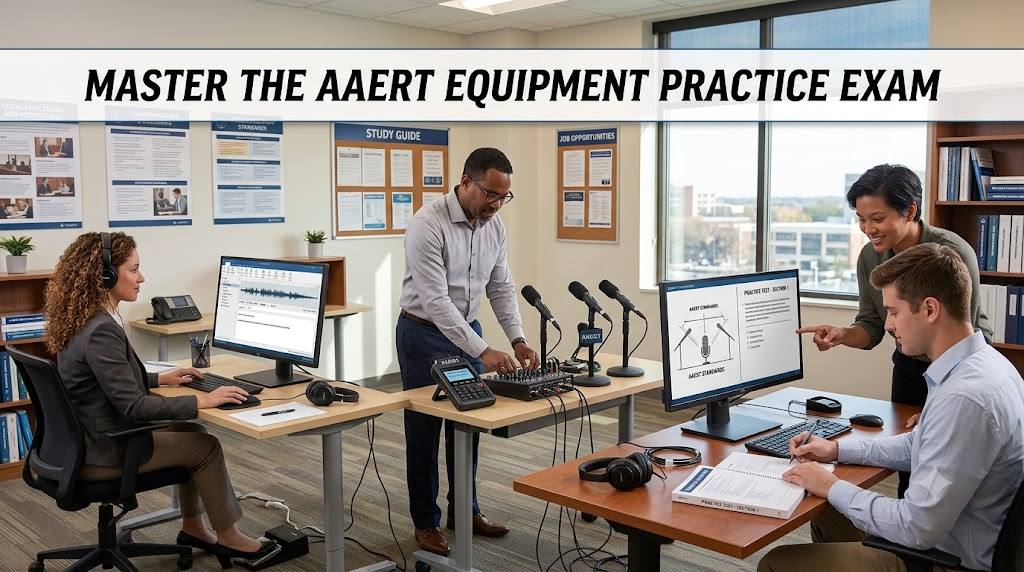
Additional Information
What the Course Entails and Exam Details
This practice test is structured to mirror the core equipment competencies and practical scenarios that AAERT professionals encounter in the field. The test covers a range of vital topics, ensuring you can navigate, manage, and optimize the tools of your trade:
AAERT Standards for Equipment and Best Practices: Ensuring all operations adhere to the association's rigorous guidelines for digital recording quality and security.
Recording Software Operations: Demonstrating proficiency in configuring and managing multi-channel digital recording platforms commonly used in courtrooms, depositions, and hearings.
Audio and Video Capture Setup: Testing your knowledge of microphones, mixers, recorders, and camera placements for clear, comprehensive audio and visual capture.
File Management and Security: Mastering secure storage, naming conventions, and protection of critical digital record data.
Equipment Troubleshooting and Maintenance: Developing practical skills to identify and quickly resolve common hardware and software issues during active proceedings.
Transcript Formatting in Context: Understanding how equipment setup can directly influence the transcription process and ultimate product quality.
The practice test is delivered in a realistic, online format. It typically features multiple-choice questions and potentially interactive simulations to gauge your response to practical scenarios. The structure is designed to evaluate both your theoretical understanding and your ability to apply that knowledge effectively, simulating the conditions and technical knowledge areas of the final AAERT knowledge exams and equipment components. The number of questions and exact duration may vary slightly, but it is calibrated to provide a challenging and comprehensive readiness check, typically taking between 60 to 90 minutes to complete.
What to Expect in the Final Exam
While this is a practice test, it is a crucial component of preparation for the final AAERT certification process. To eventually achieve your designation, you will need to take the actual AAERT Knowledge and potentially a Practical exam (depending on the certification path, like CER/CDR or CET). Here’s what you can generally expect in those final, official proctored assessments regarding equipment:
Format: The core AAERT certification knowledge exams are typically online, proctored, and consist of a substantial number of multiple-choice questions. A significant portion of these questions are dedicated explicitly to equipment, digital recording systems, software, security, and troubleshooting. The practice test is a realistic preview of the complexity, tone, and specific knowledge areas of these questions.
Knowledge Exam Score & Time: A passing score for the knowledge exam is typically 80% or higher. For instance, a knowledge exam may have around 188 questions and a time limit of approximately 120 minutes. Keep in mind that not all questions contribute to your final score, as some are unscored and used for future testing.
Practical Exam (if applicable): For transcription paths like CET, you will be required to create a transcript from a digitally recorded proceeding, demonstrating a high degree of equipment-related comprehension through practical execution. Passing accuracy for the practical transcription is traditionally set at a very high standard, often 95% or more. The CER/CDR knowledge-based assessment itself is often a key validator for equipment proficiency. The practical transcription exam has a specific time limit, such as 180 minutes for a multi-page transcript.
Testing Rules: Official AAERT exams are online proctored, meaning your identity is verified, and your test-taking environment is secured and monitored via your webcam. This ensures the integrity of the process, just as your careful maintenance of equipment ensures the integrity of the record.
How to Study and Exam Centers
Preparation for success, both on this practice test and the final AAERT certification, requires a combination of strategic study, hands-on practice, and realistic simulation.
Actionable Study Strategies:
Familiarize Yourself with AAERT Resources: While AAERT doesn’t dictate a single course, they provide blueprints and a Best Practices Guide (for a fee, with periodic updates) which contain vital information on industry standards and equipment usage. Study these documents, identifying key equipment competencies.
Hands-on Practice: There is no substitute for actual experience. Maximize your time with the exact types of digital recording software, mixers, and multi-channel microphones and transcription tools you'll be tested on. Set up and simulate recording scenarios, including various participant arrangements and lighting/audio conditions.
Use Practice Software & Simulate Conditions: Leverage the AAERT Equipment Practice Test as a cornerstone of your study. Take the test in a realistic, timed environment to build time management skills and experience the pressure. Analyze your incorrect answers to pinpoint specific knowledge gaps and revisit those areas. Look for interactive practice materials that simulate equipment setup and troubleshooting scenarios.
Join Professional Networks: Engage with the AAERT community. Other certified professionals often share invaluable insights and tips on study materials and best practices. Look for official forums, workshops, and webinars.
Develop Checklists: Create your own detailed checklists for equipment setup, maintenance, and troubleshooting, referencing AAERT standards. Rehearsing these checklists will build confidence and ensure no critical step is missed in high-pressure situations.
Taking the Practice and Final Exams:
Practice Tests: Practice tests like this one are available through online learning platforms, potential training schools, or as part of pre-approved preparation materials. They can usually be accessed directly online at your convenience.
Final AAERT Certification Exams: The official AAERT certification exams are typically delivered in an online proctored environment (like ProctorU), allowing you to schedule your exam session at any hour of any day from the convenience of your home or office, as long as you meet the technical requirements (e.g., webcam, stable high-speed internet, consistent software updates). AAERT may also list authorized test centers, approved schools, or specific institutional portals on their official website. You can find up-to-date and specific guidance on scheduling and approved methods on the AAERT website’s certification section.
Job Opportunities from the Course
Earning your AAERT certification – and being fully equipped for it through dedicated practice – can open doors to diverse and rewarding career paths. Successfully mastering the AAERT Equipment standards makes you a strong candidate for key roles in the digital court reporting and transcription industry:
Digital Court Reporter / Electronic Court Reporter: Use sophisticated digital equipment to accurately capture a verbatim record of courtroom proceedings, hearings, and depositions. Manage recording software, microphones, and participants, ensuring a clear and high-quality recording.
Deposition Reporter (CER / CDR): Specialize in capturing the record for depositions and out-of-court legal proceedings, often with advanced digital technologies for multi-channel recording and precise participant identification.
Electronic Court Transcriber (CET): Produce official transcripts from digitally recorded proceeding, applying AAERT accuracy standards, formatting rules, and efficient software use to convert audio records into precise legal documents.
Transcription Editor / Proofreader: Apply meticulous detail and understanding of AAERT standards to review and correct draft transcripts, ensuring the absolute accuracy of the final record.
Legal Data Specialist / Records Manager: Combine your technical skills in file management and security to manage the secure storage, access, and distribution of critical digital records for law firms and judicial systems.
AAERT certification is widely recognized by court systems, transcription agencies, and law firms across the United States and Canada, often giving certified professionals a significant competitive advantage and higher earning potential.
We hope this study guide helps you master the AAERT Equipment Practice Test and move one step closer to achieving your valuable AAERT certification! Consistency, practice with actual equipment, and utilizing these resources are your keys to success. Good luck on your journey to becoming a certified leader in the field of electronic reporting and transcription.
Frequently Asked Questions
Reviews
5.0
Based on 0 reviews
Leave a Review
No reviews yet. Be the first to review!