
AAERT Certified Deposition Reporter (CDR) Practice Exam.
$69.00
- Buy to unlock unlimited access to all Quiz questions.
- After purchase you can print a PDF of the whole quiz at any point. The PDF will contain the questions and the correct answers.
About this Exam
The AAERT Certified Deposition Reporter (CDR) certification is the premier credential for digital court reporters who specialize in capturing the record of depositions and other out-of-court legal proceedings. This certification, administered by the American Association of Electronic Reporters and Transcribers (AAERT), validates a professional's knowledge and skill in digital recording technology, legal procedures, and ethical practices. The CDR is designed for individuals who possess a strong command of the English language, an understanding of legal terminology, and the technical proficiency to manage multi-channel digital recording equipment during critical legal testimonies. It is ideal for both new court reporters looking to establish their expertise and experienced reporters seeking to formalize their skills with a nationally recognized designation.
Ready to test your knowledge?
Buy Now to Access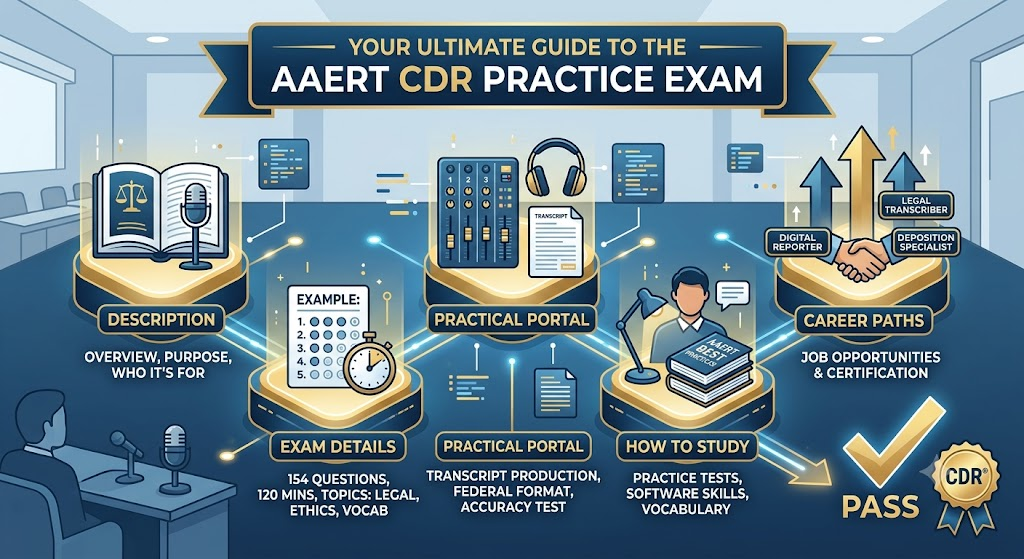
Additional Information
What the Course Entails and Exam Details
The AAERT CDR certification is a two-part process, consisting of a comprehensive knowledge examination and a practical transcription examination. To succeed, candidates must master a broad range of topics. The core curriculum covers legal procedures and terminology specific to depositions and other non-court proceedings, such as Examinations Under Oath (EUOs). You will study ethical and professional behavior, proper reporting protocols, and the use of digital reporting software and multi-channel equipment. The exam also heavily tests vocabulary, English grammar, punctuation, and usage, ensuring that you can produce a verbatim and accurate transcript.
What to Expect in the Final Exam
The final AAERT CDR exam is rigorous and designed to simulate real-world deposition scenarios. The first component, the knowledge examination, is a proctored, computer-based test containing approximately 154 multiple-choice questions. Candidates are typically given 120 minutes to complete this portion, and a minimum passing score of 80 percent is required. The test bank includes questions on legal and medical terminology, court reporting best practices, and the technical aspects of recording. Following successful completion of the knowledge exam, candidates move to the practical examination. This part requires you to create a legal transcript using federal formatting from a provided four-channel digital recording of a mock proceeding. This tests your transcription speed, accuracy, and attention to detail.
How to Study and Exam Centers
A strategic approach to studying is essential to earn the CDR credential. For the knowledge exam, your primary resource should be the AAERT Best Practices Guide, which covers the foundation of the association's standards. Complement this by enrolling in an AAERT-approved training program, many of which offer specific exam preparation courses. Utilize practice questions, which can often be found on the AAERT website or through third-party platforms, to familiarize yourself with the question format. To prepare for the practical exam, practice transcribing from multi-channel audio files using federal formatting templates. Focus on speed, 100 percent accuracy, and consistent formatting. The AAERT CDR exams are typically taken online through a proctored system like ProctorU, allowing you to take the test from the convenience of your home or office. Physical testing centers are less common, with online proctoring being the standard method.
Job Opportunities from the Course
Earning the AAERT Certified Deposition Reporter (CDR) certification opens numerous career paths within the legal and court reporting industries. Here is a clear list of specific job titles that this certification unlocks:
Certified Deposition Reporter
Digital Court Reporter
Legal Transcriber/Editor
Electronic Court Reporter
Verbatim Reporter
Deposition Specialist
Proctor for Online Depositions
By achieving this certification, you distinguish yourself in a competitive field, demonstrating to potential employers and clients your commitment to the highest standards of professional competence and ethical behavior.
Frequently Asked Questions
Reviews
5.0
Based on 0 reviews
Leave a Review
No reviews yet. Be the first to review!