
AAB Medical Technologist (MT) – Basic Knowledge Practice Exam
$69.00
- Buy to unlock unlimited access to all Quiz questions.
- After purchase you can print a PDF of the whole quiz at any point. The PDF will contain the questions and the correct answers.
About this Exam
The American Association of Bioanalysts (AAB) Medical Technologist (MT) certification is a prestigious credential that validates an individual's competency in the diverse and complex field of clinical laboratory science. This certification is designed for laboratory professionals who have the education and experience to perform a broad range of complex laboratory tests. Obtaining your AAB MT certification can significantly enhance your professional credibility, open doors to advanced career opportunities, and demonstrate your commitment to quality patient care. This study guide focuses on the "Basic Knowledge" core of the exam, providing the foundational understanding required to succeed. Whether you are a recent graduate looking to enter the field or an experienced technician seeking to elevate your status, this guide is your roadmap to AAB MT success.
Ready to test your knowledge?
Buy Now to Access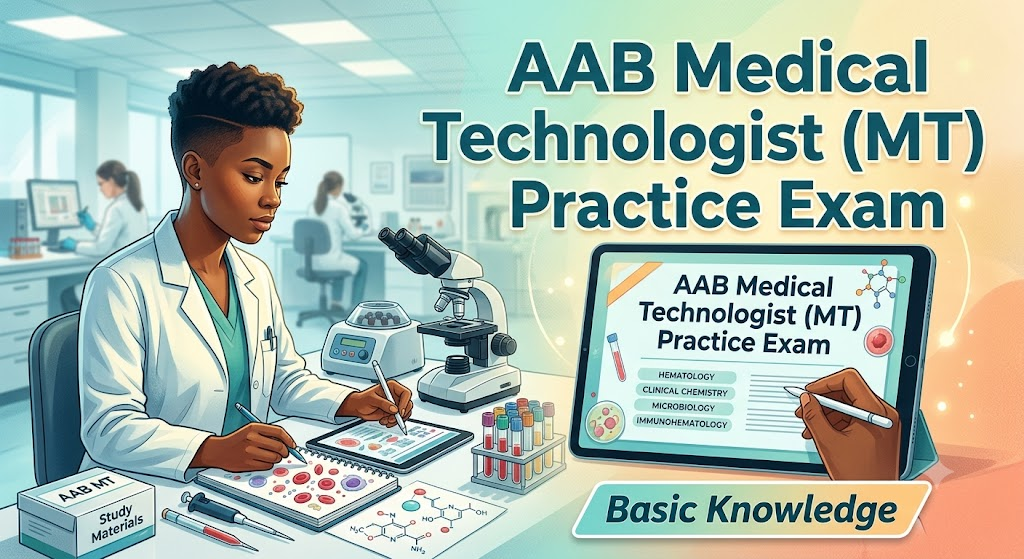
Additional Information
What the Course Entails and Exam Details
The AAB Medical Technologist (MT) – Basic Knowledge Practice Exam is a comprehensive assessment that covers the foundational principles of clinical laboratory science. It does not focus on a single sub-specialty but instead evaluates your integrated understanding of multiple core disciplines. Key topics you must master include Hematology, where you will analyze blood cells, morphology, and coagulation disorders. In Clinical Chemistry, you will demonstrate knowledge of instrumentation, quality control, and the analysis of various analytes like glucose, electrolytes, and enzymes. Microbiology will cover the identification and susceptibility testing of bacteria, fungi, parasites, and viruses. Immunology and Serology will test your understanding of immune responses, antibody testing, and infectious disease diagnostics. Immunohematology (Blood Bank) will include blood grouping, crossmatching, and transfusion medicine. Finally, Urinalysis and Body Fluids will assess your ability to perform physical, chemical, and microscopic examinations.
What to Expect in the Final Exam
The actual AAB Medical Technologist (MT) exam is a rigorous, comprehensive assessment, and understanding its structure is a critical part of your preparation. You should expect a multiple-choice question format, designed to test both your recall of factual information and your ability to apply that knowledge to solve complex clinical problems. AAB exams are typically timed, so practice with time constraints is highly recommended to build your speed and endurance. The passing score requirements are determined by a scaled scoring system, which means the raw number of correct answers needed can vary slightly between different versions of the test. AAB will provide you with a full content outline and specific rules well in advance of your test date. You must strictly adhere to these guidelines, which include bringing proper identification and arriving on time at the testing facility.
How to Study and Exam Centers
Effective study for the AAB MT exam requires a strategic, multifaceted approach. First, you must obtain and meticulously review the official AAB MT Exam Content Outline, as this is the blueprint for your test. Second, incorporate a variety of learning tools, including textbooks, online courses, flashcards for key terms and normal ranges, and, most importantly, numerous practice exams. Practice exams are invaluable for identifying your weak areas, reinforcing known concepts, and building familiarity with the multiple-choice format and time pressure. Third, create a structured study schedule that allocates dedicated time to each core discipline, focusing more on your challenging subjects. Finally, form or join a study group to discuss difficult concepts and gain new perspectives. Regarding exam centers, AAB typically utilizes secure, proctored testing, which can be delivered through online proctoring portals, physical Pearson VUE testing centers, and authorized, affiliated schools or physical testing locations across the country.
Job Opportunities from the Course
Earning your AAB Medical Technologist (MT) certification significantly expands your career horizons and positions you for specialized, high-impact roles within the healthcare system. Certified MTs are in high demand and possess the credential needed to pursue many rewarding career paths. Specific job opportunities include:
Medical Technologist in generalist roles
Hematology Specialist
Clinical Chemistry Specialist
Microbiology Technologist
Immunohematology (Blood Bank) Specialist
Immunology/Serology Technologist
Molecular Diagnostics Technologist
Laboratory Supervisor or Manager
Laboratory Quality Control Coordinator
Point-of-Care Testing (POCT) Coordinator
Research Technologist in clinical or academic settings
Public Health Laboratory Technologist
Technical Support Specialist for laboratory instrument manufacturers
Frequently Asked Questions
Reviews
5.0
Based on 0 reviews
Leave a Review
No reviews yet. Be the first to review!