
A1 Field Crops Pest Management Practice Test
$69.00
- Buy to unlock unlimited access to all Quiz questions.
- After purchase you can print a PDF of the whole quiz at any point. The PDF will contain the questions and the correct answers.
About this Exam
The A1 Field Crops Pest Management certification is a specialized credential designed for individuals involved in the production of agronomic and field crops. This certification, often known as Category 1A in various states, validates an applicant's ability to safely and effectively manage insects, plant diseases, weeds, and other pests that threaten yield and quality. It is a critical requirement for commercial pesticide applicators, consultants, and farm managers who handle or make decisions regarding restricted-use pesticides on commodities such as corn, soybeans, alfalfa, small grains, dry beans, and sugar beets. This qualification ensures that professionals are equipped with the knowledge to balance high crop yields with environmental stewardship and regulatory compliance.
Ready to test your knowledge?
Buy Now to Access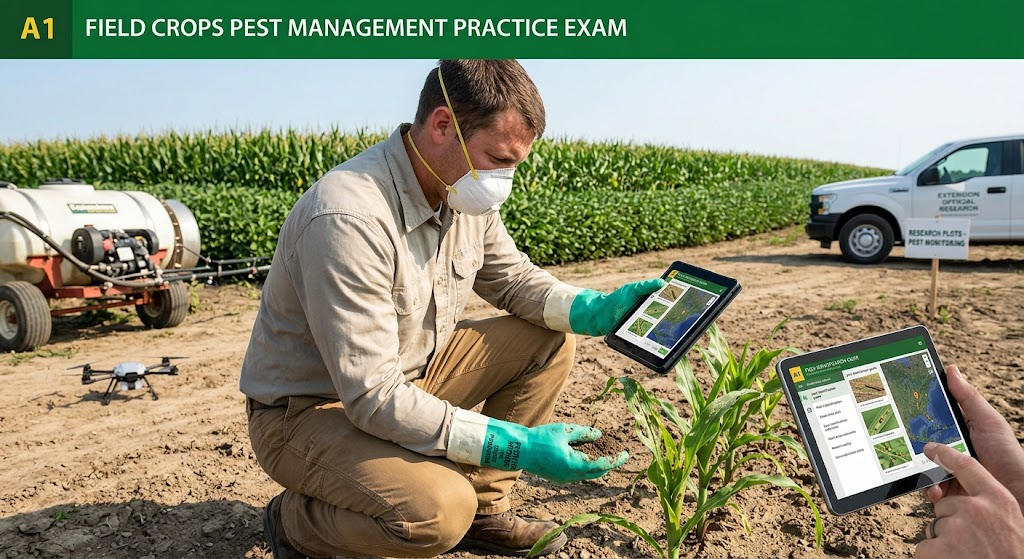
Additional Information
What the Course Entails and Exam Details
To prepare for this practice test and the subsequent final exam, applicants must master a diverse syllabus that combines agricultural science with regulatory knowledge.
The core topics include:
Integrated Pest Management (IPM): The foundational philosophy, emphasizing a combination of strategies to manage pest populations in the most cost-effective and environmentally sound manner. You will cover scouting techniques, monitoring, and applying economic thresholds (ET) and economic injury levels (EIL).
Pest Identification and Biology: The ability to identify common insects, weeds, diseases (bacterial, viral, fungal), and nematodes specific to field crops at various life stages, including understanding their damage symptoms and biology.
Pest Management Strategies: Actionable methods for control, including cultural practices (e.g., crop rotation, tillage), biological controls (e.g., beneficial insects), host resistance, and chemical control.
Pesticide Application and Safety: Safe handling, storage, transport, and disposal of pesticides; understanding and interpreting pesticide labels; personal protective equipment (PPE) requirements; and techniques to minimize pesticide drift and impact on non-target organisms and groundwater.
Application Equipment and Calibration: A detailed understanding of different types of sprayers, nozzles, and application equipment. A significant portion of the course and exam will test your mathematical ability to perform accurate sprayer calibration, calculate flow rates, and determine the correct amount of product needed per acre or tank.
What to Expect in the Final Exam
While exact specifications vary by jurisdiction (usually the State Department of Agriculture), the A1 Field Crops Pest Management final exam generally follows a consistent format.
Format: It is a closed-book examination, primarily comprised of multiple-choice questions. It may include some scenario-based questions that require you to apply multiple concepts, particularly regarding calibration or pesticide label interpretation.
Structure: The exam is typically divided into sections. The largest part is often the sub-category specific material for Field Crops (which this guide and practice test cover), and it must be taken in conjunction with or after passing the "Pesticide Applicator Core Exam," which covers general safety, laws, and regulations.
Time Limit: You can expect a time limit ranging from 1.5 to 3 hours for the sub-category exam. The practice test will help you build your pacing for this environment.
Passing Score: The typical passing score is 70% or 75%.
Rules: The exam is proctored, whether taken online or in person. No outside notes or textbooks are allowed. A calculator is usually required and provided.
How to Study and Exam Centers
Actionable Study Strategies
Master the Manual: Your primary and most important resource is the current study manual for Field Crops Pest Management provided by your state's extension service or department of agriculture. Read it thoroughly, multiple times.
Focus on Calibration: The mathematical problems on sprayer calibration are non-negotiable. Memorize the formulas for gallons per minute (GPM), gallons per acre (GPA), and travel speed (MPH). Practice these calculations until they are automatic.
Utilize Practice Tests: Use the "A1 Field Crops Pest Management Practice Test" strategically. Do not just look for correct answers; understand the rationale behind why the alternative choices are wrong.
Practice Pest Identification: Create or find flashcards for key field crop pests, showing both the adult/immature stage and the typical damage symptoms on specific crops.
Exam Centers and How to Take the Exam
You must schedule your exam through your official State Department of Agriculture or authorized testing partner. The primary modes of delivery are:
Online Portals: Many states offer online, remotely proctored exams through services like Everblue or a dedicated state system, allowing you to take the test from home or a local extension office.
Pearson VUE: A common partner for professional licensure, offering a vast network of physical testing centers globally.
State-Run In-Person Locations: These may include specific regional offices or dedicated test centers operated by the department of agriculture.
Authorized Schools: Specific community colleges or agricultural training schools are sometimes authorized proctors.
Job Opportunities from the Course
A certification in A1 Field Crops Pest Management is a required credential that unlocks specific career paths in the multi-billion dollar field crops industry. Individuals holding this license are qualified for the following roles:
Commercial Pesticide Applicator (Field Crops Category)
Agricultural Crop Consultant / Agronomist
Custom Applicator
Farm Manager
Agricultural Sales Representative (Pesticides, Seeds, and Fertilizer)
Pesticide Technician
Vector Control Officer (State and Federal)
Research Assistant (Field Crops Research)
These positions are foundational to modern production agriculture and provide essential services for ensuring sustainable, compliant, and efficient crop production.
Frequently Asked Questions
Reviews
5.0
Based on 0 reviews
Leave a Review
No reviews yet. Be the first to review!